
Blog
Introduction to prebidding for SSAI in live streams
Apr 4, 2019
·
4
min read
In a previous post I discussed the concept of “prefetch” for live streams. In this post I’m discussing “prebidding” which is an add-on to prefetch, so if you haven’t read the prefetch post yet I suggest you go through that first – you can find it here.
“Prebidding” is analogous to the concept of “header bidding”, an approach to selecting advertising demand that has become very popular because of its ability to optimise advertising revenues on websites. Header bidding allows advertisers to participate in an online auction for placement on the page while the page is being loaded.
In practical terms, individual advertisers do not participate in the auction, but instead bids are aggregated by systems called Supply-Side Platforms (SSPs) which in turn solicit bids from Demand-Side Platforms (DSPs). It is with the DSP, that the advertiser (or their buying agent) establishes the commercial contract for payment on placement.
Until the concept of header bidding came along, a webpage would get advertisements from a first-party ad server (for example, DoubleClick for Publishers) which would be set-up to define a ‘pecking order’ of SSPs or DSPs that would be given the opportunity to place an ad. If an SSP or DSP couldn’t place an ad, the next SSP/DSP in line would be given the opportunity.
There were a number of problems with this approach. The first was that this cascade could simply take a long time to execute. The second was that it didn’t reflect the fact that the best price could come back from any of the SSPs in the chain – only the first price above the publisher’s bid floor was used, not the best price. And finally, the further down the pecking order an SSP/DSP would be the less insight into how many placement opportunities a given publisher was able to supply.
Having an accurate idea of how many placement opportunities a given publisher is making available is critical to optimising the bid responses. Header bidding allows all SSPs or DSPs to be treated equally by calling to them simultaneously, rather than in a cascade, meaning the best price across all SSPs can be seen and everyone gets to see the placement opportunities and, importantly for the user experience, it’s faster.
Prebidding takes this concept of header bidding to video advertising inserted into a live broadcast stream. In live streaming multiple ad breaks can be viewed by the same user during a single streaming session. This new logic exists inside the Yospace system that is responsible for delivering the stream to the user rather than the header of a web page, hence why the feature is named “prebidding” and not “header bidding”.
The system also solves another issue for the broadcaste, which is the separation of advertising by industry type. If, for example, the first ad in an ad pod (ad break) is a first-party sold automotive ad, prebidding allows the ad server to ensure that no other automotive ad is included in that pod. In addition, if an automotive ad comes back from the SSPs at a higher CPM than the first-party sold ad then the ad server could swap out the first-party sold ad, if the broadcaster configured it to do so. Obviously, there are many nuances to where a broadcaster would want to prioritise higher-priced third party advertising over their own sold ads, but the technology would let them do this.
Until now a typical workflow for server-side ad insertion (SSAI) for live streams has looked like the first workflow here (1. Typical SSAI ad calls):

As you can see from the diagram, the ADS has not had visibility in advance of the SSP decisions. It decides which ad in the pod are to be programmatic but without the foresight to know the CPM or content type of the programmatic ads that are to be stitched into the stream.
In the second diagram (2. Typical prebidding SSAI ad calls), prebidding allows the ADS to see the CPMs and ad types returned by SSPs in the ad call from the SSAI system (Yospace). As a result the ADS is able to make a fully informed decision on which ads to place, resulting in realising the maximum value of the ad pod while ensuring an advertisers message is not diluted.
Partnering with a pioneer: a history of innovation with TV4
Apr 4, 2019
·
2
min read
Swedish broadcaster TV4 has long been a leader in the broadcast space, from going digital in the noughties and its early adoption of server-side ad insertion (SSAI) technology, to forming key partnerships with broadcasters and operators to grow its audience and boost ad revenue.
TV4’s innovative approach is paying off, too. In the press release that announced the renewal of its contract with Yospace, the company’s COO Mathias Berg revealed that the company achieved its highest ever revenue in 2018. He credited the ability to provide a platform-agnostic experience for advertisers across all video as a key factor, an experience that is enabled by SSAI.
TV4’s record earnings, at SEK 1,382 million (€112,537,903), were up 35.2% on 2017, making it one of the most successful broadcasters on the continent.
How did the broadcaster achieve these heights? And how did it use SSAI to carve out its route to a profitable future – for TV4, for advertisers, and for its audience?
Digital ad stitching
TV4’s forward-thinking approach was apparent when it became the first broadcaster in Sweden to implement SSAI, notably adopting the technology for both live and on demand content to deliver a consistent TV quality viewing experience, with one to one addressability and ad measurement.
SSAI has allowed TV4 to unlock new revenue opportunities by allowing for consistent monetisation of all its content across all connected devices, and for viewer data to be harnessed to inform and deliver addressable advertising. This is a sector which shows no signs of slowing, with addressable TV ad spend forecast to exceed $3 billion by the close of this year.
Reinvention and investment
TV4’s CEO Casten Almqvist recognised back in 2012 that in order to outstrip the competition in Sweden’s TV market, the network must “continue to reinvent” itself, investing in its digital service TV4Play, while continuing to focus on “breadth, diversity and quality” and producing “engaging TV for the whole country”.
This prompted TV4 to turn to SSAI soon after, which in turn paved the way for another innovative move last year. A first in Sweden, TV4 collaborated with Telia, Discovery Networks and Modern Times Group (MTG) in March 2018 to launch a targeted advertising initiative on Telia’s Play service. This delivers tailored advertising based on an individual’s location, the channel they’re watching, the kind of screen and the type of device they’re using to stream content.
Later the same year, TV4’s adoption of SSAI allowed it to secure distribution deals with other major distributors including Com Hem.
TV4 is clearly a pioneer, with a data-driven, viewer-first approach to growing its business and monetising content for the long-term, an approach that has been enabled by SSAI. In fact, TV4 has precisely pinpointed its adoption of SSAI for helping it achieve that aforementioned record 2018, with Mathias Berg, COO at TV4 Group commenting that, “as a result of a successful implementation of this strategy TV4 delivered its best financial result in terms of turnover and profitability in the history of the company.”
And with the broadcaster continuing to innovate, then long may this continue.
Server-side ad insertion for MPEG-DASH
Apr 3, 2019
·
3
min read
There’s been a lot of talk in the industry about MPEG-DASH and we’re finding that a number of our customers are turning to this protocol, and of those a number are looking to it as a means of implementing multi-platform DRM.
Yospace was the first vendor to announce server-side ad insertion (SSAI) support for MPEG-DASH and are one of the only vendors today that can boast live services.
The ecosystem for supporting MPEG-DASH is still relatively immature in terms of players, encoders and packagers. Behind this is the fact that the specification for MPEG-DASH doesn’t specify exactly how an MPD should be expressed to support SSAI, while the DASH-IF has only made a recommendation which is not universally followed.
Compared to HLS, which provides a simple list of segments in its manifest files, MPEG-DASH lists a much more complex set of information which includes the exact presentation time of each segment. This complexity and precision makes replacing segments a much more involved task.
In a traditional linear television environment ad breaks are usually pretty precise, but in digital this is not always the case. The SSAI system may receive four 30-second ads from the ad server to fill a two minute ad break but find they are not actually 30 seconds to frame, meaning there may be a slight under run over overrun at the end of the break. HLS handles these discrepancies in a much simpler manner than MPEG-DASH through the use of a simple holding slate.
To avoid gaps between period in MPEG-DASH (which would lead to a break/buffer of the playback experience) it is necessary to adjust the timing of every period (content and ad breaks). MPEG-DASH requires that all levels must be expressed on every manifest update, and the XML format of the MPD is quite wordy, so the CPU required to support a manifest update in MPEG-DASH is greater and more bandwidth is required. HLS, by contrast, uses a more terse expression syntax and the player only grabs the levels it is actually playing, ultimately making server-side ad insertion more expensive for MPEG-DASH than it is for HLS.
It’s also harder to match audio and video when the programming is time-shifted in this way due to the fact that they are digitised in different ways: audio is usually divided in 44000 or 48000 samples per second whereas video is divided into 25 or 50 frames per second.
While MPEG-DASH throws up some complexities for applying SSAI, they are by no means insurmountable and Yospace has proved this over the last 12 months. We were the first SSAI vendor to announce support for MPEG-DASH, in March 2018, and the first to implement it in a live customer environment later that year. Today we have several customers using MPEG-DASH with SSAI.
There does remain more expertise in supporting SSAI for HLS though, and we are seeing broadcasters start to explore the alternative of using HLS with CMAF, the Common Media Access Format. HLS with CMAF maintains the simplicity of HLS (especially for SSAI) while many of the advantages provided by MPEG-DASH. I would actively encourage broadcasters to consider harmonising to CMAF fragments as they are now supported on Apple devices, and use MPEG-DASH as and when it is required.
Where there are devices that can support both MPEG-DASH and HLS+CMAF, careful consideration should be given as to what format is most suited to their in-house expertise.
The advantages of using server-side ad insertion for AVOD
Mar 5, 2019
·
3
min read
The amount of video accessed online, particularly by mobile devices, is expanding exponentially, and there is an associated need to maximise the monetisation of the streams by delivering ads across multiple device types with a uniformity of presentation and minimum of overhead.
Server-Side Ad Insertion (SSAI) has emerged as a technology solution that can deliver a consistent experience akin to TV, at the same time as opening up addressable advertising opportunities. This consistency is a by-product of the 'ad copy normalisation' that is built into SSAI, providing ad content that is encoded with the same bitrates, frame rates and audio levels as those of the original content, and ensuring a technical compatibility between primary and stitched content (with the same CDN being loaded for both content and ads).SSAI technology is already being used with increasing success by broadcasters to deliver a seamless, engaging Live experience. It therefore makes sense to use it for VoD streaming as well.
However, the principal means of monetisation for catch-up remains Client-Side Ad Insertion (CSAI), where, at the start of every ad break, the primary player has to be stopped and the ad player put on top, with the primary player having to be resumed at the end of the break.It is, of course, possible for broadcasters to deliver a near-seamless experience using this model, by pre-loading the ad player and buffer in the background and swapping the players over at the exact moments when an ad break starts and resumes.
However, there is always the risk of playback issues caused by inconsistent encoding of the ad copy. In addition, considerable effort is required in terms of implementation, with code having to be continuously duplicated from one device type to another, and from one environment to another, with the inevitable testing and maintenance overhead to achieve this result consistently across devices. Many of those broadcasters of VoD streams who have a working CSAI solution in place are finding it increasingly hard to maintain, so there is a growing interest in the SSAI approach. This is partly driven by positive experiences of SSAI for Live, where CSAI is not an option owing to the strict requirements around ad break timings. There are a number of reasons why SSAI should appeal to broadcasters over CSAI:
- Implementation. The code is decoupled from the ad server, with the work on stitching and interfacing to the ad server being performed by the backend SSAI platform, giving an overall flexibility in that the inventory and decisioning engine is abstracted from the actual delivery. SDKs have also been developed, which means that there is effectively a middleware layer, with the SDKs talking to the backend, and the backend talking to the ad server, making it possible to swap out the ad server without changes to the SDKs.
- Control. There can be a single point for all ad insertion calls across Live and VoD, a single interface providing access to a single set of Broadcast Streams, Promotions and VoD assets, and a single API providing real-time analytics.
- The aforementioned SDKs can support the use of clickable linear content and dynamic overlays, and also allow broadcasters to customise the instances when skipping, seeking and pausing are allowed.
- Ad blockers. The stitching used by SSAI mean that ad blockers are unable to decipher where the call to the server is being made, and so cannot differentiate between an ad and the content itself, making SSAI highly resistant to ad blocking.
Besides being able to deliver SSAI at scale and to provide all of the existing benefits of configurable user interactivity, SSAI has enormous security benefits, which cannot be totally covered in this article. In brief:
- With SSAI, the aforementioned middleware layer affords control over the systems with which viewers are interacting. By contrast, with CSAI, the viewer’s device is touching the ad server and presenting its IP address (and potentially other information). The first party ad server might, in turn, involve the use of multiple third party servers and expose the same viewers to being tracked by unknown companies, to the possible detriment of a broadcaster's commercial model.
With the correct deployment, there is no logical reason why broadcasters should not consider SSAI when deploying AVOD streams. As OTT audiences for Live and VoD continue to thrive, providers are increasingly likely to seek a joined-up SSAI strategy, and by so doing, not only safeguard their current ad revenues, but also enhance them.
You can read some examples of the impact of a joined-up live and AVOD SSAI strategy with DIRECTV in the USA and TV 2 in Norway.
Handling the opposing forces of programmatic and low latency
Feb 28, 2019
·
2
min read
In this post I’d like to talk about the challenges faced by broadcasters in efficiently monetising live sports at scale using server-side ad insertion.
We have broadcasters in five continents monetising live sports using our platform. During the World Cup last year, we saw a peak audience of 1.6 million concurrent users and only a few weeks ago, in January this year, we saw that record double to 3.2 million – a significant jump in the space of just six months.So the ability to scale SSAI, and to plan for future scale, is really important but this topic is made complex because there are two opposing forces at play.
On one hand you have the desire for the broadcaster to improve the viewer experience by reducing latency.
On the other hand, the way in which online advertising is being bought and sold is trending towards automated, or ‘programmatic’, fulfilment. This makes the user-level ad decisioning much more complex.
Underlying all of this is the fact that the industry as a whole is finding online audiences, especially where major sports events are concerned, are growing at an ever faster rate, and it’s important that solutions deployed can continue to keep ahead of this growth.
So why is it that these forces are opposing? The reason for this is that in live streaming everyone watches the ad break at more or less the same time. In order for us to know which ads to stitch in to each individual stream, we need to make a call to the ad decisioning ecosystem on behalf of each individual streaming session.Naturally, these calls all take place in a very short space of time. The lower latency the stream, the shorter the time frame under which this bevy of calls will be made. As this time window is made even smaller, you need each individual ad decision request to also take less time.
Ok, so let’s hold that thought. On the other hand, because the ad decisioning ecosystem is getting more complex, it actually needs more time to resolve ad decisions. Real-time bidding is required in the process of getting decisions for ad placement, so you’re not making calls to a single ad server, you’re making calls to multiple partners in the ecosystem. Furthermore, you’re depending on all of those partners to be able to scale to handle these bursts of requests. Therefore, to deliver the low latency experience at scale for live sports, and to plan for future scale, with a complex ad decisioning ecosystem to maximise the revenue opportunity, it’s necessary to the make ad decisioning calls in an orderly fashion way ahead of the actual break taking place. By doing this you are no longer hostage to stream latency and how long you can spend, or how many calls you can make to get a decision for each user.
So this is what we do with the Yospace SSAI platform. We call it prefetch and it allows us to scale to support the world’s biggest live events. We authored a white paper on the topic. It's called "Go Live" and you can download it here.
Why Yospace's acquisition by RTL Group is a huge endorsement of its SSAI
Jan 22, 2019
·
3
min read
On 8th January RTL Group announced it was acquiring 100% of Yospace Technologies Ltd. The announcement represents a huge endorsement of Yospace, our people and the server-side ad insertion technology we have developed.
Having launched VOD server-side ad insertion (SSAI) in 2011, Yospace was first to market with SSAI for live streaming at the start of 2012, showcasing it in partnership with ITV at the 2012 IBC Innovation Awards. Since that time the team has focused exclusively on development and innovation in the SSAI space. This has been with a focus on solving broadcaster challenges while maintaining a TV-like viewer experience.
Today we are the world’s leading provider of one-to-one addressable SSAI and stream management. This is an achievement we are hugely proud of. We are also immensely proud of building a profitable market-leading business organically, while maintaining the independence required to have such a laser-sharp focus on the long-term development of our product. As such we were fortunate to be in a position where we could carefully consider an acquisition that best suited the future ambitions of the team, primary of which is to continue to innovate with our loyal existing broadcast customer base while accelerating global adoption of our capabilities.
The key principles of our technology road map since 2011 have been based on understanding the close integrations with broadcast playout systems and the end-to-end streaming workflows needed to deliver a true broadcast experience, and a willingness to adapt to the evolving and often complex needs of broadcasters. Challenges such as achieving one-to-one addressability at true broadcast scale, while delivering real-time metrics reliably and supporting enhanced viewer experiences have all been addressed.
As the market continues to mature and advertiser expectations increase, the ability to deliver a truly optimised standards-based programmatic SSAI solution will become increasingly critical. To this end, the opportunity to work more closely with SpotX, who we’ve been a partner with for a number of years, will be of huge benefit to Yospace and to the wider industry, as the learnings we will gain will optimise integration with the entire programmatic and SSAI ecosystem.
As SpotX remains committed to all its existing SSAI partnerships, Yospace remains ad server and ad tech agnostic. Our independent stance and freedom to work with providers across the broadcast and advertising ecosystems are crucial, and this is recognised by SpotX and the RTL Group.
Our aim, as it has always been, is to provide the world’s leading server-side ad insertion platform and establish our technology as the de facto standard for the industry. We will continue to serve all of our existing customers, without whom we would not have achieved the market position we are so proud of today, and to whom we remain fully committed. This focus will in turn allow us to accelerate further the expansion of our global customer base.
Ultimately our decision to join RTL Group was an easy one. The Group has bought into our strategy and is fully committed to supporting both our product roadmap and our expansion plans. Whether you are an existing customer or a customer-to-be, we’re looking forward to working with you.
Sincerely,
Tim Sewell
CEO, Yospace.
The unique value of live streaming
Jul 5, 2018
·
4
min read
Live event streaming offers tremendous value for viewers – thus, tremendous value for advertisers. Events like the World Cup present golden opportunities for broadcasters to supercharge ad breaks and golden moments for brands to be seen at scale.
Live simulcast gaining pace
The number of viewers who live stream content is growing; even in the early group stages of the World Cup, live streaming figures exceeded those of Super Bowl by 40%, with Conviva recording a peak 7.7 million concurrent viewers.
In the UK alone, a record 3.3 million requests were made to stream England’s dramatic penalties win against Colombia via ITV Hub. This trend isn’t confined to live sports. Events like the Royal Wedding and Trump’s presidential inauguration all drew significant online audiences, illustrating a diversity in event-based live viewing. And why not? Live simulcast is now a valued part of the fan experience, and one which can be enhanced with added extras, like watching and syncing content on multiple devices, scrub control and interactive features.
Commanding hearts, minds, and eyeballs
Live events and, in particular, sports, command the hearts and minds (and eyeballs) of viewers, and huge rights sums from major broadcasters. Viewers expect to see premium quality content with advertising that is delivered seamlessly, frame-accurately and without interrupting or disrupting the live stream, regardless of the type of device they are watching on.
When broadcasters deliver on expectations, the result is vast audience numbers who are engaged for a specific reason, at a specific time, creating a hugely valuable opportunity for advertisers to achieve mass reach at a single point in time, with the accuracy that digital measurement can bring. This is something that brands simply can’t achieve anywhere else, whether it’s a leading social media service or AVOD platform.
BT Sport recognised this opportunity and has been using Yospace’s server-side ad insertion (SSAI) technology since 2016 to monetise live sports. Jeremy Rosenberg, Head Of Advertising Partnerships TV at BT perfectly sums this up: "Audience and reach is paramount to any advertiser. It is about appointment to view and I would say that reaching that at such a high level where people are engaged is paramount compared to other platforms out there that give you a very short attention span from a content perspective.”
A golden opportunity
Audience reach is great for advertisers, but how can broadcasters manage this scale? In live OTT all viewers go to an ad break at the same time, putting huge strain on an ad server which will have to manage a bombardment of ad requests: during a football match an ad server could be stone-cold for 45 minutes, until a half-time break unleashes millions of simultaneous ad requests.
BT Sport is just one name to have scored with scale-management: the broadcaster recently completed its second full season of Premier League and Champions League football with addressable DAI. Yospace’s prefetch system – a core component of scaling addressable DAI – ensures calls to the ad server are paced over a longer period so the ad server isn’t overloaded and the broadcaster can ensure maximum fill-rates. All of this must be achieved without affecting the viewer experience, of course.
Other broadcasters are in a strong position to do the same. Live events continue to command huge numbers of engaged viewers who expect a high quality viewer experience. Investing in advanced ad tech translates this engagement into valuable opportunities for broadcasters, who’ll be able to open up new ad inventory, and to advertisers who are keen to capitalise on the unique appointment-to-view experience: “You can't get that anywhere else,” concludes Rosenberg.
Read more about the BT Sport project in our case study.
Jeremy Rosenberg was speaking at the Future TV Advertising event in London in December 2017.
Delivering a world-class World Cup experience
Jun 14, 2018
·
2
min read
The World Cup kicks off this week: cue blanket media coverage and scores of football puns. We’ll of course be following the tournament’s progress, but will be keeping an even closer eye on how the world streams – and how broadcasters monetise – live content.

Our server-side ad insertion (SSAI) technology is being used by multiple broadcasters across four continents to monetise the 2018 World Cup, with every viewer worldwide delivered a one-to-one addressable live stream.Major live events have driven huge innovation in the live OTT arena, particularly in monetisation and scale. Yospace has developed an advanced system to pace ad requests, called pre-fetch, which lessens the load on ad servers during those moments when all viewers go to an ad break simultaneously – an innovation which earned Yospace a Sports Technology Award recently with BT Sport.
When it comes to monetisation of live events, scale is of course becoming increasingly important. In 2016, a record 2.3 million people live-streamed England’s Euro 2016 win over Wales, via the BBC Sport website; more than doubling the channel’s previous audience number. This figure contributed to (another) record-breaking 14.6 million unique visitors who live-streamed Euro content on the site on a single day. It is widely expected that these figures will be eclipsed during the World Cup.In fact, we expect live streaming records to be broken this Summer by all host broadcasters in the UK: BBC, ITV and STV. The latter two monetise their streams using Yospace’s server-side DAI.
On a global scale, a brief glance at Akamai’s figures are further proof of the increasing popularity of live sports streaming amongst fans: from the maximum peak traffic of 1.4Tbs generated by 2012’s Superbowl, which leaps to peak traffic of 6.9Tbp for 2014’s football World Cup.
Earlier this year Akamai set a global streaming record of 10.3 million concurrent viewers for a VIVO Indian Premier League match – another record that could well be broken in the next few weeks. Yospace expect to break concurrency records for personalised SSAI, too.
While scale will no doubt be the focus of industry headlines, the sub-plot of the story is viewer experience and reliability. Advertisements must be seamlessly integrated into a live stream to ensure a true TV-quality experience for millions of football fans, and – for broadcasters monetising content and advertisers relying on its success – form a frictionless component of the end-to-end delivery mechanism for live sports streaming.Football – as with most sports – is unpredictable. Whilst this delivers edge-of-your-seat viewing experiences to fans, these nervous moments must be the result of the outcome of the match, not the outcome of a poor viewing experience.We’ll steer clear of predicting the winners and losers amongst this year’s World Cup qualifying teams, but one thing Yospace can reliably predict is the quality of end-user experience for many of the millions of viewers who’ll be going OTT in the coming weeks. And in turn, scoring wins for advertisers and broadcasters alike.
Award wins celebrate latest innovations in SSAI
Jun 5, 2018
·
2
min read
Yospace enjoyed a great start to the industry’s awards season last month, winning at both the Sports Technology Awards and The Connies, with BT Sport and Medialaan respectively.
The STA was awarded for monetising a full season of top-flight sport with server-side ad insertion (SSAI). The significance of that achievement cannot be understated. Viewers are moving online and a reliable and scalable monetisation system is central to any broadcaster's long-term aspirations.
Achieving scale with major live events can be particularly challenging, especially when applying any advanced level of addressability. Yospace‘s platform provides true personalisation – that is, ad calls and measurement for each user session. In a live stream, unlike VOD, all viewers go to an ad break simultaneously so catering for millions of ad calls is incredibly important. Yospace developed innovative new approaches to pacing ad requests and managing peak traffic, which allows concurrent audiences to grow into the millions – all receiving DAI-enabled streams, all personalised.
The system was also successfully integrated into BT Sport’s enhanced player provided by Deltatre which allowed viewers to scrub back to important moments in a match without affecting the ability of the broadcaster to monetise. This was only possible due to the fact that each viewer received their own personalised stream. This last point brings me onto the Medialaan project, for which dynamic ad insertion was one part of a full stream management system that Yospace provided (not “just” SSAI).
Each viewer watching a live stream was able to scrub back to an earlier point in the channel’s timeline, switching seamlessly from live to catch-up, or “startover”, as we call it.A viewer in startover mode is served with shorter ad breaks so they can catch up with the live channel. And if they’re delivered an ad break that they’ve already seen then they’re free to skip it – thus reducing ad load in order to improve viewer experience. In doing this, Medialaan were specifically catering for the next generation of viewer.I’m very pleased that Medialaan’s forward-thinking approach has been recognised with an award. It also offered Yospace the perfect platform to demonstrate what our one-to-one DAI technology can do.Combined with the BT Sport award, Yospace is able to show off its ability to support the three central pillars of 21stcentury broadcasting:
Viewer experience.
Monetisation.
Scale.
Seven West Media reports 66% YOY growth for live simulcast
Mar 7, 2018
·
2
min read
Yospace sponsored Mediatel’s inaugural Future TV Advertising Forum in Sydney last month and were very pleased to be associated with such a strong event for broadcasters and advertisers alike.
Our CTO and Founder David Springall co-presented a case study with James Bayes, Digital Sales Director – OTT Video at Seven West Media at the event. Seven launched Dynamic Ad Insertion for live simulcast with Yospace for the Australian Open in January 2017 and reported a 68% year-on-year increase in streamed minutes for this year’s event. There were 107.5m total streamed minutes across the fortnight this year, with 10.6m of those on the Men’s Final day alone.
Bayes also reported figures for the Superbowl (viewing minutes up 65% YOY), Olympic Winter Games (57.3m total live streamed minutes) and 2017 Melbourne Cup, which generated a 66% YOY increase in streamed minutes (11m in total), with a 22% increase in the number of users. These figures demonstrate that significantly more people are streaming live content from one year to the next, and for longer too.
This growth, of course, has a positive impact on the amount of addressable inventory the broadcaster is able to open up. Bayes summed up the broadcaster’s attitude to online viewing and the requirement to be forward-thinking when it comes to monetisation.
“When does a stream become a river? It's irrefutable to think that the primary distribution method that we're going to be experiencing in the future around video is going to be IP-delivered. Preparing for that future of IP-delivered video content and the opportunity it creates around addressability is something that we all need to start working on and start investing in.”
He also described why live DAI in OTT streams is so appealing for advertisers.
"Premium, long-form, scripted, brand-safe video content delivered on the biggest and best screens that there are. That's an amazing opportunity for brands."
"One live stream, one moment in time, multiple users all delivered a personalised advertising experience...everybody seeing a different ad based upon their profile data that they shared with us when they registered and signed in, and then coming back and everybody sharing that same linear experience.”
Thanks to James Bayes and Seven West Media for co-presenting with us, and thanks to Mediatel for organising another excellent addition to it's FTVA series.
Streaming Tech Sweden: Why addressable advertising is dependent on centralised ad copy
Jan 24, 2018
·
2
min read
Yospace recently presented a paper with Adstream called “Translating Broadcast Ad Copy Principles to the Dynamic Ad Insertion Age” at the excellent Streaming Tech Sweden event. A video of the presentation was published this week and you can watch it here.
The paper calls for a centralised system for managing and delivering ad copy online. In the traditional broadcast world ad copy is centrally managed to help ensure that:
1) Audio and video levels are up to standard
2) All ad creatives are rights-cleared and their contents is logged
3) There is reliable and effective measurement of ad views
These principles need to be carried across to the online world if broadcast channels are to continue to be the primary home for big advertiser spending. There is also a huge amount of revenue potential in data-driven advertising and programmatic workflows, but the potential can only be realised if there is a centralised system for managing ad copy, metadata and measurement. Find out more and download the paper here.
Reflections on 2017: another bumper year
Dec 22, 2017
·
2
min read
It’s been another busy year here at Yospace. Many happy returns to all our customers, partners and everyone we’ve worked with or met with in 2017.
Here are some of the many highlights of a memorable year:
Customer launches
We were delighted to add 8 customer launches to further grow our global footprint for live DAI. We also agreed a long-term extension with BT Sport, ensuring that Yospace will continue to monetise all the biggest commercial sporting events in the UK.
Major events
Australian Open, 6 Nations Premier League (full season), Champions League (full season), T20 cricket, Rugby League World Cup.
Awards
We were delighted to be recognised again at Mediatel's Connected Consumer Awards (with Sky Media) and Digital TV Europe’s Content Innovation Awards (with BT Sport). We were the first company to win at the CIAs two years running - a fantastic achievement!
Future of live and linear video
This research programme, conducted with MTM across Europe and the US, asks broadcasters what needs to be done to compete effectively with the major internet companies for ad spend online. Download the findings here.
Ad copy management
We presented a paper at NAB that called for a centralised approach to the management, delivery and measurement of ad copy in the digital world. This will surely become an even bigger topic for discussion in 2018. Download the paper here.
We’re looking forward to catching up in the new year. In Q1 we’ll be at CES, Future TV Advertising Forum Sydney and NAB - contact us if you'd like to meet. See you in 2018!
3 minutes with… Andy Bell at Channel 4
Dec 9, 2025
·
4
min read
Yospace had the pleasure of speaking to long-time customers and partners at IBC 2025 in Amsterdam. In this series, our conversations explore the latest trends in streaming, ad tech, and monetisation, as well as the achievements and experiences that have come from collaborating with Yospace.
In this instalment of the series, you can read our chat with Andy Bell, Head of Technology, Content Systems at Channel 4. You can also watch it here:
Can you tell us about your journey in video streaming?
I started at Channel 4 to deliver 4oD 20 years ago, a very long time ago, and at that point, the industry didn’t really exist. You look around the halls [of IBC] today, 20 years on, and there are so many solutions that solve problems that we had and couldn’t solve, apart from developing solutions ourselves.
It was a very fragmented set of components and systems that we had to put together, whereas today, you can buy solutions pretty much from one organisation. So I think that’s the biggest change in the industry.
I think the journey has been really fun. [It has been] really, really, really enjoyable to see the industry evolve and focus very much on digital and IP rather than traditional television and broadcasting.
What value does Yospace add to Channel 4?
We deliver a lot of live output: our daily news, and we do a lot of big sports events - football, Formula One, etc. So my team is very much involved in getting the content in, processing, and preparing it. But also, with the relationship with Yospace and our integration for dynamic ad replacement, we can fill and replace ads in any of our content. In all of our live output and all of our on-demand output as well. So it’s been a really, really useful journey.
How is Channel 4 approaching the viewer experience today?
People want to find content easily. There’s an enormous amount of content out there now, so easing that journey and providing applications that are intuitive for viewers, and recommending the right content for them rather than everything or something irrelevant, is really important.
So the content journey and the viewer experience are obviously significantly different. Channel 4, like any other broadcaster or content provider, very much focuses on making the user journey and experience frictionless.
What are the viewer experience priorities when it comes to advertising?
Doing it well and keeping it invisible to the viewer is very important, and doing it everywhere. Making sure that no matter where the inventory is, we can serve dynamic content, not just commercials. In the future, perhaps different types of content will be served to different viewers, [and you would] be able to do that on every device type, every service, traditional linear television, and digital - it doesn’t matter.
What are the innovations in OTT advertising that interest you most?
The switch to being able to cover the underlying ads, while still broadcasting in the traditional, schedule-based way, is interesting. Addressable advertising is a very interesting one. There’s a lot of complexity in how to deliver it. There are a lot of different platforms that require content to be prepared in different ways, signals to be applied in different ways, so that’s a real, complex challenge.
I’m spending quite a bit of time with all the suppliers here [at IBC] just trying to understand how we can improve that journey.
Channel 4 has worked with Yospace for over a decade now. What does this partnership mean to you?
When I met Yospace originally, they were pretty much the only organisation that could deliver this type of service. We had a really difficult challenge, being able to support devices that weren’t really mature, with video specifications that were pulled together from all over the place - a bit fragmented, as it was originally. Yospace took that challenge on.
We ended up with a solution that worked pretty quickly, and we’ve continued over the last 10 years to just build on that. The experience has been great. As a supplier, there’s an excellent relationship. We throw lots of demand and change at Yospace on a regular basis. They take it on, and we get the results. So yeah, we’re very pleased.
3 minutes with… Stefan Lederer at Bitmovin
Nov 17, 2025
·
3
min read
Yospace had the pleasure of speaking to several long-time customers and partners at IBC 2025 in Amsterdam. In this series, our conversations explore the latest trends in streaming, adtech and monetisation, plus we celebrate the achievements and experiences that have been gained along the way.
In this first instalment of the series, we spoke with Stefan Lederer, CEO and Co-founder of Bitmovin. You can also watch it here:
Can you tell us about Bitmovin’s journey in video streaming?
Well, we started 12 years ago. We started out of research and development and standardisation right at the beginning, when OTT streaming started with MPEG-DASH and HLS. We built the first reference implementations around it, right out of university and right out of our PhDs.
It was the right technology at the right time. Suddenly, those customers appeared and wanted what we did in research, and the rest is history.
OTT streaming is a real business today. When we started, it was like the new thing. Everybody played around with it, and nobody needed to make a business out of it, but today the whole industry has shifted towards streaming.
The new norm is that streaming needs to pay the bills. So, everybody is significantly more serious about the monetisation and the top line, as well as the costs and the bottom line.
You’ve partnered with Yospace on server-guided ad insertion (SGAI). How did that come about?
Our background and our DNA is innovation, and we try to find partners that share this DNA. Yospace clearly has that.
And so we said [to Yospace], hey, server-guided insertion is a new thing; it fits into the theme of the current time in terms of optimising profitability and revenues and making a business out of streaming services. So it's really extremely important for the whole industry and for our customers.
We need to find partners that go ahead with these technology steps, show how it's working, show it's real, and make it easy for our customers to deploy it, and that's what we did with Yospace.
Tell us more about server-guided ad insertion (SGAI).
Server-guided ad insertion (SGAI) is a completely new technology. It's fully standardised on the HLS side, it's still getting finished on the DASH side. So, from that perspective, we are still in new territory here.
We need to test it out. How does it work with the integration on the encoding side, on the player side, the feedback, the decisioning, and the complexities on the Smart TVs?
There's a lot more logic that happens on the client side suddenly, and that's more load, more work that we all need to test out. Does it work on all devices or a subset of the devices?
So we try to do as much of the discovery and the learning before our customers put the technology into production.
Bitmovin is a long-term partner of Yospace. What has our partnership allowed you to achieve?
We work on really cool technologies, like what server-guided ad insertion (SGAI) is today. A previous version of the technology we deployed 5, 6, or 7 years ago with joint customers in the field, so there's a lot of expertise in how to do things like that already, through this long-lasting partnership.
We ran into each other in, literally, some of our first customers 10-12 years ago and have worked together ever since.
Specifically, the interesting use cases, the interesting customers that push the envelope and really go ahead in terms of new technologies - that’s where we typically run into each other, and that's a cool sign.
Why measurement is vital to unlocking CTV ad value
Oct 21, 2025
·
6
min read
When people think about monetising video, they often focus only on ad insertion: getting the mid-rolls, pre-rolls, and post-rolls just right. But the reality is this: ad insertion on its own doesn’t pay, ad insertion and measurement does.
If you want to build sustainable and scalable revenue in streaming, you have to prove value. That proof comes from data. Not just whether an ad was delivered, but whether it was seen, heard, completed, and engaged with. Through the IAB's standardisation work, the industry has established a consistent means of achieving this. That is what ad measurement is all about.
In this article, I’ll explain why ad measurement (not just ad insertion) is what drives real value. I’ll explore how tracking works today and how emerging standards are changing how we think about ad delivery across devices, formats, and viewing environments.
The foundation: tracking pixels and CPMs
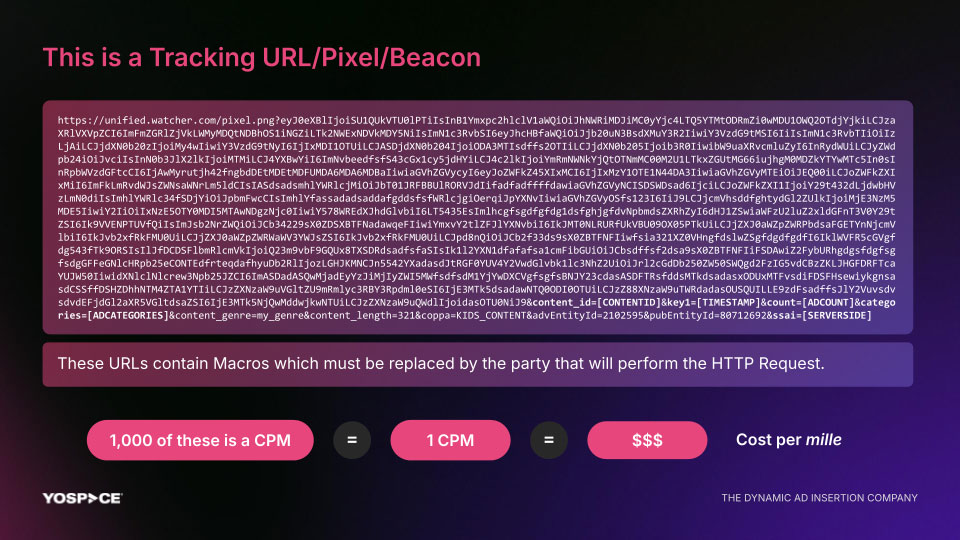
At its core, ad measurement starts with something deceptively simple: a tracking URL, often known as a tracking pixel or beacon. You can see an example of this in the picture above.
The name ‘pixel’ comes from the very beginning of web display advertising, where the tracker would be a 1x1 pixel GIF image loaded by the browser (therefore, in video advertising, which covers a multitude of devices, not just web browsers), it is perhaps more appropriate to use the term ‘beacons’ or ‘trackers’. When the URL is called, the server on the receiving end will log that transaction.
Each time a viewer is shown an ad, a specific tracking URL is called. For example, when playback starts, mutes or skips, or the ad completes, a tracking beacon will be called. This may be described in the ad tech world as a ‘pixel/beacon/tracker firing’. These URLs often contain dynamically replaceable strings referred to as macros or tokens. These are placeholders that must be replaced by the player or server to fill in contextual information that is only known by the client at the time of firing the beacon.
Advertisers pay based on impressions, usually calculated per thousand ad plays (CPM, cost per mille). So, every time that tracking URL is triggered 1,000 times (in other words, when the ad has been started 1,000 times), it represents one CPM unit, and ultimately, that is where the money comes in.
In other words, you don’t get paid when you insert the ad. You get paid when the tracking pixels confirm the ad was actually played.
When and where to measure tracking pixels
Tracking pixels are fired at specific moments during playback. These fall into two key categories:
The first is referred to as “standard measurement”. This encompasses various types of playback measurement, which include a tracking pixel firing impressions (when an ad begins), quartiles (25%, 50% and 75% progress gates), and completions (when an ad ends). It also references user interactions with the ad, such as muting/unmuting, expanding/collapsing the window, click-throughs, or ad skips.
The second is referred to as “enhanced measurement”. As the name suggests, this provides a bit more context, specifically on ad viewability. This can include volume level, the amount of screen space the ad occupies, or whether the ad is displayed at all.
Some ad servers may include ‘bookend’ beacons at the start and end of the break, primarily to support ancillary functions such as forecasting and operational reporting, not “standard measurement”.
Each of these tracking events provide crucial context to advertisers. To assess the impact on metrics like website traffic, sales, and overall campaign effectiveness, advertisers need to know whether it was viewed, played in a sound-on environment, and played for a meaningful duration.
To broadcasters or publishers, measurement is not only a means of being paid, it can be an invaluable tool allowing them to forecast their inventory and thus sales strategy, and to help their partners in the programmatic ecosystem pace third-party demand.
Inside the ad chain
Behind every ad impression is a complex ecosystem. At the top of the chain is the broadcaster or publisher, who owns the content and the ad inventory.
The ad server manages campaigns and decides which ads to play and when. The supply-side platform (SSP) groups publishers together and offers available ad slots to buyers. The demand-side platform (DSP) represents advertisers who are looking to purchase those slots.
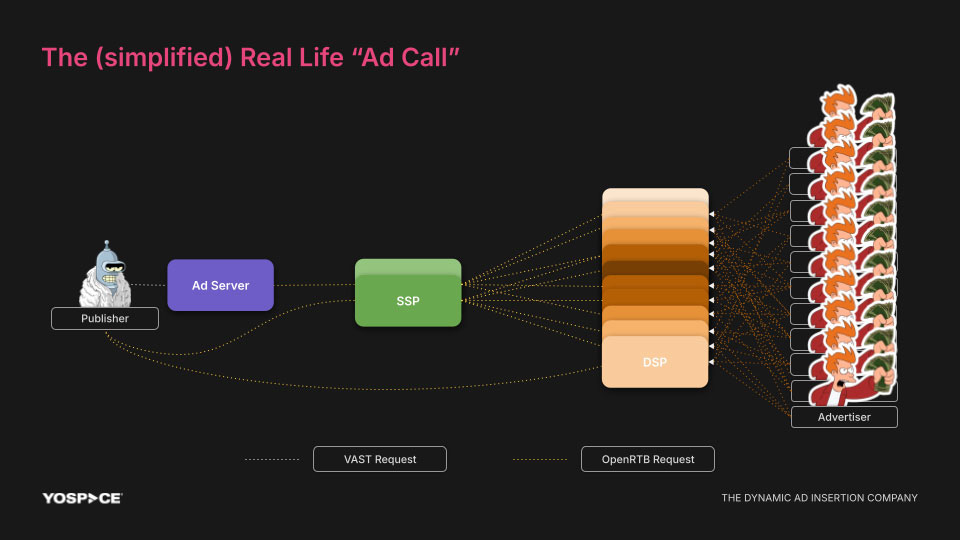
When an ad slot becomes available, many real-time bidding requests are made. SSPs reach out to multiple DSPs, which then bid to fill that slot.
Each player in this chain, the publisher, the SSP, and the DSP, needs confirmation that their part of the deal has occurred. A single ad impression can therefore trigger multiple tracking URLs, one for each stakeholder. Bidders for placement may use the ratio of winning bids to ad impressions to set the bid responses and pacing.
This makes ad measurement both technically intricate and data-heavy. But without it, nobody gets paid, and advertisers will lose trust in the system.
The challenge of measurement in SSAI and SGAI
In today’s streaming world, Server-Side Ad Insertion (SSAI), Server-Guided Ad Insertion (SGAI), and Client-Side Ad Insertion (CSAI) are the backbone of dynamic ad delivery.
With CSAI, the player manages the entire interaction with the ad system and fires the tracking URLs directly. But in SSAI and SGAI, the player doesn’t manage interactions with the ad server and thus isn’t aware of what content is on the stream by default. Here, ads are stitched into the stream on the server (SSAI) or player (SGAI), and tracking must take place simultaneously with successful playback of those assets.
Check out this explainer article on the differences between CSAI, SSAI, and SGAI.
SSAI or SGAI vendors may provide measurement features that report playback data and send tracking beacons, such as SDKs or server-side tracking, or they may consider themselves as simply an “ad stitcher” and leave the job of ad measurement to the customer.
Add in the variety of devices, such as Connected TVs, mobile, web players, and set-top boxes, and you quickly see why maintaining accurate measurement at scale is so difficult. Connected TVs alone pose significant challenges, as sometimes more work is required to ensure an SDK aligns with widely varying device capabilities; Even devices from the same manufacturer can have different requirements!
Even basic functions, such as knowing the playhead position, can behave differently across formats and devices. In VOD, it’s more straightforward: playback starts at zero and progresses linearly. But in live SSAI or SGAI environments, players interpret time differently depending on streaming protocols such as HLS or MPEG-DASH.
That inconsistency affects how tracking data aligns with actual playback, creating potential gaps in reporting accuracy and ultimately in revenue recognition.
Ad measurement of the future
The industry is aware of these challenges, and two emerging standards aim to address them: SVTA Ad Creative Signalling and the latest iteration of CTA’s Common Media Client Data (CMCDv2) for Client-Guided Tracking.
Client tracking with SVTA ad creative signalling
Led by the Streaming Video Technology Alliance (SVTA), this approach defines a JSON-based standard for delivering ad metadata to the player.
In practical terms, it provides a consistent way to embed or reference tracking data, either in-band (within the manifest) or out-of-band, so that players can interpret it without needing custom SDKs.
Version 2 of the standard defines key tracking events, such as start, quartiles, and completion, while version 3 will expand support for nonlinear and companion ads, such as L-banner or side-by-side ads.
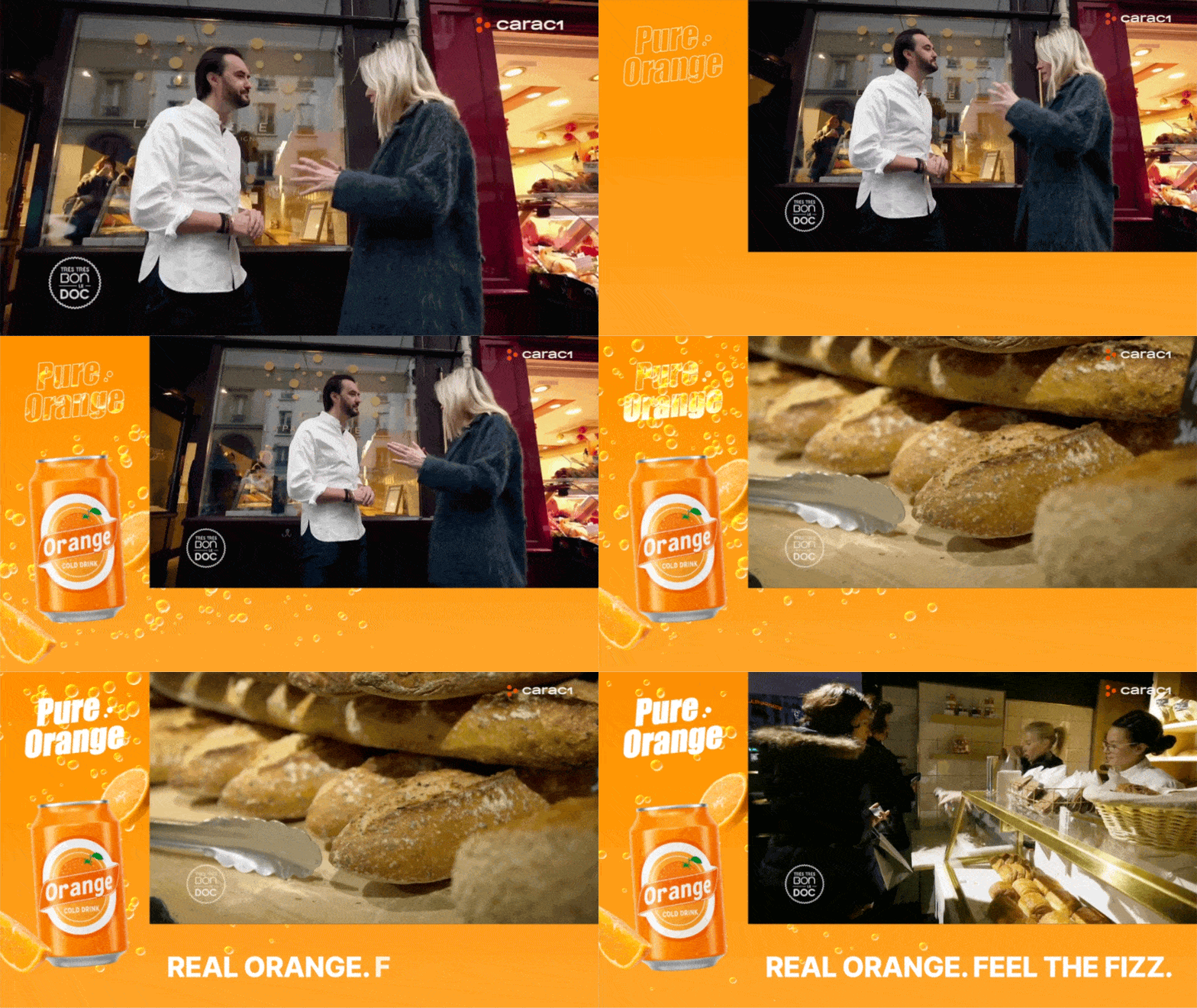

The advantage of this model is its simplicity and transparency. Everything the player needs is described in a standard, readable format. That means less custom code, easier debugging, and faster interoperability between platforms.
CMCDv2 client-guided tracking
The other emerging model focuses on a server-side approach. Here, the concept is to leverage the features within the CMCDv2 standard, produced by the CTA wave project. Here, the player regularly reports primitive playback state information such as playhead position and user interactions, to a measurement endpoint.
That endpoint then performs the tracking on the player’s behalf, which means there are no direct pixel calls from the device and server-side resources are required to track the state of playback.
The advantages here are that ad blockers cannot interfere, since tracking happens server-side, reducing client-side overhead while helping unify reporting across devices. As beacons are not called directly from the user, it may be argued that this method may be better placed to protect user privacy, and to prevent accidental leaking of a publisher’s audience data to third parties. Finally, reducing implementation complexity in the player may make this a good choice for devices with constrained CPU and memory.
Comparing the two approaches
SVTA Ad Signalling and CMCDv2 serve different but complementary roles.
In practice, most ecosystems can use both. SVTA offers rich, client-aware measurement that supports detailed analytics and viewability reporting. CMCDv2 provides resilience and consistency when client support is limited, as in the case of content syndication across third-party apps.
The role of viewability
Of all the metrics, viewability remains the closest we can get to knowing whether someone truly watched an ad.
Viewability measurement aims to answer several questions:
- How much of the ad was visible on-screen?
- Was any other content obstructing it?
- Was the sound on?
- How long the ad remained in view
This is enabled by the IAB Open Measurement SDK (OMSDK), which lets players report playback events, viewport changes, and audio volume in standardised ways. The OMSDK was intended to replace vendor-specific SDKs, although some vendor-specific viewability measurement is still active.
Each implementation must be certified by the IAB for every platform, including iOS, Android, CTV, and Web. This ensures consistent and trusted reporting across devices.
Advertisers increasingly demand this kind of verified, privacy-safe measurement because it tells them what they are really paying for.
In conclusion: Why does measurement build trust?
To put it simply, rich and accurate measurement leads to:
- Greater advertiser confidence
- Increased value in advertising opportunities
- Better management of ad inventory
- New standards being developed to simplify measurement integration and consistency across devices
Quality ad measurement doesn’t just improve analytics, it builds advertiser confidence.
When advertisers trust the data, they invest more. They pay higher per CPM, renew campaigns, and experiment with new formats.
In other words, measurement is revenue.
Emerging standards like SVTA Ad Creative Signalling and CTA’s CMCDv2 are paving the way toward a more interoperable and transparent ad ecosystem, one where ad delivery and measurement are finally inseparable.
As with SSAI and SGAI, there will not be a single, universal solution overnight. But by adopting a mix of these standards, we can cover all use cases and make ad-supported streaming both more profitable and more accountable.
Because at the end of the day, ad insertion doesn’t pay, ad measurement does.
This blog post was written using content from a webinar Olivier presented for Qualabs. To watch the webinar, click here.
Understanding CSAI, SSAI, and SGAI in dynamic ad insertion
Aug 14, 2025
·
6
min read
Yospace has been a leader in dynamic ad insertion (DAI) technologies for 14 years. As a result, we're frequently asked about the latest innovations in this space. A common question we’ve been asked this year is: "What is server-guided ad insertion and how does it differ from SSAI?" This article answers that question and more.
We’ll break down the three most popular types of ad insertion used in modern streaming:
- Client-Side Ad Insertion (CSAI)
- Server-Side Ad Insertion (SSAI)
- Server-Guided Ad Insertion (SGAI)
We’ll explain what each method does, where it performs best, its limitations, and offer guidance on how to maximise dynamic ad insertion's revenue potential.
What is dynamic ad insertion?
Dynamic ad insertion (DAI) is a strategy for delivering advertisements into video content, both in video-on-demand (VOD) and live streaming environments. It helps broadcasters and streaming platforms increase advertising revenue by targeting viewers with relevant ads while maintaining an uninterrupted user experience.
Here are the ways in which dynamic ad insertion is executed.
Client-side ad insertion (CSAI)
With CSAI, the video player (or "client") is responsible for pausing the content, fetching an ad from an ad server, playing the ad, and then resuming the main video.
Server-side ad insertion (SSAI)
SSAI shifts the ad insertion process to the server. Ads are stitched directly into the content before it reaches the user, creating a single continuous stream.
However, Yospace solves the measurement issue with:
- Client-side SDKs for hybrid tracking
- Common Media Client Data (CMCDv2) compliant solutions for frame-accurate measurement where SDKs cannot be implemented - across third-party players for syndicated content, for example
Server-guided ad insertion (SGAI)
SGAI represents the next evolution in dynamic ad insertion. Built on HLS Interstitials and MPEG-DASH Events, it divides responsibilities between the server and the client to provide a more efficient ad insertion solution. With SGAI, the server identifies ad opportunities and sends signals to the client to fetch and play ads.
This next phase of DAI is the first based on industry standards. It offers benefits such as lower server load, enabling better monetisation of VOD and extended DVR windows, as well as a broader range of ad formats.
At NAB Show 2025, Yospace showcased SGAI with new side-by-side ad formats and support for dynamic ad insertion during extended DVR windows — whereby ads viewed when a viewer scrolls back a live stream are replaced. This addresses a 12% live viewer segment that often goes unmonetised.
Formats like L-shaped banners and in-screen ads are possible today with SSAI, but they require bespoke client-side development. Today SGAI does not necessarily support these features “out of the box,” but in time, it will simplify implementation considerably.
Comparing dynamic ad insertion strategies
CSAI, SSAI and SGAI Comparison Summary
*Various DAI vendors offer different solutions. Best practice is to offer SSAI and/ or SGAI combined with client-side measurement, so broadcasters get the best of both worlds.
Limitations of SSAI and SGAI: scale and measurement
Why prefetch is critical for scaling up
While SGAI and SSAI are highly effective, they are only part of the solution as neither fully resolves the issue of scaling DAI to large audiences, particularly during unpredictable live events.
This surge of ad calls can overwhelm SSPs and ad servers, resulting in missed ad opportunities and revenue losses.
The solution is intelligent prefetch systems that pace ad requests to prevent server overload, reduce timeouts and ensure high-value ad inventory is filled and its value is maximised.
Whether you're deploying SSAI or SGAI, a prefetch strategy is crucial for reliably scaling dynamic ad insertion.
Standards stop short on ad measurement
The term server-guided ad insertion, or SGAI, can mean different things to different people. SGAI is built upon the latest standards in HLS Interstitials and MPEG-DASH Events, which focus on stream stitching. However, these new additions don’t enable a standard method of ad measurement.
In order to build trust with advertisers, IAB-compliant measurement of ad views is a must. Best practice is to ensure that SGAI (or SSAI) is accompanied by a lightweight SDK that delivers client-side measurement. SDKs require control of the player, which is not always possible. This is often the case with syndicated channels across third-party endpoints.
Adoption of the new Common Media Client Data v2 (CMCDv2) standard addresses the third-party distribution issue. CMCDv2 delivers low-level playback information to the server-side, which the DAI system can convert into the measurement advertisers require.
Final Thoughts: Choosing the right dynamic ad insertion strategy
SGAI is generating significant excitement within the industry, but it's important to recognise that this is more of an evolution than a revolution. While SGAI refines ad insertion techniques, it doesn't fundamentally change the landscape. Instead, it optimises the existing approaches to make ad insertion more flexible, efficient, and cost-effective for future-proof ad monetisation.
There are many factors to consider when choosing the best dynamic ad insertion strategy for you, including:
- Device compatibility and audience reach
- Viewer experience
- Latency requirements
- Digital rights management (DRM)
- Player control and measurement capabilities

Frequently asked questions on dynamic ad insertion
What is dynamic ad insertion (DAI)?
DAI is a technology that enables real-time, personalised adverts to be inserted into live or on-demand video content.
What is the difference between CSAI and SSAI?
CSAI inserts ads on the client side, offering detailed tracking, but is vulnerable to ad blockers. SSAI stitches ads server-side for smoother playback and better ad blocker resistance.
What is server-guided ad insertion (SGAI)?
SGAI is a new evolution of DAI. It is a hybrid approach where the server identifies ad slots and guides the client to fetch and play ads. It balances tracking, playback quality, and scalability.
What is the difference between server-guided ad insertion (SGAI) and server-side ad insertion?
SGAI shares responsibilities between the server and the client, enabling real-time ad resolution and increased flexibility in playback. In contrast, SSAI handles all ad stitching server-side before the stream is delivered. SGAI typically supports more dynamic use cases and enables cost-effective scaling, especially for live and VOD content.
3 minutes with… Andy Bell at Channel 4
Dec 9, 2025
·
4
min read
Yospace had the pleasure of speaking to long-time customers and partners at IBC 2025 in Amsterdam. In this series, our conversations explore the latest trends in streaming, ad tech, and monetisation, as well as the achievements and experiences that have come from collaborating with Yospace.
In this instalment of the series, you can read our chat with Andy Bell, Head of Technology, Content Systems at Channel 4. You can also watch it here:
Can you tell us about your journey in video streaming?
I started at Channel 4 to deliver 4oD 20 years ago, a very long time ago, and at that point, the industry didn’t really exist. You look around the halls [of IBC] today, 20 years on, and there are so many solutions that solve problems that we had and couldn’t solve, apart from developing solutions ourselves.
It was a very fragmented set of components and systems that we had to put together, whereas today, you can buy solutions pretty much from one organisation. So I think that’s the biggest change in the industry.
I think the journey has been really fun. [It has been] really, really, really enjoyable to see the industry evolve and focus very much on digital and IP rather than traditional television and broadcasting.
What value does Yospace add to Channel 4?
We deliver a lot of live output: our daily news, and we do a lot of big sports events - football, Formula One, etc. So my team is very much involved in getting the content in, processing, and preparing it. But also, with the relationship with Yospace and our integration for dynamic ad replacement, we can fill and replace ads in any of our content. In all of our live output and all of our on-demand output as well. So it’s been a really, really useful journey.
How is Channel 4 approaching the viewer experience today?
People want to find content easily. There’s an enormous amount of content out there now, so easing that journey and providing applications that are intuitive for viewers, and recommending the right content for them rather than everything or something irrelevant, is really important.
So the content journey and the viewer experience are obviously significantly different. Channel 4, like any other broadcaster or content provider, very much focuses on making the user journey and experience frictionless.
What are the viewer experience priorities when it comes to advertising?
Doing it well and keeping it invisible to the viewer is very important, and doing it everywhere. Making sure that no matter where the inventory is, we can serve dynamic content, not just commercials. In the future, perhaps different types of content will be served to different viewers, [and you would] be able to do that on every device type, every service, traditional linear television, and digital - it doesn’t matter.
What are the innovations in OTT advertising that interest you most?
The switch to being able to cover the underlying ads, while still broadcasting in the traditional, schedule-based way, is interesting. Addressable advertising is a very interesting one. There’s a lot of complexity in how to deliver it. There are a lot of different platforms that require content to be prepared in different ways, signals to be applied in different ways, so that’s a real, complex challenge.
I’m spending quite a bit of time with all the suppliers here [at IBC] just trying to understand how we can improve that journey.
Channel 4 has worked with Yospace for over a decade now. What does this partnership mean to you?
When I met Yospace originally, they were pretty much the only organisation that could deliver this type of service. We had a really difficult challenge, being able to support devices that weren’t really mature, with video specifications that were pulled together from all over the place - a bit fragmented, as it was originally. Yospace took that challenge on.
We ended up with a solution that worked pretty quickly, and we’ve continued over the last 10 years to just build on that. The experience has been great. As a supplier, there’s an excellent relationship. We throw lots of demand and change at Yospace on a regular basis. They take it on, and we get the results. So yeah, we’re very pleased.
3 minutes with… Stefan Lederer at Bitmovin
Nov 17, 2025
·
3
min read
Yospace had the pleasure of speaking to several long-time customers and partners at IBC 2025 in Amsterdam. In this series, our conversations explore the latest trends in streaming, adtech and monetisation, plus we celebrate the achievements and experiences that have been gained along the way.
In this first instalment of the series, we spoke with Stefan Lederer, CEO and Co-founder of Bitmovin. You can also watch it here:
Can you tell us about Bitmovin’s journey in video streaming?
Well, we started 12 years ago. We started out of research and development and standardisation right at the beginning, when OTT streaming started with MPEG-DASH and HLS. We built the first reference implementations around it, right out of university and right out of our PhDs.
It was the right technology at the right time. Suddenly, those customers appeared and wanted what we did in research, and the rest is history.
OTT streaming is a real business today. When we started, it was like the new thing. Everybody played around with it, and nobody needed to make a business out of it, but today the whole industry has shifted towards streaming.
The new norm is that streaming needs to pay the bills. So, everybody is significantly more serious about the monetisation and the top line, as well as the costs and the bottom line.
You’ve partnered with Yospace on server-guided ad insertion (SGAI). How did that come about?
Our background and our DNA is innovation, and we try to find partners that share this DNA. Yospace clearly has that.
And so we said [to Yospace], hey, server-guided insertion is a new thing; it fits into the theme of the current time in terms of optimising profitability and revenues and making a business out of streaming services. So it's really extremely important for the whole industry and for our customers.
We need to find partners that go ahead with these technology steps, show how it's working, show it's real, and make it easy for our customers to deploy it, and that's what we did with Yospace.
Tell us more about server-guided ad insertion (SGAI).
Server-guided ad insertion (SGAI) is a completely new technology. It's fully standardised on the HLS side, it's still getting finished on the DASH side. So, from that perspective, we are still in new territory here.
We need to test it out. How does it work with the integration on the encoding side, on the player side, the feedback, the decisioning, and the complexities on the Smart TVs?
There's a lot more logic that happens on the client side suddenly, and that's more load, more work that we all need to test out. Does it work on all devices or a subset of the devices?
So we try to do as much of the discovery and the learning before our customers put the technology into production.
Bitmovin is a long-term partner of Yospace. What has our partnership allowed you to achieve?
We work on really cool technologies, like what server-guided ad insertion (SGAI) is today. A previous version of the technology we deployed 5, 6, or 7 years ago with joint customers in the field, so there's a lot of expertise in how to do things like that already, through this long-lasting partnership.
We ran into each other in, literally, some of our first customers 10-12 years ago and have worked together ever since.
Specifically, the interesting use cases, the interesting customers that push the envelope and really go ahead in terms of new technologies - that’s where we typically run into each other, and that's a cool sign.
Why measurement is vital to unlocking CTV ad value
Oct 21, 2025
·
6
min read
When people think about monetising video, they often focus only on ad insertion: getting the mid-rolls, pre-rolls, and post-rolls just right. But the reality is this: ad insertion on its own doesn’t pay, ad insertion and measurement does.
If you want to build sustainable and scalable revenue in streaming, you have to prove value. That proof comes from data. Not just whether an ad was delivered, but whether it was seen, heard, completed, and engaged with. Through the IAB's standardisation work, the industry has established a consistent means of achieving this. That is what ad measurement is all about.
In this article, I’ll explain why ad measurement (not just ad insertion) is what drives real value. I’ll explore how tracking works today and how emerging standards are changing how we think about ad delivery across devices, formats, and viewing environments.
The foundation: tracking pixels and CPMs
At its core, ad measurement starts with something deceptively simple: a tracking URL, often known as a tracking pixel or beacon. You can see an example of this in the picture above.
The name ‘pixel’ comes from the very beginning of web display advertising, where the tracker would be a 1x1 pixel GIF image loaded by the browser (therefore, in video advertising, which covers a multitude of devices, not just web browsers), it is perhaps more appropriate to use the term ‘beacons’ or ‘trackers’. When the URL is called, the server on the receiving end will log that transaction.
Each time a viewer is shown an ad, a specific tracking URL is called. For example, when playback starts, mutes or skips, or the ad completes, a tracking beacon will be called. This may be described in the ad tech world as a ‘pixel/beacon/tracker firing’. These URLs often contain dynamically replaceable strings referred to as macros or tokens. These are placeholders that must be replaced by the player or server to fill in contextual information that is only known by the client at the time of firing the beacon.
Advertisers pay based on impressions, usually calculated per thousand ad plays (CPM, cost per mille). So, every time that tracking URL is triggered 1,000 times (in other words, when the ad has been started 1,000 times), it represents one CPM unit, and ultimately, that is where the money comes in.
In other words, you don’t get paid when you insert the ad. You get paid when the tracking pixels confirm the ad was actually played.
When and where to measure tracking pixels
Tracking pixels are fired at specific moments during playback. These fall into two key categories:
The first is referred to as “standard measurement”. This encompasses various types of playback measurement, which include a tracking pixel firing impressions (when an ad begins), quartiles (25%, 50% and 75% progress gates), and completions (when an ad ends). It also references user interactions with the ad, such as muting/unmuting, expanding/collapsing the window, click-throughs, or ad skips.
The second is referred to as “enhanced measurement”. As the name suggests, this provides a bit more context, specifically on ad viewability. This can include volume level, the amount of screen space the ad occupies, or whether the ad is displayed at all.
Some ad servers may include ‘bookend’ beacons at the start and end of the break, primarily to support ancillary functions such as forecasting and operational reporting, not “standard measurement”.
Each of these tracking events provide crucial context to advertisers. To assess the impact on metrics like website traffic, sales, and overall campaign effectiveness, advertisers need to know whether it was viewed, played in a sound-on environment, and played for a meaningful duration.
To broadcasters or publishers, measurement is not only a means of being paid, it can be an invaluable tool allowing them to forecast their inventory and thus sales strategy, and to help their partners in the programmatic ecosystem pace third-party demand.
Inside the ad chain
Behind every ad impression is a complex ecosystem. At the top of the chain is the broadcaster or publisher, who owns the content and the ad inventory.
The ad server manages campaigns and decides which ads to play and when. The supply-side platform (SSP) groups publishers together and offers available ad slots to buyers. The demand-side platform (DSP) represents advertisers who are looking to purchase those slots.
When an ad slot becomes available, many real-time bidding requests are made. SSPs reach out to multiple DSPs, which then bid to fill that slot.
Each player in this chain, the publisher, the SSP, and the DSP, needs confirmation that their part of the deal has occurred. A single ad impression can therefore trigger multiple tracking URLs, one for each stakeholder. Bidders for placement may use the ratio of winning bids to ad impressions to set the bid responses and pacing.
This makes ad measurement both technically intricate and data-heavy. But without it, nobody gets paid, and advertisers will lose trust in the system.
The challenge of measurement in SSAI and SGAI
In today’s streaming world, Server-Side Ad Insertion (SSAI), Server-Guided Ad Insertion (SGAI), and Client-Side Ad Insertion (CSAI) are the backbone of dynamic ad delivery.
With CSAI, the player manages the entire interaction with the ad system and fires the tracking URLs directly. But in SSAI and SGAI, the player doesn’t manage interactions with the ad server and thus isn’t aware of what content is on the stream by default. Here, ads are stitched into the stream on the server (SSAI) or player (SGAI), and tracking must take place simultaneously with successful playback of those assets.
Check out this explainer article on the differences between CSAI, SSAI, and SGAI.
SSAI or SGAI vendors may provide measurement features that report playback data and send tracking beacons, such as SDKs or server-side tracking, or they may consider themselves as simply an “ad stitcher” and leave the job of ad measurement to the customer.
Add in the variety of devices, such as Connected TVs, mobile, web players, and set-top boxes, and you quickly see why maintaining accurate measurement at scale is so difficult. Connected TVs alone pose significant challenges, as sometimes more work is required to ensure an SDK aligns with widely varying device capabilities; Even devices from the same manufacturer can have different requirements!
Even basic functions, such as knowing the playhead position, can behave differently across formats and devices. In VOD, it’s more straightforward: playback starts at zero and progresses linearly. But in live SSAI or SGAI environments, players interpret time differently depending on streaming protocols such as HLS or MPEG-DASH.
That inconsistency affects how tracking data aligns with actual playback, creating potential gaps in reporting accuracy and ultimately in revenue recognition.
Ad measurement of the future
The industry is aware of these challenges, and two emerging standards aim to address them: SVTA Ad Creative Signalling and the latest iteration of CTA’s Common Media Client Data (CMCDv2) for Client-Guided Tracking.
Client tracking with SVTA ad creative signalling
Led by the Streaming Video Technology Alliance (SVTA), this approach defines a JSON-based standard for delivering ad metadata to the player.
In practical terms, it provides a consistent way to embed or reference tracking data, either in-band (within the manifest) or out-of-band, so that players can interpret it without needing custom SDKs.
Version 2 of the standard defines key tracking events, such as start, quartiles, and completion, while version 3 will expand support for nonlinear and companion ads, such as L-banner or side-by-side ads.
The advantage of this model is its simplicity and transparency. Everything the player needs is described in a standard, readable format. That means less custom code, easier debugging, and faster interoperability between platforms.
CMCDv2 client-guided tracking
The other emerging model focuses on a server-side approach. Here, the concept is to leverage the features within the CMCDv2 standard, produced by the CTA wave project. Here, the player regularly reports primitive playback state information such as playhead position and user interactions, to a measurement endpoint.
That endpoint then performs the tracking on the player’s behalf, which means there are no direct pixel calls from the device and server-side resources are required to track the state of playback.
The advantages here are that ad blockers cannot interfere, since tracking happens server-side, reducing client-side overhead while helping unify reporting across devices. As beacons are not called directly from the user, it may be argued that this method may be better placed to protect user privacy, and to prevent accidental leaking of a publisher’s audience data to third parties. Finally, reducing implementation complexity in the player may make this a good choice for devices with constrained CPU and memory.
Comparing the two approaches
SVTA Ad Signalling and CMCDv2 serve different but complementary roles.
In practice, most ecosystems can use both. SVTA offers rich, client-aware measurement that supports detailed analytics and viewability reporting. CMCDv2 provides resilience and consistency when client support is limited, as in the case of content syndication across third-party apps.
The role of viewability
Of all the metrics, viewability remains the closest we can get to knowing whether someone truly watched an ad.
Viewability measurement aims to answer several questions:
- How much of the ad was visible on-screen?
- Was any other content obstructing it?
- Was the sound on?
- How long the ad remained in view
This is enabled by the IAB Open Measurement SDK (OMSDK), which lets players report playback events, viewport changes, and audio volume in standardised ways. The OMSDK was intended to replace vendor-specific SDKs, although some vendor-specific viewability measurement is still active.
Each implementation must be certified by the IAB for every platform, including iOS, Android, CTV, and Web. This ensures consistent and trusted reporting across devices.
Advertisers increasingly demand this kind of verified, privacy-safe measurement because it tells them what they are really paying for.
In conclusion: Why does measurement build trust?
To put it simply, rich and accurate measurement leads to:
- Greater advertiser confidence
- Increased value in advertising opportunities
- Better management of ad inventory
- New standards being developed to simplify measurement integration and consistency across devices
Quality ad measurement doesn’t just improve analytics, it builds advertiser confidence.
When advertisers trust the data, they invest more. They pay higher per CPM, renew campaigns, and experiment with new formats.
In other words, measurement is revenue.
Emerging standards like SVTA Ad Creative Signalling and CTA’s CMCDv2 are paving the way toward a more interoperable and transparent ad ecosystem, one where ad delivery and measurement are finally inseparable.
As with SSAI and SGAI, there will not be a single, universal solution overnight. But by adopting a mix of these standards, we can cover all use cases and make ad-supported streaming both more profitable and more accountable.
Because at the end of the day, ad insertion doesn’t pay, ad measurement does.
This blog post was written using content from a webinar Olivier presented for Qualabs. To watch the webinar, click here.
Understanding CSAI, SSAI, and SGAI in dynamic ad insertion
Aug 14, 2025
·
6
min read
Yospace has been a leader in dynamic ad insertion (DAI) technologies for 14 years. As a result, we're frequently asked about the latest innovations in this space. A common question we’ve been asked this year is: "What is server-guided ad insertion and how does it differ from SSAI?" This article answers that question and more.
We’ll break down the three most popular types of ad insertion used in modern streaming:
- Client-Side Ad Insertion (CSAI)
- Server-Side Ad Insertion (SSAI)
- Server-Guided Ad Insertion (SGAI)
We’ll explain what each method does, where it performs best, its limitations, and offer guidance on how to maximise dynamic ad insertion's revenue potential.
What is dynamic ad insertion?
Dynamic ad insertion (DAI) is a strategy for delivering advertisements into video content, both in video-on-demand (VOD) and live streaming environments. It helps broadcasters and streaming platforms increase advertising revenue by targeting viewers with relevant ads while maintaining an uninterrupted user experience.
Here are the ways in which dynamic ad insertion is executed.
Client-side ad insertion (CSAI)
With CSAI, the video player (or "client") is responsible for pausing the content, fetching an ad from an ad server, playing the ad, and then resuming the main video.
Server-side ad insertion (SSAI)
SSAI shifts the ad insertion process to the server. Ads are stitched directly into the content before it reaches the user, creating a single continuous stream.
However, Yospace solves the measurement issue with:
- Client-side SDKs for hybrid tracking
- Common Media Client Data (CMCDv2) compliant solutions for frame-accurate measurement where SDKs cannot be implemented - across third-party players for syndicated content, for example
Server-guided ad insertion (SGAI)
SGAI represents the next evolution in dynamic ad insertion. Built on HLS Interstitials and MPEG-DASH Events, it divides responsibilities between the server and the client to provide a more efficient ad insertion solution. With SGAI, the server identifies ad opportunities and sends signals to the client to fetch and play ads.
This next phase of DAI is the first based on industry standards. It offers benefits such as lower server load, enabling better monetisation of VOD and extended DVR windows, as well as a broader range of ad formats.
At NAB Show 2025, Yospace showcased SGAI with new side-by-side ad formats and support for dynamic ad insertion during extended DVR windows — whereby ads viewed when a viewer scrolls back a live stream are replaced. This addresses a 12% live viewer segment that often goes unmonetised.
Formats like L-shaped banners and in-screen ads are possible today with SSAI, but they require bespoke client-side development. Today SGAI does not necessarily support these features “out of the box,” but in time, it will simplify implementation considerably.
Comparing dynamic ad insertion strategies
CSAI, SSAI and SGAI Comparison Summary
*Various DAI vendors offer different solutions. Best practice is to offer SSAI and/ or SGAI combined with client-side measurement, so broadcasters get the best of both worlds.
Limitations of SSAI and SGAI: scale and measurement
Why prefetch is critical for scaling up
While SGAI and SSAI are highly effective, they are only part of the solution as neither fully resolves the issue of scaling DAI to large audiences, particularly during unpredictable live events.
This surge of ad calls can overwhelm SSPs and ad servers, resulting in missed ad opportunities and revenue losses.
The solution is intelligent prefetch systems that pace ad requests to prevent server overload, reduce timeouts and ensure high-value ad inventory is filled and its value is maximised.
Whether you're deploying SSAI or SGAI, a prefetch strategy is crucial for reliably scaling dynamic ad insertion.
Standards stop short on ad measurement
The term server-guided ad insertion, or SGAI, can mean different things to different people. SGAI is built upon the latest standards in HLS Interstitials and MPEG-DASH Events, which focus on stream stitching. However, these new additions don’t enable a standard method of ad measurement.
In order to build trust with advertisers, IAB-compliant measurement of ad views is a must. Best practice is to ensure that SGAI (or SSAI) is accompanied by a lightweight SDK that delivers client-side measurement. SDKs require control of the player, which is not always possible. This is often the case with syndicated channels across third-party endpoints.
Adoption of the new Common Media Client Data v2 (CMCDv2) standard addresses the third-party distribution issue. CMCDv2 delivers low-level playback information to the server-side, which the DAI system can convert into the measurement advertisers require.
Final Thoughts: Choosing the right dynamic ad insertion strategy
SGAI is generating significant excitement within the industry, but it's important to recognise that this is more of an evolution than a revolution. While SGAI refines ad insertion techniques, it doesn't fundamentally change the landscape. Instead, it optimises the existing approaches to make ad insertion more flexible, efficient, and cost-effective for future-proof ad monetisation.
There are many factors to consider when choosing the best dynamic ad insertion strategy for you, including:
- Device compatibility and audience reach
- Viewer experience
- Latency requirements
- Digital rights management (DRM)
- Player control and measurement capabilities
Frequently asked questions on dynamic ad insertion
What is dynamic ad insertion (DAI)?
DAI is a technology that enables real-time, personalised adverts to be inserted into live or on-demand video content.
What is the difference between CSAI and SSAI?
CSAI inserts ads on the client side, offering detailed tracking, but is vulnerable to ad blockers. SSAI stitches ads server-side for smoother playback and better ad blocker resistance.
What is server-guided ad insertion (SGAI)?
SGAI is a new evolution of DAI. It is a hybrid approach where the server identifies ad slots and guides the client to fetch and play ads. It balances tracking, playback quality, and scalability.
What is the difference between server-guided ad insertion (SGAI) and server-side ad insertion?
SGAI shares responsibilities between the server and the client, enabling real-time ad resolution and increased flexibility in playback. In contrast, SSAI handles all ad stitching server-side before the stream is delivered. SGAI typically supports more dynamic use cases and enables cost-effective scaling, especially for live and VOD content.
NAB Show 2025 Round-Up: The latest trends in dynamic ad insertion
Apr 9, 2025
·
3
min read
This week, we had the pleasure of exhibiting at NAB Show in Las Vegas, showcasing the latest dynamic ad insertion (DAI) tools and techniques to boost ad performance and increase advertising revenues.
This year, we took our participation to new heights. We presented product demos on every corner of our stand, shared tips on DAI best practice, and took advantage of the opportunity to connect in person with industry friends. And if you were there, it would have been hard to miss our banner at the entrance to West Hall!
For those who couldn’t make it to the show, we’ve rounded up our highlights and key takeaways from our time at NAB Show 2025.
Dynamic ad insertion scales new heights
The show was well-timed as it came after a record-breaking month for Yospace. In March 2025, we stitched 8.4 billion one-to-one addressable ads across our global customer base. This new milestone is especially significant as it was only in July 2024 that we marked 6 billion ads stitched in a single month. The acceleration in the growth of DAI is amazing, and it emphasises the importance of successfully scaling the technology.
Extended DVR with historically resolved breaks
In the streaming age, there are increased viewer expectations for functionality like extended DVR/ rewind windows in live streams. However, until now, efficiently monetising these viewing experiences has been a challenge:
- It required “speculative” ad-requests for historic breaks on behalf of all users when they join the stream, regardless of whether they will enter DVR mode or not. This can lead to slow stream start times
- Increased ad-decisioning costs associated with ads that will often never be viewed, this in turn impacts campaign pacing algorithms and ad operations’ view of fill rates
- Finally, where programmatic demand is in play, the low bid win-to impression ratio associated with these types of use cases will damage SSP demand as SSPs may either stop bidding or bid a lower CPM rate based on their view of the value of the inventory
As a result of these types of viewing experiences, extended DVRs have typically been delivered as “start-over” functionality, but with growing player support for HLS interstitials (SGAI), the ad-tech/ ad operations challenges, as well as the potential scaling considerations, fall away.
In collaboration with castLabs, we tackled these challenges at NAB Show. We demonstrated how to monetise these historic ad breaks effectively using HLS Interstitials and server-guided ad insertion (SGAI).
Based on Yospace usage data, we estimate that effective monetisation of historic ad breaks could unlock in excess of $50m of untapped ad revenue potential every month for Yospace customers alone. It also has huge potential for the industry as a whole.
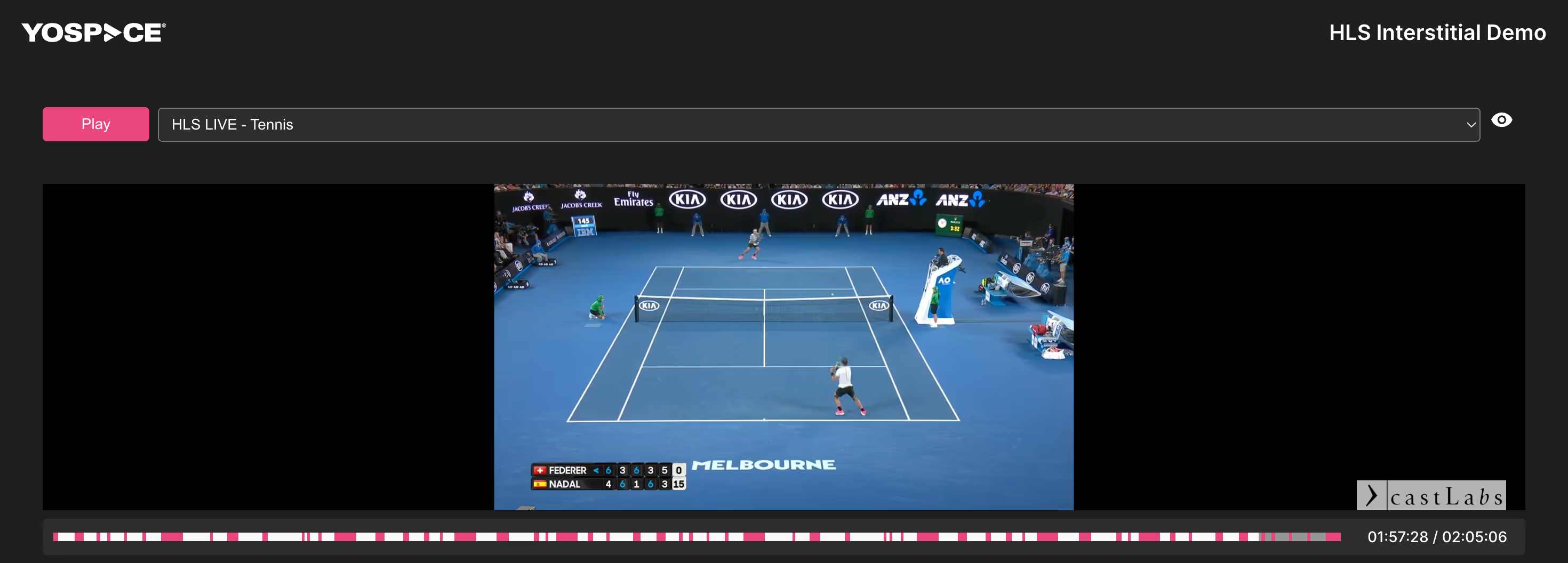

Orchestrator for monetising one-off live events
In collaboration with Capella Systems, we demonstrated how automated live channel creation with dynamic ad insertion can greatly increase the amount of ad inventory available during live events. Orchestrator provides operators with a live dashboard to monitor multiple channels simultaneously. Live feeds come direct from the encoder, eliminating latency, and allowing more in-play ad spots.
Side-by-side ads using SGAI
Using HLS Interstitials, our collaboration with Bitmovin demonstrated side-by-side ads in live and VOD streams. Ad formats like these offer greater flexibility for monetisation alongside in-stream advertising. Squeeze back and L-shaped banners have also been popular topics over the last week.

Want to explore any of these solutions further? Contact us here.
Award win
Now for the icing on the cake. TVB Europe honored us with a Best of Show award for our extended DVR with historically resolved ad breaks. Go us!

Looking Ahead
With NAB Show now behind us, we’re already gearing up for more events this year. The next big one will be IBC in September, where we’ll continue to share our innovations and insights. We’ll also be at Streaming Tech Sweden, ANGA, Cannes Lions, Inter BEE, Demuxed, Future TV Advertising Global, and more.
If you would like to meet with us, don’t hesitate to get in touch with our dedicated team here. You can also follow us on LinkedIn to see what we’re up to.
Yospace at 25… with Frank Heineberg at RTL
Jan 7, 2025
·
4
min read
Yospace is celebrating its 25th anniversary, a period of time that has seen huge transformation in digital video. We’re marking the milestone by asking some of our valued partners about their own journeys in digital video and what they think the priorities are moving forward. This week we’re speaking with Frank Heineberg, who is VP Standards and Innovations at RTL Technology.
Can you tell us a bit about who you are and what you do?
My name is Frank Heineberg. I work for RTL Technology, the technology provider of RTL Deutschland, as VP Standards and Innovations.
I manage innovation projects at RTL and represent our organisation in various standardisation bodies like HbbTV and DVB. One topic I'm very involved in is the implementation of addressable TV on our linear services where we use server side and client-side dynamic ad insertion (DAI) technologies.
Can you tell us a bit about your own journey in the digital video industry?
I've been with RTL for almost 34 years. I started out as an audio/video systems engineer and was involved in the maintenance and integration of broadcasting technology; at that time, analogue Betacam tape machines were the state of the art in video recording equipment!
But in the 90s, the transition to digital technology progressed rapidly. Later in my career, I managed the broadcast system engineering department before I started working in TV Distribution 10 years ago. This is a very exciting field of work as the intervals between technical innovations are getting faster and faster and the variety of services is increasing; while RTL started 40 years ago with just one broadcast channel, today RTL Deutschland provides a huge portfolio of digital media, via broadcast, streaming, radio, digital and print.
How important is viewer experience when it comes to advertising?
It is very important; the expectation is of course that the advertising is technically of high quality, e.g. in terms of seamless switching between PGM and Ads, no issues like buffering etc. And targeted ads of personal interest can also help to satisfy the viewer, same as frequency capping of ads.
To avoid viewer frustration and achieve a high level of compatibility with users' devices, the technical ad distribution infrastructure must be highly reliable and future proof.
TV advertising is at a pivot point as more and more viewers move online. What do you think is working well? What needs to be improved?
Technically it already works quite well, so that addressable TV advertising in various forms is daily business for RTL and our competitors. What still can be improved from the engineering viewpoint is, e.g. the implementation of open standards like HbbTV-TA (client side), technical compatibility in combination with DASH streams & encoding, scalability and pre-announcement of load/traffic, and ad-server handling with regards to many requests at the same time in the same environment.
As an extension to that question, what do you think the biggest priorities will be for ad-funded broadcasters over the next few years?
Although linear television is still alive and well, the challenge is to maintain our Broadcast reach, while expanding Streaming reach at the same time. This goes hand in hand with the linking of linear TV advertising with addressable advertising technologies over IP. And we have entered a world where we are competing with the US giants in terms of ad technology/revenue and content. Therefore, we are continuously working on new and flexible models for ad distribution in hybrid marketing approaches, with a clear focus on addressable reach on big screens.
We need smart technologies and good partners to create these transitions.
RTL is a long-standing partner of Yospace. What does the relationship mean to you?
I would say we are not only partners, but colleagues in between the RTL Group; it has been a very trustful cooperation over the years; We solve solve problems together in motivated teams and have a common vision; we always can rely on the great support from Yospace, and their expertise in server-side ad substitution is highly appreciated - congratulations on the 25th anniversary!
Yospace at 25… with Zak Putnam at Akamai
Nov 19, 2024
·
4
min read
Yospace is celebrating its 25th anniversary this year, a period of time that has seen huge transformation in digital video. We’re marking the milestone by asking some of our valued partners about their own journeys in digital video and what they think the priorities are moving forward. This week we’re speaking with Zak Putnam, who is Senior Director of Business and Innovation at Akamai Technologies, about Akamai's long-term partnership with Yospace, our future work together, and how it will meet the monetisation demands of OTT video.
Can you tell us a bit about who you are and what you do?
My name is Zak Putnam. I'm the Senior Director of Business Development and Innovation at Akamai. I'm really focused on bringing interesting, compelling, strategic partnerships into our compute platform. And so I'm working on everything that our cloud touches, but media and entertainment is a really core vertical for us. And so I'm really here at IBC and working with our media specific partners on joint marketing opportunities, co-selling, and interoperability.
I’ve been at Akamai for about 17 years, so I have been working in media for a long time.
Yospace has furthered its partnership with Akamai by joining your Cloud Compute Partner program. Tell us more about the program.
We're very happy that Yospace has joined our qualified computing partner program at Akamai as an Independent Software Vendor (ISV) partner. The QCP program, as we call it for short, is really focused on building a really vibrant ecosystem of ISV partners around our compute platform. The program is really focused on three core tenants: co-marketing, technical interoperability, and co-selling with our partners to tell vibrant, better together stories for our joint customers in the market.
You’ve been a long term partner of Yospace. Tell us about the added value that Yospace is bringing to your media customers.
Yospace and Akamai have been great partners for a very long time. We’ve worked very closely with each other for probably going on a decade now. We're really excited about what we can do in the market together for our joint customers, specifically around our new compute offering. We think that Yospace brings a really unique dynamic capability with its server-side ad insertion (SSAI) capabilities, especially as our joint customers in the media space are always looking for better monetisation capabilities. It's really an important piece to the entire video workflow solutions.
So Akamai being a classic CDN provider, and now with our compute platform, we're building this really interesting ecosystem of media workflow providers. We're trying to create the best platform of infrastructure with the best ISV partners running on top of it to give our customers the best choice in the market.
If you think about the entire video workflow, all the way from contribution all the way out to distribution on the CDN, we want to make sure we have the best in class providers providing the best services for every step along the journey that the video takes from the camera all the way to the end user. Yospace, and the monetisation capabilities that it has, is an extremely vital piece of the entire workflow, so we're so excited that if someone wants to come onto the compute platform at Akamai, they have the option of running Yospace’s technology in a really highly interoperable fashion with our platform, in a way that fits really well inside of their entire ecosystem.
We think it's extremely competitive, cost efficient, and really a nice way to like meet our customer's demands.
Read more about our involvement with Akamai’s Qualified Compute Partner Program here.
Yospace at 25… with Dom Foulkes at Channel 4
Oct 29, 2024
·
4
min read
Yospace is celebrating its 25th anniversary this year, a period of time that has seen huge transformation in digital video. We’re marking the milestone by asking some of our valued partners about their own journeys in digital video and what they think the priorities are for OTT advertising moving forward. This week we’re speaking with Dom Foulkes, who is Broadcast Technology Manager at Channel 4.
Can you tell us a bit about who you are and what you do?
Hi, I'm Dom from Channel Four Television and I'm the Engineering Manager for our streaming services.
Can you tell us a bit about your own journey in the digital video industry?
So I started working on coding and Mux systems. I worked on the UK's first IP based, digital terrestrial mux system. At that time, IP delivery was a really efficient way of transporting video to TV transmitters. Then I stayed with IP and now it's become the core of everything we do.
I worked for DAZN, launching what was quite a niche sports streaming app and is now a pretty well known brand in the sports streaming industry. I moved to Channel Four a few years ago as I was really interested in working for a public service broadcaster. And there's no better disrupter than Channel Four. We're really loud, we're very exciting, and it's a really fun place to innovate and grow.
Channel 4 has had a big summer, with high profile Paralympics coverage. Tell us a bit about what you were doing for that.
So we're all buzzing after the end of the Paralympics. We're already tired as well, but it was fantastic. We had 20 million viewers across our linear and digital platform, so about a third of the UK's population tuned in.
We had 7.9 billion viewer minutes, we had 45 million people watching on our digital platforms, and so it was a really successful Paralympics for us. We had our best audience share since 2012.
It was all supported by our really key partners, including Yospace, who made it happen and made it a real technical success as well as a viewer success.
How important is viewer experience in making such big events a success?
Our viewers are really critical. What was really important for the Paralympics was to make sure that anyone who wants to watch can watch wherever they want to watch, on any device, whenever they want to watch, and that we stream every single minute of sports.
And Yospace really helped with that. As well as supporting our advertising, they support the watch again feature on our app. It means anyone who's tuning in who has missed the start is able to rewind and not miss a single minute. So they’re really helping with that viewer experience.
TV advertising is at a pivot point as more and more viewers move online. What do you think is working well? What needs to be improved?
Personalization. And our dynamic ad product is really successful. We're working well. We're still adding more devices.
Something we were working on for the Paralympics actually was improving accessibility across commercials. So we've added for the first time subtitles on our commercials on our streaming service. And I really hope that we can continue that journey and make commercials as accessible as our program content.
So we're still working on that and hope to make a lot of progress on that next year.
As an extension to that question, what do you think the biggest priorities will be for ad-funded broadcasters over the next few years?
The priority is going to be personalisation, monetisation, and doing that smarter. Having spent some time at the IBC show this year, it's really clear that a lot of those AI concepts have become real products that we can deploy. And I think that's going to be really, really important for our advertisers and broadcasters to enable better personalisation and monetisation ads.
You’ve been a valued partner of Yospace for over a decade now, that’s a long time in streaming. What does the relationship mean to you?
Yospace and Channel four have been working together for over 10 years. I've been around for about half of that, and when I first joined that relationship, it was clear that it was a very collaborative and very strong relationship. As we've worked and developed further, the spirit of working together is only strengthened.
Yospace is one of those partners where, every time we embark on a new project, there is definitely a real spirit of togetherness and we want to do the best thing to create the best outcome for our viewers. Yospace has been a fantastic partner to work with.
Read more about our decade of working with Channel 4, here.
Watkins’ Wonder Goal Boosts Advertising Impact
Jul 11, 2024
·
3
min read
England’s last minute semi final win at Euro 2024 drove an almost 200% uplift in ad views compared to Spain v France semi final.
- Half time ad break was most valuable of the match
- Big moments drove viewing peaks on mobile throughout, including Saka’s disallowed offside strike
- Extended viewing peak as England fans waited on tenterhooks for VAR penalty decision
- Full time ad break saw almost 200% uplift in ad views compared to the Spain v France semi final
England’s wait for a shot at Euro 2024 glory is over. The negativity around ‘dull’ play, lack of form and energy were all forgotten when Ollie Watkins’ sensational strike in the 90th minute found the back of the net. Viewing stats from Yospace, the dynamic ad insertion company, and gathered from broadcaster customers across four continents, showed that - thanks to the match being action-packed from start to finish - viewing stats were high throughout, with the ad break at half time proving to be the most watched of the match.
End to end football from start to finish is not just the fans dream but also a dream for advertisers too. In the first semi final on Tuesday between Spain and France, where all three goals came in the first half, Yospace saw a 71% drop off in ad views at full time compared to half time. On the other hand, the England game, with its late drama, saw an almost 200% uplift in ad views at full time compared to the pattern of Spain v France.
There were distinctive peaks in mobile traffic at all of the key moments of the match. There was a sudden surge in mobile viewers for all of the goals, including Bukayo Saka’s disallowed goal for England in the second half. VAR drove the longest peak as fans awaited a penalty decision and watched Harry Kane’s resulting spot kick goal.

We delivered two semi finals with two very different stories in terms of viewer and ad trends, which goes to show the unpredictable nature of streaming and monetising live sports, especially when the complexities of addressability and mass scale come together.
Yospace has unique insights by working with 13 broadcasters of Euro 2024 across the globe. To date, we havemonetised five Olympic Games, five FIFA World Cups, and thirty-five Grand Slam tennis tournaments. Euro 2024 is the third edition of the pan-European men’s football tournament to be monetised by our technology.
Last-Minute Action Boosts Ad Values Throughout Euro 2024 Quarter Finals
Jul 9, 2024
·
5
min read
Penalties, an extra time thriller, and a tenacious comeback meant the viewing and ad trends from Yospace’s global broadcaster base were as dynamic as this weekend’s quarter finals
- The ad break right before England's first spot kick had almost double the viewers than the one after 90 minutes of play
- Germany’s late equaliser drove a 3% uplift in ad views among some viewer segments, compared to how the game seemed destined to play out
- The ad break just before penalties in the France v Portugal game had 42% more viewers than at full time
- The added excitement of the Netherland’s comeback against Turkey resulted in 7% more viewers than at the half time break
Football fans were treated to some decisive action late in the game in each of the Euro 2024 quarter finals last weekend. From last minute equalisers to nail-biting penalty shootouts, the action really came in the second half and beyond in each match. As a result, the viewing and advertising trends we gathered from broadcaster customers across four continents, capture the unpredictable peaks in ad views that come with top-level sport.
The unpredictable nature of live sport makes planning addressable advertising at scale increasingly challenging. With each game placing very different demands on the technology involved for both streamers and advertisers, the tournament highlights some of the challenges that lie ahead as rights-holders move to an all-IP future.
Spain’s 119th minute winner stops shootout drama
The game came to a head in the 89th minute. With Germany on the verge of becoming the first host of the Euros to exit at the quarter final stage, they scored a last minute equaliser, forcing extra time. Half an hour later, when it looked like we were on the verge of a penalty shootout, Spain’s Merino hit the back of the net to knock out the hosts.

The CTV audience grew steadily throughout the match as the drama unfolded. Mobile was more changeable, with surges in viewership coming after each goal, reaching a peak with Germany's last-minute equaliser.
The ad break at the final whistle of normal time suddenly increased in value as it came moments after Germany’s dramatic equaliser. It was the most popular ad break for a number of broadcasters. Full-time ad breaks typically generate significantly lower viewing figures than at half-time, but this ad break saw an 83% increase in ad views among some viewer segments when compared to the trajectory of ad breaks in the group stages.
France’s spot kick precision the only way through
Friday night’s other match was, in comparison, a duller spectacle with no goals after both full time and extra time. France went on to win 5-3 on penalties to add some late drama to an otherwise ordinary game.

The audience for the match built slowly over 120 minutes as the prospect of a goal became more decisive to the outcome of the game. It reached a crescendo for penalties, with the ad break right before penalties gaining 42% more viewers than at full time.
England’s Saka equalises before Pickford saves the day
There were not a lot of clear-cut chances until the 75th minute when the game suddenly burst into life and Switzerland took the lead. This woke up England and Bukayo Saka responded just five minutes later. A goalless extra time meant the game was decided by the high drama of a penalty shootout and thanks to an early save from England’s Jordan Pickford and five flawless penalties, they saw their way through to the Semi Finals.

As with the action, the audience ramped up across the four phases of the game: first half, second half, extra time and then penalties. Concurrent viewers grew steadily, with each phase drawing more viewers than the one before.
There’s nothing like a penalty shoot-out to drive attention. As a result, The ad break right after England's shoot-out victory garnered almost double the views as at full time in normal play.
Netherlands fight back to overcome Turkish underdogs
Underdogs Turkey took the lead in the first half and fought hard for a second. Arguably the most action-packed match of the quarter finals, The Netherlands stepped up a gear in the second half and scored two goals in quick succession deep into the match to take the win.

Audiences anticipating an upset were more than double the start of the second half compared to the first. With match notifications ringing around the world, mobile traffic surged when The Netherlands scored two goals in quick succession. As Turkey launched a heavy attack in search of an equaliser, the audience grew steadily to the end of the match.
Even though there were no unscheduled ad breaks in this game, as the result was decided in normal time, the added excitement of the last 20 minutes caused the ad break after the final whistle to be much more popular. In usual circumstances, a half-time break would have more viewers than at full-time. This game generated 7% more viewers during the full-time ad break compared to half-time, and a 92% uplift compared to a full-time ad break in the group stages.
These games just go to show the unpredictable nature of streaming live sports, trying to plan for the unexpected big moments and the technical challenge of unscheduled, addressable ad breaks. The more rights-holders can pre-empt and prepare for the unpredictable nature of sport, the greater the opportunity to turn these twists and turns into a winning formula for advertisers as well as sports fans.
Yospace has unique insights by working with 13 broadcasters of Euro 2024 across the globe. To date, we havemonetised five Olympic Games, five FIFA World Cups, and thirty-five Grand Slam tennis tournaments. Euro 2024 is the third edition of the pan-European men’s football tournament to be monetised by our technology.
Advertisers Cheer as England's Euro Dream Is Rescued by Golden Kick
Jul 4, 2024
·
3
min read
Spectacular 95th-minute goal boosted viewing figures and advertising views across streaming platforms around the world.
It’s safe to say that England fans are still waiting for the team to kick into gear at Euro 2024. Many have been disillusioned by unimpressive performances to date and Sunday’s knockout game against Slovakia followed the trend - until Jude Bellingham’s spectacular equaliser in the 95th minute. Viewing stats gathered from our broadcaster customers across four continents show a massive boost in streaming audiences and advertising in the final, dramatic moments of the match.
Immediately after Jude Bellingham’s overhead kick in the 95th minute, audiences leaped up - with people hearing about the heroics and switching on. The majority logged on from their mobiles wherever they were at the time. Within seconds, the referee blew the final whistle, which was followed immediately afterwards by an ad break. Suddenly, this ad break became by far the most watched and most valuable of all, delivering millions of extra, unscheduled ad spots to a highly engaged audience. Ads stitched for mobile were almost double those during the half-time ad breaks.

England captain Harry Kane’s classic header at the beginning of extra time also drove a spike in viewers - again mainly driven by mobile - suggesting that such sporting events have the power to pull in viewers for key moments and drive extra advertising value on top of the usual audiences for the full 90, or in this case, 120 minutes.
England’s performance so far demonstrates the unpredictable nature of live-streaming sports. Major events like Euro 2024 are defined by huge moments that capture the attention of viewers everywhere, on top of the high concurrent audiences you normally see for high-profile sports. As knockout tensions rise during the tournament, advertisers and broadcasters will need to be able to scale up their capabilities at a moment’s notice and be prepared for the brilliance of Bellingham’s 95th-minute equaliser.
Yospace has unique insights by working with 13 broadcasters of Euro 2024 across the globe. To date, we have monetised five Olympic Games, five FIFA World Cups, and thirty-five Grand Slam tennis tournaments. Euro 2024 is the third edition of the pan-European men’s football tournament to be monetised by our SSAI technology.
Yospace x Endeavor Streaming: powering the future of regional sports
Apr 9, 2024
·
3
min read
Our partnership with Endeavor Streaming opens up huge potential for sports organisations to grow their OTT advertising. Endeavor Streaming has a history of transforming the world’s best-known sports brands into full-blown media owners. Its Vesper Platform offers a complete end-to-end streaming solution that enables clubs and rights-holders to build upon and deliver memorable direct-to-consumer (D2C) streaming experiences for their fans.
If you look at the changing face of the regional sports market, it’s easy to see why our best-in-breed SSAI is the perfect complement to Vesper.
The changing face of regional sports
Sports organisations have never been more empowered to connect directly with fans on a daily basis and grow brand loyalty. Owned & operated, direct-to-consumer (D2C) apps are enabling fans to interact with their favourite clubs in new ways, both during and in between match days. At the heart of these interactions is OTT video.
Right now, sports clubs and rights-holders are in the nascent stages of D2C. Most are taking their first steps into OTT and need to define their strategy, which can bring a lot of uncertainty.
If you’re a sports organisation, you may look to licence your games initially through an established streaming provider, using your D2C app to surface supporting content. While traditionally a valid and tested strategy, this approach comes with limitations because it wouldn’t provide you with the level of control, brand interaction or fan engagement you would get if you were streaming matches yourself and owning the relationship with your fans. Then again, streaming and monetising live sports is a complex process. It takes time to get set up. So, it may make sense to licence matches out initially while building your D2C path to the future.
As their D2C propositions grow, sports organisations will have the assurance that they can benefit from turnkey access to Yospace’s world-leading SSAI through Endeavor Streaming.
The Yospace x Endeavor Streaming difference
The combination of Yospace and Endeavor Streaming solutions not only offers best-in-breed streaming and SSAI tech, we’re also combining years of experience working in partnership with household sports brands across the globe. The complexities of deploying and running ad-based live streaming mean that there are significant advantages to working with experts who can guide you through - not just for launch, but to support long-term strategy as well.
SSAI is not a simple case of turning on a tap and watching advertising revenues flow in. Careful campaign management is required, based on real-time live measurement, to maximise fill-rates and generate the highest return on ad revenues possible. Yospace and Endeavor Streaming can help sports organisations from a standing start through to running advanced advertising strategies.
There are lots of exciting opportunities to grow your business through D2C if you’re a sports organisation today. Our partnership with Endeavor Streaming means that you will be as prepared as possible to make the most of them, whichever form they take.
Why measurement is vital to unlocking CTV ad value
Oct 21, 2025
·
6
min read
When people think about monetising video, they often focus only on ad insertion: getting the mid-rolls, pre-rolls, and post-rolls just right. But the reality is this: ad insertion on its own doesn’t pay, ad insertion and measurement does.
If you want to build sustainable and scalable revenue in streaming, you have to prove value. That proof comes from data. Not just whether an ad was delivered, but whether it was seen, heard, completed, and engaged with. Through the IAB's standardisation work, the industry has established a consistent means of achieving this. That is what ad measurement is all about.
In this article, I’ll explain why ad measurement (not just ad insertion) is what drives real value. I’ll explore how tracking works today and how emerging standards are changing how we think about ad delivery across devices, formats, and viewing environments.
The foundation: tracking pixels and CPMs
At its core, ad measurement starts with something deceptively simple: a tracking URL, often known as a tracking pixel or beacon. You can see an example of this in the picture above.
The name ‘pixel’ comes from the very beginning of web display advertising, where the tracker would be a 1x1 pixel GIF image loaded by the browser (therefore, in video advertising, which covers a multitude of devices, not just web browsers), it is perhaps more appropriate to use the term ‘beacons’ or ‘trackers’. When the URL is called, the server on the receiving end will log that transaction.
Each time a viewer is shown an ad, a specific tracking URL is called. For example, when playback starts, mutes or skips, or the ad completes, a tracking beacon will be called. This may be described in the ad tech world as a ‘pixel/beacon/tracker firing’. These URLs often contain dynamically replaceable strings referred to as macros or tokens. These are placeholders that must be replaced by the player or server to fill in contextual information that is only known by the client at the time of firing the beacon.
Advertisers pay based on impressions, usually calculated per thousand ad plays (CPM, cost per mille). So, every time that tracking URL is triggered 1,000 times (in other words, when the ad has been started 1,000 times), it represents one CPM unit, and ultimately, that is where the money comes in.
In other words, you don’t get paid when you insert the ad. You get paid when the tracking pixels confirm the ad was actually played.
When and where to measure tracking pixels
Tracking pixels are fired at specific moments during playback. These fall into two key categories:
The first is referred to as “standard measurement”. This encompasses various types of playback measurement, which include a tracking pixel firing impressions (when an ad begins), quartiles (25%, 50% and 75% progress gates), and completions (when an ad ends). It also references user interactions with the ad, such as muting/unmuting, expanding/collapsing the window, click-throughs, or ad skips.
The second is referred to as “enhanced measurement”. As the name suggests, this provides a bit more context, specifically on ad viewability. This can include volume level, the amount of screen space the ad occupies, or whether the ad is displayed at all.
Some ad servers may include ‘bookend’ beacons at the start and end of the break, primarily to support ancillary functions such as forecasting and operational reporting, not “standard measurement”.
Each of these tracking events provide crucial context to advertisers. To assess the impact on metrics like website traffic, sales, and overall campaign effectiveness, advertisers need to know whether it was viewed, played in a sound-on environment, and played for a meaningful duration.
To broadcasters or publishers, measurement is not only a means of being paid, it can be an invaluable tool allowing them to forecast their inventory and thus sales strategy, and to help their partners in the programmatic ecosystem pace third-party demand.
Inside the ad chain
Behind every ad impression is a complex ecosystem. At the top of the chain is the broadcaster or publisher, who owns the content and the ad inventory.
The ad server manages campaigns and decides which ads to play and when. The supply-side platform (SSP) groups publishers together and offers available ad slots to buyers. The demand-side platform (DSP) represents advertisers who are looking to purchase those slots.
When an ad slot becomes available, many real-time bidding requests are made. SSPs reach out to multiple DSPs, which then bid to fill that slot.
Each player in this chain, the publisher, the SSP, and the DSP, needs confirmation that their part of the deal has occurred. A single ad impression can therefore trigger multiple tracking URLs, one for each stakeholder. Bidders for placement may use the ratio of winning bids to ad impressions to set the bid responses and pacing.
This makes ad measurement both technically intricate and data-heavy. But without it, nobody gets paid, and advertisers will lose trust in the system.
The challenge of measurement in SSAI and SGAI
In today’s streaming world, Server-Side Ad Insertion (SSAI), Server-Guided Ad Insertion (SGAI), and Client-Side Ad Insertion (CSAI) are the backbone of dynamic ad delivery.
With CSAI, the player manages the entire interaction with the ad system and fires the tracking URLs directly. But in SSAI and SGAI, the player doesn’t manage interactions with the ad server and thus isn’t aware of what content is on the stream by default. Here, ads are stitched into the stream on the server (SSAI) or player (SGAI), and tracking must take place simultaneously with successful playback of those assets.
Check out this explainer article on the differences between CSAI, SSAI, and SGAI.
SSAI or SGAI vendors may provide measurement features that report playback data and send tracking beacons, such as SDKs or server-side tracking, or they may consider themselves as simply an “ad stitcher” and leave the job of ad measurement to the customer.
Add in the variety of devices, such as Connected TVs, mobile, web players, and set-top boxes, and you quickly see why maintaining accurate measurement at scale is so difficult. Connected TVs alone pose significant challenges, as sometimes more work is required to ensure an SDK aligns with widely varying device capabilities; Even devices from the same manufacturer can have different requirements!
Even basic functions, such as knowing the playhead position, can behave differently across formats and devices. In VOD, it’s more straightforward: playback starts at zero and progresses linearly. But in live SSAI or SGAI environments, players interpret time differently depending on streaming protocols such as HLS or MPEG-DASH.
That inconsistency affects how tracking data aligns with actual playback, creating potential gaps in reporting accuracy and ultimately in revenue recognition.
Ad measurement of the future
The industry is aware of these challenges, and two emerging standards aim to address them: SVTA Ad Creative Signalling and the latest iteration of CTA’s Common Media Client Data (CMCDv2) for Client-Guided Tracking.
Client tracking with SVTA ad creative signalling
Led by the Streaming Video Technology Alliance (SVTA), this approach defines a JSON-based standard for delivering ad metadata to the player.
In practical terms, it provides a consistent way to embed or reference tracking data, either in-band (within the manifest) or out-of-band, so that players can interpret it without needing custom SDKs.
Version 2 of the standard defines key tracking events, such as start, quartiles, and completion, while version 3 will expand support for nonlinear and companion ads, such as L-banner or side-by-side ads.
The advantage of this model is its simplicity and transparency. Everything the player needs is described in a standard, readable format. That means less custom code, easier debugging, and faster interoperability between platforms.
CMCDv2 client-guided tracking
The other emerging model focuses on a server-side approach. Here, the concept is to leverage the features within the CMCDv2 standard, produced by the CTA wave project. Here, the player regularly reports primitive playback state information such as playhead position and user interactions, to a measurement endpoint.
That endpoint then performs the tracking on the player’s behalf, which means there are no direct pixel calls from the device and server-side resources are required to track the state of playback.
The advantages here are that ad blockers cannot interfere, since tracking happens server-side, reducing client-side overhead while helping unify reporting across devices. As beacons are not called directly from the user, it may be argued that this method may be better placed to protect user privacy, and to prevent accidental leaking of a publisher’s audience data to third parties. Finally, reducing implementation complexity in the player may make this a good choice for devices with constrained CPU and memory.
Comparing the two approaches
SVTA Ad Signalling and CMCDv2 serve different but complementary roles.
In practice, most ecosystems can use both. SVTA offers rich, client-aware measurement that supports detailed analytics and viewability reporting. CMCDv2 provides resilience and consistency when client support is limited, as in the case of content syndication across third-party apps.
The role of viewability
Of all the metrics, viewability remains the closest we can get to knowing whether someone truly watched an ad.
Viewability measurement aims to answer several questions:
- How much of the ad was visible on-screen?
- Was any other content obstructing it?
- Was the sound on?
- How long the ad remained in view
This is enabled by the IAB Open Measurement SDK (OMSDK), which lets players report playback events, viewport changes, and audio volume in standardised ways. The OMSDK was intended to replace vendor-specific SDKs, although some vendor-specific viewability measurement is still active.
Each implementation must be certified by the IAB for every platform, including iOS, Android, CTV, and Web. This ensures consistent and trusted reporting across devices.
Advertisers increasingly demand this kind of verified, privacy-safe measurement because it tells them what they are really paying for.
In conclusion: Why does measurement build trust?
To put it simply, rich and accurate measurement leads to:
- Greater advertiser confidence
- Increased value in advertising opportunities
- Better management of ad inventory
- New standards being developed to simplify measurement integration and consistency across devices
Quality ad measurement doesn’t just improve analytics, it builds advertiser confidence.
When advertisers trust the data, they invest more. They pay higher per CPM, renew campaigns, and experiment with new formats.
In other words, measurement is revenue.
Emerging standards like SVTA Ad Creative Signalling and CTA’s CMCDv2 are paving the way toward a more interoperable and transparent ad ecosystem, one where ad delivery and measurement are finally inseparable.
As with SSAI and SGAI, there will not be a single, universal solution overnight. But by adopting a mix of these standards, we can cover all use cases and make ad-supported streaming both more profitable and more accountable.
Because at the end of the day, ad insertion doesn’t pay, ad measurement does.
This blog post was written using content from a webinar Olivier presented for Qualabs. To watch the webinar, click here.
Watkins’ Wonder Goal Boosts Advertising Impact
Jul 11, 2024
·
3
min read
England’s last minute semi final win at Euro 2024 drove an almost 200% uplift in ad views compared to Spain v France semi final.
- Half time ad break was most valuable of the match
- Big moments drove viewing peaks on mobile throughout, including Saka’s disallowed offside strike
- Extended viewing peak as England fans waited on tenterhooks for VAR penalty decision
- Full time ad break saw almost 200% uplift in ad views compared to the Spain v France semi final
England’s wait for a shot at Euro 2024 glory is over. The negativity around ‘dull’ play, lack of form and energy were all forgotten when Ollie Watkins’ sensational strike in the 90th minute found the back of the net. Viewing stats from Yospace, the dynamic ad insertion company, and gathered from broadcaster customers across four continents, showed that - thanks to the match being action-packed from start to finish - viewing stats were high throughout, with the ad break at half time proving to be the most watched of the match.
End to end football from start to finish is not just the fans dream but also a dream for advertisers too. In the first semi final on Tuesday between Spain and France, where all three goals came in the first half, Yospace saw a 71% drop off in ad views at full time compared to half time. On the other hand, the England game, with its late drama, saw an almost 200% uplift in ad views at full time compared to the pattern of Spain v France.
There were distinctive peaks in mobile traffic at all of the key moments of the match. There was a sudden surge in mobile viewers for all of the goals, including Bukayo Saka’s disallowed goal for England in the second half. VAR drove the longest peak as fans awaited a penalty decision and watched Harry Kane’s resulting spot kick goal.
We delivered two semi finals with two very different stories in terms of viewer and ad trends, which goes to show the unpredictable nature of streaming and monetising live sports, especially when the complexities of addressability and mass scale come together.
Yospace has unique insights by working with 13 broadcasters of Euro 2024 across the globe. To date, we havemonetised five Olympic Games, five FIFA World Cups, and thirty-five Grand Slam tennis tournaments. Euro 2024 is the third edition of the pan-European men’s football tournament to be monetised by our technology.
Last-Minute Action Boosts Ad Values Throughout Euro 2024 Quarter Finals
Jul 9, 2024
·
5
min read
Penalties, an extra time thriller, and a tenacious comeback meant the viewing and ad trends from Yospace’s global broadcaster base were as dynamic as this weekend’s quarter finals
- The ad break right before England's first spot kick had almost double the viewers than the one after 90 minutes of play
- Germany’s late equaliser drove a 3% uplift in ad views among some viewer segments, compared to how the game seemed destined to play out
- The ad break just before penalties in the France v Portugal game had 42% more viewers than at full time
- The added excitement of the Netherland’s comeback against Turkey resulted in 7% more viewers than at the half time break
Football fans were treated to some decisive action late in the game in each of the Euro 2024 quarter finals last weekend. From last minute equalisers to nail-biting penalty shootouts, the action really came in the second half and beyond in each match. As a result, the viewing and advertising trends we gathered from broadcaster customers across four continents, capture the unpredictable peaks in ad views that come with top-level sport.
The unpredictable nature of live sport makes planning addressable advertising at scale increasingly challenging. With each game placing very different demands on the technology involved for both streamers and advertisers, the tournament highlights some of the challenges that lie ahead as rights-holders move to an all-IP future.
Spain’s 119th minute winner stops shootout drama
The game came to a head in the 89th minute. With Germany on the verge of becoming the first host of the Euros to exit at the quarter final stage, they scored a last minute equaliser, forcing extra time. Half an hour later, when it looked like we were on the verge of a penalty shootout, Spain’s Merino hit the back of the net to knock out the hosts.
The CTV audience grew steadily throughout the match as the drama unfolded. Mobile was more changeable, with surges in viewership coming after each goal, reaching a peak with Germany's last-minute equaliser.
The ad break at the final whistle of normal time suddenly increased in value as it came moments after Germany’s dramatic equaliser. It was the most popular ad break for a number of broadcasters. Full-time ad breaks typically generate significantly lower viewing figures than at half-time, but this ad break saw an 83% increase in ad views among some viewer segments when compared to the trajectory of ad breaks in the group stages.
France’s spot kick precision the only way through
Friday night’s other match was, in comparison, a duller spectacle with no goals after both full time and extra time. France went on to win 5-3 on penalties to add some late drama to an otherwise ordinary game.
The audience for the match built slowly over 120 minutes as the prospect of a goal became more decisive to the outcome of the game. It reached a crescendo for penalties, with the ad break right before penalties gaining 42% more viewers than at full time.
England’s Saka equalises before Pickford saves the day
There were not a lot of clear-cut chances until the 75th minute when the game suddenly burst into life and Switzerland took the lead. This woke up England and Bukayo Saka responded just five minutes later. A goalless extra time meant the game was decided by the high drama of a penalty shootout and thanks to an early save from England’s Jordan Pickford and five flawless penalties, they saw their way through to the Semi Finals.
As with the action, the audience ramped up across the four phases of the game: first half, second half, extra time and then penalties. Concurrent viewers grew steadily, with each phase drawing more viewers than the one before.
There’s nothing like a penalty shoot-out to drive attention. As a result, The ad break right after England's shoot-out victory garnered almost double the views as at full time in normal play.
Netherlands fight back to overcome Turkish underdogs
Underdogs Turkey took the lead in the first half and fought hard for a second. Arguably the most action-packed match of the quarter finals, The Netherlands stepped up a gear in the second half and scored two goals in quick succession deep into the match to take the win.
Audiences anticipating an upset were more than double the start of the second half compared to the first. With match notifications ringing around the world, mobile traffic surged when The Netherlands scored two goals in quick succession. As Turkey launched a heavy attack in search of an equaliser, the audience grew steadily to the end of the match.
Even though there were no unscheduled ad breaks in this game, as the result was decided in normal time, the added excitement of the last 20 minutes caused the ad break after the final whistle to be much more popular. In usual circumstances, a half-time break would have more viewers than at full-time. This game generated 7% more viewers during the full-time ad break compared to half-time, and a 92% uplift compared to a full-time ad break in the group stages.
These games just go to show the unpredictable nature of streaming live sports, trying to plan for the unexpected big moments and the technical challenge of unscheduled, addressable ad breaks. The more rights-holders can pre-empt and prepare for the unpredictable nature of sport, the greater the opportunity to turn these twists and turns into a winning formula for advertisers as well as sports fans.
Yospace has unique insights by working with 13 broadcasters of Euro 2024 across the globe. To date, we havemonetised five Olympic Games, five FIFA World Cups, and thirty-five Grand Slam tennis tournaments. Euro 2024 is the third edition of the pan-European men’s football tournament to be monetised by our technology.
Advertisers Cheer as England's Euro Dream Is Rescued by Golden Kick
Jul 4, 2024
·
3
min read
Spectacular 95th-minute goal boosted viewing figures and advertising views across streaming platforms around the world.
It’s safe to say that England fans are still waiting for the team to kick into gear at Euro 2024. Many have been disillusioned by unimpressive performances to date and Sunday’s knockout game against Slovakia followed the trend - until Jude Bellingham’s spectacular equaliser in the 95th minute. Viewing stats gathered from our broadcaster customers across four continents show a massive boost in streaming audiences and advertising in the final, dramatic moments of the match.
Immediately after Jude Bellingham’s overhead kick in the 95th minute, audiences leaped up - with people hearing about the heroics and switching on. The majority logged on from their mobiles wherever they were at the time. Within seconds, the referee blew the final whistle, which was followed immediately afterwards by an ad break. Suddenly, this ad break became by far the most watched and most valuable of all, delivering millions of extra, unscheduled ad spots to a highly engaged audience. Ads stitched for mobile were almost double those during the half-time ad breaks.
England captain Harry Kane’s classic header at the beginning of extra time also drove a spike in viewers - again mainly driven by mobile - suggesting that such sporting events have the power to pull in viewers for key moments and drive extra advertising value on top of the usual audiences for the full 90, or in this case, 120 minutes.
England’s performance so far demonstrates the unpredictable nature of live-streaming sports. Major events like Euro 2024 are defined by huge moments that capture the attention of viewers everywhere, on top of the high concurrent audiences you normally see for high-profile sports. As knockout tensions rise during the tournament, advertisers and broadcasters will need to be able to scale up their capabilities at a moment’s notice and be prepared for the brilliance of Bellingham’s 95th-minute equaliser.
Yospace has unique insights by working with 13 broadcasters of Euro 2024 across the globe. To date, we have monetised five Olympic Games, five FIFA World Cups, and thirty-five Grand Slam tennis tournaments. Euro 2024 is the third edition of the pan-European men’s football tournament to be monetised by our SSAI technology.
Yospace x Endeavor Streaming: powering the future of regional sports
Apr 9, 2024
·
3
min read
Our partnership with Endeavor Streaming opens up huge potential for sports organisations to grow their OTT advertising. Endeavor Streaming has a history of transforming the world’s best-known sports brands into full-blown media owners. Its Vesper Platform offers a complete end-to-end streaming solution that enables clubs and rights-holders to build upon and deliver memorable direct-to-consumer (D2C) streaming experiences for their fans.
If you look at the changing face of the regional sports market, it’s easy to see why our best-in-breed SSAI is the perfect complement to Vesper.
The changing face of regional sports
Sports organisations have never been more empowered to connect directly with fans on a daily basis and grow brand loyalty. Owned & operated, direct-to-consumer (D2C) apps are enabling fans to interact with their favourite clubs in new ways, both during and in between match days. At the heart of these interactions is OTT video.
Right now, sports clubs and rights-holders are in the nascent stages of D2C. Most are taking their first steps into OTT and need to define their strategy, which can bring a lot of uncertainty.
If you’re a sports organisation, you may look to licence your games initially through an established streaming provider, using your D2C app to surface supporting content. While traditionally a valid and tested strategy, this approach comes with limitations because it wouldn’t provide you with the level of control, brand interaction or fan engagement you would get if you were streaming matches yourself and owning the relationship with your fans. Then again, streaming and monetising live sports is a complex process. It takes time to get set up. So, it may make sense to licence matches out initially while building your D2C path to the future.
As their D2C propositions grow, sports organisations will have the assurance that they can benefit from turnkey access to Yospace’s world-leading SSAI through Endeavor Streaming.
The Yospace x Endeavor Streaming difference
The combination of Yospace and Endeavor Streaming solutions not only offers best-in-breed streaming and SSAI tech, we’re also combining years of experience working in partnership with household sports brands across the globe. The complexities of deploying and running ad-based live streaming mean that there are significant advantages to working with experts who can guide you through - not just for launch, but to support long-term strategy as well.
SSAI is not a simple case of turning on a tap and watching advertising revenues flow in. Careful campaign management is required, based on real-time live measurement, to maximise fill-rates and generate the highest return on ad revenues possible. Yospace and Endeavor Streaming can help sports organisations from a standing start through to running advanced advertising strategies.
There are lots of exciting opportunities to grow your business through D2C if you’re a sports organisation today. Our partnership with Endeavor Streaming means that you will be as prepared as possible to make the most of them, whichever form they take.
Marking a decade of SSAI for live events
Feb 22, 2024
·
2
min read
It’s now over a decade since Yospace launched server-side ad insertion (SSAI) for live streaming into production. In the intervening time Yospace has helped monetise the full spectrum of major sports, not to mention era-defining news events.
Remember Messi’s magical World Cup victory at the first winter World Cup? Or Max Verstappen’s dramatic final-lap F1 victory in 2021? Or Federer’s epic Australian Open win against his great rival Rafael Nadal in 2017? Or Usain Bolt’s unprecedented third 100m gold medal during Rio2016? All have been monetised successfully with SSAI from Yospace.
We’ve created new innovations to deal with the high demands of live event television, working in partnership with rights-holders across the world to scale their advertising operations and increase advertising revenues. We’ve created new ways to unlock inventory, increase ad load, and improve advertising experiences in the most complicated live scenarios.
Here’s some of our sports experience in numbers from the past decade:

And here are just a few of the most significant news moments that we have delivered with SSAI:

There’s plenty more to come, with 2024 alone set to deliver a Euro2024 football tournament, the Olympics, and national elections in the UK, USA, and beyond. This is on top of our usual coverage of the English Premier League (EPL), Champions League, Grand Slam tennis, NFL, Formula 1, and much, much more.
A decade in and there’s a huge amount of growth to come yet. We’re looking forward to it!
How to monetise World Cup football
Jun 5, 2019
·
3
min read
This month sees the kick-off of the FIFA Women’s World Cup in France in what promises to be the highest-profile edition of the tournament yet. It will also see the finals of the inaugural UEFA Nations League, so we’re set for an eventful summer of high profile football that will garner significant monetisation opportunities for rights-holders worldwide.
I’ve picked three matches from the 2018 FIFA World Cup to illustrate some of the challenges to consider when looking to monetise major tournament football using server-side ad insertion (SSAI). These examples highlight the need to implement the most reliable ad-tech and the most dynamic, too, in order to maximise the significant addressable revenue opportunities.
South Korea 2-0 Germany
The German team was the holder of the trophy going into the tournament and as such was among the most streamed during the World Cup based on data from Akamai, driving an average of 18.18Tbps average peak traffic during its matches. Yet the team’s fate took an unexpected turn in the group stages, when the four-time champions were unexpectedly knocked out.
An earlier loss to Mexico suddenly heaped pressure on the German team for their final group match against South Korea match: 90 minutes which was previously expected to be insignificant, ended up drawing huge global interest. In fact, this match – plus Mexico v Sweden, which took place at the same time – drove Akamai’s biggest traffic of the entire tournament.
This presented an opportunity for advertisers that would not have been planned before the tournament began, with a great many more viewers tuned in, engaged, and on the edge of their seats throughout. Pressure wouldn’t just have been on Germany, but on broadcasters’ ad servers (ADS) which would have had to cope with an unpredicted swell in traffic.
Many ADS’s will have slowed at this point. Adopting SSAI architecture with prefetch is the only way of monetising a broadcast-grade user experience at scale.
Croatia 1-1 Denmark
A match top-and-tailed with drama, this quarter-final game highlighted the need for an SSAI platform that is not only capable of delivering at scale, but is capable of doing so rapidly, and with very little fore-warning.
Two early goals in the match’s opening were followed by a slow 120 minutes, during which time many neutral viewers switched off due to the lack of action. Then, penalties – a situation that fans with a vested interest dread but a neutral supporter loves. Whichever side you’re on, a penalty shoot-out is highly engaging for all viewers. Rights-holders had reason to cheer, too, with an unscheduled and lucrative ad break falling just before the most viewed moment of the match.
Unlike VoD, highly valuable ad breaks occur at exactly the same time for millions of viewers, requiring simultaneous ad calls to the ADS within a matter of seconds. An SSAI platform must therefore support fluctuations in demand, and rapid, unpredictable variations in the number of concurrent streamers.
Brazil 1-2 Belgium
This quarter-final match between two of the tournament’s favourites featured global superstars including Neymar for Brazil and de Bruyne and Hazard for Belgium. At half time the Belgians were leading 2-0, which prompted a greater surge in interest at the prospect of a goal-laden second half as the Brazilians mounted their fight back.
And the popularity of streaming wasn’t restricted to football’s traditional heartlands; Brazil vs Belgium was the most streamed event ever for America’s Fox Sports.
This was also a testing point for ad technology, with SSAI platforms tasked with the complex feat of making millions of simultaneous ad calls across the world, all with addressability enabled. The ad break which fell just before play resumed in the second half may well have been the most valuable across the entire tournament, so advertisers and broadcasters had a lot to gain – and a lot to lose if their ad tech wasn’t able to respond as planned.
In this type of scenario a robust pre-fetch system is critical. Yospace’s SSAI platform integrates with the broadcast automation systems – which hold all the information on programme and ad break timings – in order to look ahead to determine the length of the next ad break. This allows it to pace calls to the ad server (ADS) over a prolonged period of time, which a) prevents the ADS being overloaded with simultaneous requests, and b) ensures the highest fill rates by allowing the ADS adequate time to respond.
With the right technology in place, broadcasters can realise the full value of live streaming while delivering consistent quality for the viewer, making sure that everyone is a winner.
Delivering a world-class World Cup experience
Jun 14, 2018
·
2
min read
The World Cup kicks off this week: cue blanket media coverage and scores of football puns. We’ll of course be following the tournament’s progress, but will be keeping an even closer eye on how the world streams – and how broadcasters monetise – live content.
Our server-side ad insertion (SSAI) technology is being used by multiple broadcasters across four continents to monetise the 2018 World Cup, with every viewer worldwide delivered a one-to-one addressable live stream.Major live events have driven huge innovation in the live OTT arena, particularly in monetisation and scale. Yospace has developed an advanced system to pace ad requests, called pre-fetch, which lessens the load on ad servers during those moments when all viewers go to an ad break simultaneously – an innovation which earned Yospace a Sports Technology Award recently with BT Sport.
When it comes to monetisation of live events, scale is of course becoming increasingly important. In 2016, a record 2.3 million people live-streamed England’s Euro 2016 win over Wales, via the BBC Sport website; more than doubling the channel’s previous audience number. This figure contributed to (another) record-breaking 14.6 million unique visitors who live-streamed Euro content on the site on a single day. It is widely expected that these figures will be eclipsed during the World Cup.In fact, we expect live streaming records to be broken this Summer by all host broadcasters in the UK: BBC, ITV and STV. The latter two monetise their streams using Yospace’s server-side DAI.
On a global scale, a brief glance at Akamai’s figures are further proof of the increasing popularity of live sports streaming amongst fans: from the maximum peak traffic of 1.4Tbs generated by 2012’s Superbowl, which leaps to peak traffic of 6.9Tbp for 2014’s football World Cup.
Earlier this year Akamai set a global streaming record of 10.3 million concurrent viewers for a VIVO Indian Premier League match – another record that could well be broken in the next few weeks. Yospace expect to break concurrency records for personalised SSAI, too.
While scale will no doubt be the focus of industry headlines, the sub-plot of the story is viewer experience and reliability. Advertisements must be seamlessly integrated into a live stream to ensure a true TV-quality experience for millions of football fans, and – for broadcasters monetising content and advertisers relying on its success – form a frictionless component of the end-to-end delivery mechanism for live sports streaming.Football – as with most sports – is unpredictable. Whilst this delivers edge-of-your-seat viewing experiences to fans, these nervous moments must be the result of the outcome of the match, not the outcome of a poor viewing experience.We’ll steer clear of predicting the winners and losers amongst this year’s World Cup qualifying teams, but one thing Yospace can reliably predict is the quality of end-user experience for many of the millions of viewers who’ll be going OTT in the coming weeks. And in turn, scoring wins for advertisers and broadcasters alike.
Seven West Media reports 66% YOY growth for live simulcast
Mar 7, 2018
·
2
min read
Yospace sponsored Mediatel’s inaugural Future TV Advertising Forum in Sydney last month and were very pleased to be associated with such a strong event for broadcasters and advertisers alike.
Our CTO and Founder David Springall co-presented a case study with James Bayes, Digital Sales Director – OTT Video at Seven West Media at the event. Seven launched Dynamic Ad Insertion for live simulcast with Yospace for the Australian Open in January 2017 and reported a 68% year-on-year increase in streamed minutes for this year’s event. There were 107.5m total streamed minutes across the fortnight this year, with 10.6m of those on the Men’s Final day alone.
Bayes also reported figures for the Superbowl (viewing minutes up 65% YOY), Olympic Winter Games (57.3m total live streamed minutes) and 2017 Melbourne Cup, which generated a 66% YOY increase in streamed minutes (11m in total), with a 22% increase in the number of users. These figures demonstrate that significantly more people are streaming live content from one year to the next, and for longer too.
This growth, of course, has a positive impact on the amount of addressable inventory the broadcaster is able to open up. Bayes summed up the broadcaster’s attitude to online viewing and the requirement to be forward-thinking when it comes to monetisation.
“When does a stream become a river? It's irrefutable to think that the primary distribution method that we're going to be experiencing in the future around video is going to be IP-delivered. Preparing for that future of IP-delivered video content and the opportunity it creates around addressability is something that we all need to start working on and start investing in.”
He also described why live DAI in OTT streams is so appealing for advertisers.
"Premium, long-form, scripted, brand-safe video content delivered on the biggest and best screens that there are. That's an amazing opportunity for brands."
"One live stream, one moment in time, multiple users all delivered a personalised advertising experience...everybody seeing a different ad based upon their profile data that they shared with us when they registered and signed in, and then coming back and everybody sharing that same linear experience.”
Thanks to James Bayes and Seven West Media for co-presenting with us, and thanks to Mediatel for organising another excellent addition to it's FTVA series.
Champions League Final caps a fantastic season for dynamic ad insertion
Jun 5, 2017
·
2
min read
Saturday’s UEFA Champions League Final was the premier sporting event of the year. It marked the culmination of a football season in which Yospace’s dynamic ad insertion (DAI) solution enabled monetisation across the Premier League, UEFA Champions League and UEFA Europa League.
As a football fan it doesn’t come any bigger than the final of the Champions League. It’s one of those events that viewers tune into no matter who they support, and the match rarely lets viewers down. Two giants of the game, in Real Madrid and Juventus, going head-to-head: one showing off the talents of the best player in the world; the other going on to score one of the all-time great team goals.
It's easy to see why live sport is so important to a lot of broadcaster’s plans and, with the increasing number of viewers watching online, why a reliable, user-friendly online monetisation method is essential. Come half time at a major event like the Champions League Final, we see national TV audiences go to an ad break at exactly the same moment, with a separate ad call being made on behalf of each streaming session.
It’s fantastic to be able to prove the scalability of addressable DAI across multiple platforms so emphatically. I’m delighted that all our hard work is paying off. Yospace has come a long way since our first major sports event (the Winter Olympics in 2014) and in a very short period. It’s an exciting time for the company, and I’m delighted to have so many major broadcasters across the globe on board. We're already looking forward to next season - one in which our DAI is set to be used on an even larger scale.
Server-side ad insertion: how it works
Feb 10, 2016
·
4
min read
In what promises to be a groundbreaking year for live streaming, server-side advertisement replacement holds the key to monetisation for major broadcasters and rights-holders.
Major events such as the RBS 6 Nations, Copa América Centenario, UEFA EURO 2016 and the Rio 2016 Olympic Games will drive online viewing figures to record highs. Needless to say, it is imperative that effective advertisement strategies are applied in a way that puts the viewing experience first.Dynamic, server-side ad replacement is the overwhelming preference of broadcasters, especially for live broadcasting, and in this article I’ll explain why.
User Experience
Steve Jobs once said: “You’ve got to start with the customer experience and work backwards to the technology.” So, bearing that well-informed mantra in mind, what does the viewer expect in live simulcast? Primarily, they want to see the game, uninterrupted (hence the unpopularity of pre-rolls). When play stops at half-time, an advertisement break is widely accepted – indeed expected – from a commercial broadcaster. The challenge in replacing these advertisements is to ensure frame-accurate, seamless transitions to maintain the viewer’s trust. A big strength of server-side is that transitions are seamless by nature, especially when you are able to encode advertisement assets ahead of time to exactly match the source profile of the underlying stream. Frame-accuracy is achieved by integrating with the broadcaster’s automation system and conditioning the stream at source, resulting in an experience where the viewer does not even notice the replacement take place.
Engagement
Online streaming benefits from the level of personalisation that can be achieved, which is a potent tool when applied to advertising. By investing in building user profiles and developing knowledge of their audience, broadcasters enable ad breaks to be catered to the interests of the individual viewer. User engagement is driven further by implementing clickthrough and overlay functionality that corresponds to the advertisement that is being viewed at the time. Player-side interactivity is triggered by server-side ad calls, meaning the advertiser experiences the best of both worlds – seamless, server-side ad insertions with player-side functionality. With such a seamless and engaging proposition for the viewer, combined with reliability at the scale required for major audiences, and the fact the business case proves itself time and time again, it’s easy to see why broadcasters were keen to implement server-side advertisement replacement for live sporting events.
Analytics
The principle of combining server-side insertions with player-based benefits can be applied to analytics too – an area that has traditionally been considered a weakness of server-side.
By deploying an analytics SDK in the player, ad views are tracked to the same level of intricacy that has previously been seen solely in client-side solutions. The result is the most compelling approach to monetising live simulcast yet seen. Most compelling of all to the viewer, who experiences a true broadcast-quality stream without any of the buffering or disruptions that have become so disruptive in online video. Such reliability, combined with personally engaging advertising, resulted in view-through rates of up to 98.7% during last year’s Copa América – an incredible figure, and a genuinely new source of digital revenue for the broadcaster. I almost forgot to mention ad blockers. So much debate is raging at the moment that I feel I should mention it, if nothing else just to improve the search ability of this post.
Let me finish then with another statistic: we know view-through rates during the Copa América reached 98.7%, but do you know how many ads were blocked? 0%.
3 minutes with… Andy Bell at Channel 4
Dec 9, 2025
·
4
min read
Yospace had the pleasure of speaking to long-time customers and partners at IBC 2025 in Amsterdam. In this series, our conversations explore the latest trends in streaming, ad tech, and monetisation, as well as the achievements and experiences that have come from collaborating with Yospace.
In this instalment of the series, you can read our chat with Andy Bell, Head of Technology, Content Systems at Channel 4. You can also watch it here:
Can you tell us about your journey in video streaming?
I started at Channel 4 to deliver 4oD 20 years ago, a very long time ago, and at that point, the industry didn’t really exist. You look around the halls [of IBC] today, 20 years on, and there are so many solutions that solve problems that we had and couldn’t solve, apart from developing solutions ourselves.
It was a very fragmented set of components and systems that we had to put together, whereas today, you can buy solutions pretty much from one organisation. So I think that’s the biggest change in the industry.
I think the journey has been really fun. [It has been] really, really, really enjoyable to see the industry evolve and focus very much on digital and IP rather than traditional television and broadcasting.
What value does Yospace add to Channel 4?
We deliver a lot of live output: our daily news, and we do a lot of big sports events - football, Formula One, etc. So my team is very much involved in getting the content in, processing, and preparing it. But also, with the relationship with Yospace and our integration for dynamic ad replacement, we can fill and replace ads in any of our content. In all of our live output and all of our on-demand output as well. So it’s been a really, really useful journey.
How is Channel 4 approaching the viewer experience today?
People want to find content easily. There’s an enormous amount of content out there now, so easing that journey and providing applications that are intuitive for viewers, and recommending the right content for them rather than everything or something irrelevant, is really important.
So the content journey and the viewer experience are obviously significantly different. Channel 4, like any other broadcaster or content provider, very much focuses on making the user journey and experience frictionless.
What are the viewer experience priorities when it comes to advertising?
Doing it well and keeping it invisible to the viewer is very important, and doing it everywhere. Making sure that no matter where the inventory is, we can serve dynamic content, not just commercials. In the future, perhaps different types of content will be served to different viewers, [and you would] be able to do that on every device type, every service, traditional linear television, and digital - it doesn’t matter.
What are the innovations in OTT advertising that interest you most?
The switch to being able to cover the underlying ads, while still broadcasting in the traditional, schedule-based way, is interesting. Addressable advertising is a very interesting one. There’s a lot of complexity in how to deliver it. There are a lot of different platforms that require content to be prepared in different ways, signals to be applied in different ways, so that’s a real, complex challenge.
I’m spending quite a bit of time with all the suppliers here [at IBC] just trying to understand how we can improve that journey.
Channel 4 has worked with Yospace for over a decade now. What does this partnership mean to you?
When I met Yospace originally, they were pretty much the only organisation that could deliver this type of service. We had a really difficult challenge, being able to support devices that weren’t really mature, with video specifications that were pulled together from all over the place - a bit fragmented, as it was originally. Yospace took that challenge on.
We ended up with a solution that worked pretty quickly, and we’ve continued over the last 10 years to just build on that. The experience has been great. As a supplier, there’s an excellent relationship. We throw lots of demand and change at Yospace on a regular basis. They take it on, and we get the results. So yeah, we’re very pleased.
3 minutes with… Stefan Lederer at Bitmovin
Nov 17, 2025
·
3
min read
Yospace had the pleasure of speaking to several long-time customers and partners at IBC 2025 in Amsterdam. In this series, our conversations explore the latest trends in streaming, adtech and monetisation, plus we celebrate the achievements and experiences that have been gained along the way.
In this first instalment of the series, we spoke with Stefan Lederer, CEO and Co-founder of Bitmovin. You can also watch it here:
Can you tell us about Bitmovin’s journey in video streaming?
Well, we started 12 years ago. We started out of research and development and standardisation right at the beginning, when OTT streaming started with MPEG-DASH and HLS. We built the first reference implementations around it, right out of university and right out of our PhDs.
It was the right technology at the right time. Suddenly, those customers appeared and wanted what we did in research, and the rest is history.
OTT streaming is a real business today. When we started, it was like the new thing. Everybody played around with it, and nobody needed to make a business out of it, but today the whole industry has shifted towards streaming.
The new norm is that streaming needs to pay the bills. So, everybody is significantly more serious about the monetisation and the top line, as well as the costs and the bottom line.
You’ve partnered with Yospace on server-guided ad insertion (SGAI). How did that come about?
Our background and our DNA is innovation, and we try to find partners that share this DNA. Yospace clearly has that.
And so we said [to Yospace], hey, server-guided insertion is a new thing; it fits into the theme of the current time in terms of optimising profitability and revenues and making a business out of streaming services. So it's really extremely important for the whole industry and for our customers.
We need to find partners that go ahead with these technology steps, show how it's working, show it's real, and make it easy for our customers to deploy it, and that's what we did with Yospace.
Tell us more about server-guided ad insertion (SGAI).
Server-guided ad insertion (SGAI) is a completely new technology. It's fully standardised on the HLS side, it's still getting finished on the DASH side. So, from that perspective, we are still in new territory here.
We need to test it out. How does it work with the integration on the encoding side, on the player side, the feedback, the decisioning, and the complexities on the Smart TVs?
There's a lot more logic that happens on the client side suddenly, and that's more load, more work that we all need to test out. Does it work on all devices or a subset of the devices?
So we try to do as much of the discovery and the learning before our customers put the technology into production.
Bitmovin is a long-term partner of Yospace. What has our partnership allowed you to achieve?
We work on really cool technologies, like what server-guided ad insertion (SGAI) is today. A previous version of the technology we deployed 5, 6, or 7 years ago with joint customers in the field, so there's a lot of expertise in how to do things like that already, through this long-lasting partnership.
We ran into each other in, literally, some of our first customers 10-12 years ago and have worked together ever since.
Specifically, the interesting use cases, the interesting customers that push the envelope and really go ahead in terms of new technologies - that’s where we typically run into each other, and that's a cool sign.
Yospace at 25… with Frank Heineberg at RTL
Jan 7, 2025
·
4
min read
Yospace is celebrating its 25th anniversary, a period of time that has seen huge transformation in digital video. We’re marking the milestone by asking some of our valued partners about their own journeys in digital video and what they think the priorities are moving forward. This week we’re speaking with Frank Heineberg, who is VP Standards and Innovations at RTL Technology.
Can you tell us a bit about who you are and what you do?
My name is Frank Heineberg. I work for RTL Technology, the technology provider of RTL Deutschland, as VP Standards and Innovations.
I manage innovation projects at RTL and represent our organisation in various standardisation bodies like HbbTV and DVB. One topic I'm very involved in is the implementation of addressable TV on our linear services where we use server side and client-side dynamic ad insertion (DAI) technologies.
Can you tell us a bit about your own journey in the digital video industry?
I've been with RTL for almost 34 years. I started out as an audio/video systems engineer and was involved in the maintenance and integration of broadcasting technology; at that time, analogue Betacam tape machines were the state of the art in video recording equipment!
But in the 90s, the transition to digital technology progressed rapidly. Later in my career, I managed the broadcast system engineering department before I started working in TV Distribution 10 years ago. This is a very exciting field of work as the intervals between technical innovations are getting faster and faster and the variety of services is increasing; while RTL started 40 years ago with just one broadcast channel, today RTL Deutschland provides a huge portfolio of digital media, via broadcast, streaming, radio, digital and print.
How important is viewer experience when it comes to advertising?
It is very important; the expectation is of course that the advertising is technically of high quality, e.g. in terms of seamless switching between PGM and Ads, no issues like buffering etc. And targeted ads of personal interest can also help to satisfy the viewer, same as frequency capping of ads.
To avoid viewer frustration and achieve a high level of compatibility with users' devices, the technical ad distribution infrastructure must be highly reliable and future proof.
TV advertising is at a pivot point as more and more viewers move online. What do you think is working well? What needs to be improved?
Technically it already works quite well, so that addressable TV advertising in various forms is daily business for RTL and our competitors. What still can be improved from the engineering viewpoint is, e.g. the implementation of open standards like HbbTV-TA (client side), technical compatibility in combination with DASH streams & encoding, scalability and pre-announcement of load/traffic, and ad-server handling with regards to many requests at the same time in the same environment.
As an extension to that question, what do you think the biggest priorities will be for ad-funded broadcasters over the next few years?
Although linear television is still alive and well, the challenge is to maintain our Broadcast reach, while expanding Streaming reach at the same time. This goes hand in hand with the linking of linear TV advertising with addressable advertising technologies over IP. And we have entered a world where we are competing with the US giants in terms of ad technology/revenue and content. Therefore, we are continuously working on new and flexible models for ad distribution in hybrid marketing approaches, with a clear focus on addressable reach on big screens.
We need smart technologies and good partners to create these transitions.
RTL is a long-standing partner of Yospace. What does the relationship mean to you?
I would say we are not only partners, but colleagues in between the RTL Group; it has been a very trustful cooperation over the years; We solve solve problems together in motivated teams and have a common vision; we always can rely on the great support from Yospace, and their expertise in server-side ad substitution is highly appreciated - congratulations on the 25th anniversary!
Yospace at 25… with Zak Putnam at Akamai
Nov 19, 2024
·
4
min read
Yospace is celebrating its 25th anniversary this year, a period of time that has seen huge transformation in digital video. We’re marking the milestone by asking some of our valued partners about their own journeys in digital video and what they think the priorities are moving forward. This week we’re speaking with Zak Putnam, who is Senior Director of Business and Innovation at Akamai Technologies, about Akamai's long-term partnership with Yospace, our future work together, and how it will meet the monetisation demands of OTT video.
Can you tell us a bit about who you are and what you do?
My name is Zak Putnam. I'm the Senior Director of Business Development and Innovation at Akamai. I'm really focused on bringing interesting, compelling, strategic partnerships into our compute platform. And so I'm working on everything that our cloud touches, but media and entertainment is a really core vertical for us. And so I'm really here at IBC and working with our media specific partners on joint marketing opportunities, co-selling, and interoperability.
I’ve been at Akamai for about 17 years, so I have been working in media for a long time.
Yospace has furthered its partnership with Akamai by joining your Cloud Compute Partner program. Tell us more about the program.
We're very happy that Yospace has joined our qualified computing partner program at Akamai as an Independent Software Vendor (ISV) partner. The QCP program, as we call it for short, is really focused on building a really vibrant ecosystem of ISV partners around our compute platform. The program is really focused on three core tenants: co-marketing, technical interoperability, and co-selling with our partners to tell vibrant, better together stories for our joint customers in the market.
You’ve been a long term partner of Yospace. Tell us about the added value that Yospace is bringing to your media customers.
Yospace and Akamai have been great partners for a very long time. We’ve worked very closely with each other for probably going on a decade now. We're really excited about what we can do in the market together for our joint customers, specifically around our new compute offering. We think that Yospace brings a really unique dynamic capability with its server-side ad insertion (SSAI) capabilities, especially as our joint customers in the media space are always looking for better monetisation capabilities. It's really an important piece to the entire video workflow solutions.
So Akamai being a classic CDN provider, and now with our compute platform, we're building this really interesting ecosystem of media workflow providers. We're trying to create the best platform of infrastructure with the best ISV partners running on top of it to give our customers the best choice in the market.
If you think about the entire video workflow, all the way from contribution all the way out to distribution on the CDN, we want to make sure we have the best in class providers providing the best services for every step along the journey that the video takes from the camera all the way to the end user. Yospace, and the monetisation capabilities that it has, is an extremely vital piece of the entire workflow, so we're so excited that if someone wants to come onto the compute platform at Akamai, they have the option of running Yospace’s technology in a really highly interoperable fashion with our platform, in a way that fits really well inside of their entire ecosystem.
We think it's extremely competitive, cost efficient, and really a nice way to like meet our customer's demands.
Read more about our involvement with Akamai’s Qualified Compute Partner Program here.
Yospace at 25… with Dom Foulkes at Channel 4
Oct 29, 2024
·
4
min read
Yospace is celebrating its 25th anniversary this year, a period of time that has seen huge transformation in digital video. We’re marking the milestone by asking some of our valued partners about their own journeys in digital video and what they think the priorities are for OTT advertising moving forward. This week we’re speaking with Dom Foulkes, who is Broadcast Technology Manager at Channel 4.
Can you tell us a bit about who you are and what you do?
Hi, I'm Dom from Channel Four Television and I'm the Engineering Manager for our streaming services.
Can you tell us a bit about your own journey in the digital video industry?
So I started working on coding and Mux systems. I worked on the UK's first IP based, digital terrestrial mux system. At that time, IP delivery was a really efficient way of transporting video to TV transmitters. Then I stayed with IP and now it's become the core of everything we do.
I worked for DAZN, launching what was quite a niche sports streaming app and is now a pretty well known brand in the sports streaming industry. I moved to Channel Four a few years ago as I was really interested in working for a public service broadcaster. And there's no better disrupter than Channel Four. We're really loud, we're very exciting, and it's a really fun place to innovate and grow.
Channel 4 has had a big summer, with high profile Paralympics coverage. Tell us a bit about what you were doing for that.
So we're all buzzing after the end of the Paralympics. We're already tired as well, but it was fantastic. We had 20 million viewers across our linear and digital platform, so about a third of the UK's population tuned in.
We had 7.9 billion viewer minutes, we had 45 million people watching on our digital platforms, and so it was a really successful Paralympics for us. We had our best audience share since 2012.
It was all supported by our really key partners, including Yospace, who made it happen and made it a real technical success as well as a viewer success.
How important is viewer experience in making such big events a success?
Our viewers are really critical. What was really important for the Paralympics was to make sure that anyone who wants to watch can watch wherever they want to watch, on any device, whenever they want to watch, and that we stream every single minute of sports.
And Yospace really helped with that. As well as supporting our advertising, they support the watch again feature on our app. It means anyone who's tuning in who has missed the start is able to rewind and not miss a single minute. So they’re really helping with that viewer experience.
TV advertising is at a pivot point as more and more viewers move online. What do you think is working well? What needs to be improved?
Personalization. And our dynamic ad product is really successful. We're working well. We're still adding more devices.
Something we were working on for the Paralympics actually was improving accessibility across commercials. So we've added for the first time subtitles on our commercials on our streaming service. And I really hope that we can continue that journey and make commercials as accessible as our program content.
So we're still working on that and hope to make a lot of progress on that next year.
As an extension to that question, what do you think the biggest priorities will be for ad-funded broadcasters over the next few years?
The priority is going to be personalisation, monetisation, and doing that smarter. Having spent some time at the IBC show this year, it's really clear that a lot of those AI concepts have become real products that we can deploy. And I think that's going to be really, really important for our advertisers and broadcasters to enable better personalisation and monetisation ads.
You’ve been a valued partner of Yospace for over a decade now, that’s a long time in streaming. What does the relationship mean to you?
Yospace and Channel four have been working together for over 10 years. I've been around for about half of that, and when I first joined that relationship, it was clear that it was a very collaborative and very strong relationship. As we've worked and developed further, the spirit of working together is only strengthened.
Yospace is one of those partners where, every time we embark on a new project, there is definitely a real spirit of togetherness and we want to do the best thing to create the best outcome for our viewers. Yospace has been a fantastic partner to work with.
Read more about our decade of working with Channel 4, here.
Yospace and Capella to demonstrate Cloud Orchestration for live events at NAB Show
Apr 11, 2024
·
2
min read
We’re excited to share that we’ll be demonstrating our Cloud Orchestration system at NAB Show with Capella Systems. We’ve designed it drawing on our extensive experience of the specific needs of ad-driven live sporting events – it guarantees quick and easy set-up of one-off live events that require a “pop-up” stack of encoder/packager and SSAI, while giving rights-holders a ground-breaking new way to curate ad opportunities.
The demonstration will include our integration with Cambria Stream and its Cambria Stream Encoder - a scalable cloud encoder with its own cluster management designed specifically for high availability live streaming workflows. It runs on major cloud platforms from companies like Akamai, AWS, and Google, and can ingest a wide range of live inputs including RTMP, SRT and Zixi.
It handles both encoding and packaging to adaptive streaming protocols including HLS and MPEG-DASH. Cambria Stream Encoder can work as a standalone live encoder or as a part of a network of multiple encoders managed by Cambria Stream Manager. As part of the Cambria Stream stack, we have integrated Ad Break Control, a real time monitoring and ad insertion interface allowing an operator to manually curate break opportunities to augment any in-band break triggers.
The combination of Capella and Yospace means that sports rights-holders can take a source feed to a scalable SSAI stream in minutes. Cambria’s web-based UI allows for additional commercial break opportunities to be realised, as well as topping and tailing of channels, embargoing of content, or any slates that are typical in an outside broadcast workflow.
Our all-in-one Orchestration solution delivers the best in live encoding and server-side ad insertion (SSAI), enabling broadcasters to reliably deliver live digital streams, maximise audience choice, and monetise the content effectively.
Yospace x Endeavor Streaming: powering the future of regional sports
Apr 9, 2024
·
3
min read
Our partnership with Endeavor Streaming opens up huge potential for sports organisations to grow their OTT advertising. Endeavor Streaming has a history of transforming the world’s best-known sports brands into full-blown media owners. Its Vesper Platform offers a complete end-to-end streaming solution that enables clubs and rights-holders to build upon and deliver memorable direct-to-consumer (D2C) streaming experiences for their fans.
If you look at the changing face of the regional sports market, it’s easy to see why our best-in-breed SSAI is the perfect complement to Vesper.
The changing face of regional sports
Sports organisations have never been more empowered to connect directly with fans on a daily basis and grow brand loyalty. Owned & operated, direct-to-consumer (D2C) apps are enabling fans to interact with their favourite clubs in new ways, both during and in between match days. At the heart of these interactions is OTT video.
Right now, sports clubs and rights-holders are in the nascent stages of D2C. Most are taking their first steps into OTT and need to define their strategy, which can bring a lot of uncertainty.
If you’re a sports organisation, you may look to licence your games initially through an established streaming provider, using your D2C app to surface supporting content. While traditionally a valid and tested strategy, this approach comes with limitations because it wouldn’t provide you with the level of control, brand interaction or fan engagement you would get if you were streaming matches yourself and owning the relationship with your fans. Then again, streaming and monetising live sports is a complex process. It takes time to get set up. So, it may make sense to licence matches out initially while building your D2C path to the future.
As their D2C propositions grow, sports organisations will have the assurance that they can benefit from turnkey access to Yospace’s world-leading SSAI through Endeavor Streaming.
The Yospace x Endeavor Streaming difference
The combination of Yospace and Endeavor Streaming solutions not only offers best-in-breed streaming and SSAI tech, we’re also combining years of experience working in partnership with household sports brands across the globe. The complexities of deploying and running ad-based live streaming mean that there are significant advantages to working with experts who can guide you through - not just for launch, but to support long-term strategy as well.
SSAI is not a simple case of turning on a tap and watching advertising revenues flow in. Careful campaign management is required, based on real-time live measurement, to maximise fill-rates and generate the highest return on ad revenues possible. Yospace and Endeavor Streaming can help sports organisations from a standing start through to running advanced advertising strategies.
There are lots of exciting opportunities to grow your business through D2C if you’re a sports organisation today. Our partnership with Endeavor Streaming means that you will be as prepared as possible to make the most of them, whichever form they take.
Yospace and Capella to demonstrate Orchestration system for live sporting events at IBC
Sep 14, 2023
·
2
min read
We’re excited to share that we’ll be demonstrating our SSAI Orchestration system at IBC with Capella Systems. We’ve designed it drawing on our extensive experience of the specific needs of ad-driven live sporting events – it guarantees quick and easy set-up of one-off live events that require a “pop-up” stack of encoder/packager and SSAI, while giving rights-holders a ground-breaking new way to curate ad opportunities.
The demonstration will include our new integration with Cambria Stream and its Cambria Stream Encoder - a scalable cloud encoder with its own cluster management designed specifically for high availability live streaming workflows. It runs on major cloud platforms from companies like Akamai, AWS, and Google, and can ingest a wide range of live inputs including SRT and Zixi. It handles both encoding and packaging to multiple adaptive streaming formats such as HLS, MPEG-DASH, and CMAF. Cambria Stream Encoder can work as a standalone live encoder or as a part of a network of multiple encoders managed by Cambria Stream Manager. As part of the Cambria Stream stack, we have integrated Ad Break Control a realtime monitoring and ad insertion interface allowing an operator to manually curate break opportunities to augment any in-band break triggers.
Our all-in-one Orchestration solution delivers the best in live encoding and server-side ad insertion (SSAI), enabling broadcasters to reliably deliver live digital streams, maximize audience choice, and monetise the content effectively.
Book a meeting at IBC to see our Orchestration system for yourself. Simply click here to choose the best time:
Partnering with a pioneer: a history of innovation with TV4
Apr 4, 2019
·
2
min read
Swedish broadcaster TV4 has long been a leader in the broadcast space, from going digital in the noughties and its early adoption of server-side ad insertion (SSAI) technology, to forming key partnerships with broadcasters and operators to grow its audience and boost ad revenue.
TV4’s innovative approach is paying off, too. In the press release that announced the renewal of its contract with Yospace, the company’s COO Mathias Berg revealed that the company achieved its highest ever revenue in 2018. He credited the ability to provide a platform-agnostic experience for advertisers across all video as a key factor, an experience that is enabled by SSAI.
TV4’s record earnings, at SEK 1,382 million (€112,537,903), were up 35.2% on 2017, making it one of the most successful broadcasters on the continent.
How did the broadcaster achieve these heights? And how did it use SSAI to carve out its route to a profitable future – for TV4, for advertisers, and for its audience?
Digital ad stitching
TV4’s forward-thinking approach was apparent when it became the first broadcaster in Sweden to implement SSAI, notably adopting the technology for both live and on demand content to deliver a consistent TV quality viewing experience, with one to one addressability and ad measurement.
SSAI has allowed TV4 to unlock new revenue opportunities by allowing for consistent monetisation of all its content across all connected devices, and for viewer data to be harnessed to inform and deliver addressable advertising. This is a sector which shows no signs of slowing, with addressable TV ad spend forecast to exceed $3 billion by the close of this year.
Reinvention and investment
TV4’s CEO Casten Almqvist recognised back in 2012 that in order to outstrip the competition in Sweden’s TV market, the network must “continue to reinvent” itself, investing in its digital service TV4Play, while continuing to focus on “breadth, diversity and quality” and producing “engaging TV for the whole country”.
This prompted TV4 to turn to SSAI soon after, which in turn paved the way for another innovative move last year. A first in Sweden, TV4 collaborated with Telia, Discovery Networks and Modern Times Group (MTG) in March 2018 to launch a targeted advertising initiative on Telia’s Play service. This delivers tailored advertising based on an individual’s location, the channel they’re watching, the kind of screen and the type of device they’re using to stream content.
Later the same year, TV4’s adoption of SSAI allowed it to secure distribution deals with other major distributors including Com Hem.
TV4 is clearly a pioneer, with a data-driven, viewer-first approach to growing its business and monetising content for the long-term, an approach that has been enabled by SSAI. In fact, TV4 has precisely pinpointed its adoption of SSAI for helping it achieve that aforementioned record 2018, with Mathias Berg, COO at TV4 Group commenting that, “as a result of a successful implementation of this strategy TV4 delivered its best financial result in terms of turnover and profitability in the history of the company.”
And with the broadcaster continuing to innovate, then long may this continue.
Seven West Media reports 66% YOY growth for live simulcast
Mar 7, 2018
·
2
min read
Yospace sponsored Mediatel’s inaugural Future TV Advertising Forum in Sydney last month and were very pleased to be associated with such a strong event for broadcasters and advertisers alike.
Our CTO and Founder David Springall co-presented a case study with James Bayes, Digital Sales Director – OTT Video at Seven West Media at the event. Seven launched Dynamic Ad Insertion for live simulcast with Yospace for the Australian Open in January 2017 and reported a 68% year-on-year increase in streamed minutes for this year’s event. There were 107.5m total streamed minutes across the fortnight this year, with 10.6m of those on the Men’s Final day alone.
Bayes also reported figures for the Superbowl (viewing minutes up 65% YOY), Olympic Winter Games (57.3m total live streamed minutes) and 2017 Melbourne Cup, which generated a 66% YOY increase in streamed minutes (11m in total), with a 22% increase in the number of users. These figures demonstrate that significantly more people are streaming live content from one year to the next, and for longer too.
This growth, of course, has a positive impact on the amount of addressable inventory the broadcaster is able to open up. Bayes summed up the broadcaster’s attitude to online viewing and the requirement to be forward-thinking when it comes to monetisation.
“When does a stream become a river? It's irrefutable to think that the primary distribution method that we're going to be experiencing in the future around video is going to be IP-delivered. Preparing for that future of IP-delivered video content and the opportunity it creates around addressability is something that we all need to start working on and start investing in.”
He also described why live DAI in OTT streams is so appealing for advertisers.
"Premium, long-form, scripted, brand-safe video content delivered on the biggest and best screens that there are. That's an amazing opportunity for brands."
"One live stream, one moment in time, multiple users all delivered a personalised advertising experience...everybody seeing a different ad based upon their profile data that they shared with us when they registered and signed in, and then coming back and everybody sharing that same linear experience.”
Thanks to James Bayes and Seven West Media for co-presenting with us, and thanks to Mediatel for organising another excellent addition to it's FTVA series.
Yospace and Capella to demonstrate Cloud Orchestration for live events at NAB Show
Apr 11, 2024
·
2
min read
We’re excited to share that we’ll be demonstrating our Cloud Orchestration system at NAB Show with Capella Systems. We’ve designed it drawing on our extensive experience of the specific needs of ad-driven live sporting events – it guarantees quick and easy set-up of one-off live events that require a “pop-up” stack of encoder/packager and SSAI, while giving rights-holders a ground-breaking new way to curate ad opportunities.
The demonstration will include our integration with Cambria Stream and its Cambria Stream Encoder - a scalable cloud encoder with its own cluster management designed specifically for high availability live streaming workflows. It runs on major cloud platforms from companies like Akamai, AWS, and Google, and can ingest a wide range of live inputs including RTMP, SRT and Zixi.
It handles both encoding and packaging to adaptive streaming protocols including HLS and MPEG-DASH. Cambria Stream Encoder can work as a standalone live encoder or as a part of a network of multiple encoders managed by Cambria Stream Manager. As part of the Cambria Stream stack, we have integrated Ad Break Control, a real time monitoring and ad insertion interface allowing an operator to manually curate break opportunities to augment any in-band break triggers.
The combination of Capella and Yospace means that sports rights-holders can take a source feed to a scalable SSAI stream in minutes. Cambria’s web-based UI allows for additional commercial break opportunities to be realised, as well as topping and tailing of channels, embargoing of content, or any slates that are typical in an outside broadcast workflow.
Our all-in-one Orchestration solution delivers the best in live encoding and server-side ad insertion (SSAI), enabling broadcasters to reliably deliver live digital streams, maximise audience choice, and monetise the content effectively.
Why cloud orchestration and SSAI is driving the future of live sports
Nov 13, 2023
·
4
min read
With OTT viewing numbers for live sports increasing at an ever rapid rate, they continue to be a driving force behind many streaming subscriptions. As a result, the cost of attaining sports rights continues to rise. Many broadcasters and other rights-holders are seizing opportunities to maximise the return on their investments and, with OTT streaming allowing them to move beyond the limited availability of a handful of 24/7 linear channels, they are scaling additional ad-supported channels up and down based on sporting schedules.
There are a number of use-cases where temporary (or pop-up) channels are typically deployed. A major event like the Paris 2024 Olympic and Paralympic Games is a great example. At such an event, the big track and field events would traditionally be broadcast on one of the main 24/7 linear broadcast channels, with the rest of the 30+ sports during the two-week Olympic window being streamed via pop-up channels, thereby providing far broader audience choice and creating a host of new advertising opportunities.
However, such pop-up channels for “lower tier” events with lower viewership need to be managed and monetised in a more efficient and cost-effective way than the main channels. The answer lies in automated cloud infrastructure and the integration of that capacity with server-side ad insertion (SSAI) - it’s a process we term “live orchestration.”
Live orchestration and scaling challenges
Our Orchestrator module simplifies the process of automatically scaling infrastructure to handle dynamic quantities of channels, with SSAI, while ensuring they are removed as soon as an event ends to keep infrastructure costs to a minimum.
Pop-up channels as a concept have been around for a while, but there is plenty of room for improvement when it comes to execution. Up to now, creating pop-up channels that replicate the broadcast-grade quality of 24/7 linear have required heavy broadcast workflows. It is usually a substantial project to deploy new encoding and packaging paths or to be able to place extra people in the control room (to monitor each new live stream in order to trigger ad insertions when there’s a break in play). We’ve encountered scenarios where a single broadcaster has 10+ matches happening at the same time - scaling up this many channels without automation in place is inefficient and risky.
Using the Olympics as an example again, live orchestration could provide enormous benefits to live streaming smaller events like archery, badminton, or lower profile football or tennis matches. While individually, these events may command small audiences, if they are run more efficiently then collectively they could drive a significant increase in advertising revenue. Meanwhile, the rights-holder is able to provide a better viewing experience by offering greater audience choice.
There’s more to sports than just scale
Live streaming sports today is a complex global business and making the most of the advertising potential of sports rights is incredibly important. There is a lot of talk about the ability to scale - and rightly so - as sports audiences online are only going to increase for the foreseeable future. A live orchestration solution must be able to work seamlessly with solutions like prefetch to ensure that ad calls are handled in the right way when millions of concurrent viewers are going to an ad break at the same time.
There are other requirements to consider, too, especially when streaming sports across multiple geographies and devices. Rights-holders may need to place restrictions on some sports, requiring blackout or content replacement for certain regions; for global events, there are often different streaming requirements for different regions - such as different encoding profiles - to consider.
Maximising the SSAI ad opportunities
An essential element of monetising live events is the need to curate ad opportunities, which is a manual process driven by the need to insert ad breaks based on the state of play at any given time. Typically in a live sports environment, each live channel of sport requires a dedicated operator to monitor the stream and insert ad markers when there is a break in play, which becomes a highly inefficient way of working if a broadcaster is running multiple pop-up channels.
With encoding taking place in the cloud, tools that allow operators to curate ad breaks need to be cloud-based also. Cloud-based monitoring and ad opportunity placement tools provide the following benefits:
- Monitoring and curating from any location: a single operator can manage multiple events at the same time from any location, creating significant operational efficiency.
- An increase in advertising opportunities: Digital advertising is driven by real-time programmatic demand with different ad creative lengths, plus for many markets there are fewer statutory requirements on advertising minutes per hour. Therefore, even for live feeds with ad opportunity markers already present for transmission, there is still the opportunity for operators curating break opportunities for digital-only delivery to find additional monetisation opportunities.
- Enhanced metadata support: It’s commonplace for broadcasters to require extra metadata in ad markers, for the purpose of sponsorship placements that top and tail an ad break, for example. These could be managed via an ad curation tool to further simplify the overall live streaming workflow.
You can read more about one such solution in our integration of Orchestrator solution with Cambria Stream here. Cambria Stream comes with a cloud-based monitoring and ad placement tool, which is able to deliver frame accurate break insertion.
While the ability to create pop-up channels is nothing new, creating them in an efficient and scalable way while supporting all the other complex demands of live sports streaming, not least the ad revenues, remains a challenge.
Our Orchestrator solution provides rights-holders with complete flexibility to manage their channels and business logic as they need for any given event. To date, it has already supported tens of thousands of live events and this figure is increasing every day.
If you’d like to find out more, simply get in touch here.
Yospace and Capella to demonstrate Orchestration system for live sporting events at IBC
Sep 14, 2023
·
2
min read
We’re excited to share that we’ll be demonstrating our SSAI Orchestration system at IBC with Capella Systems. We’ve designed it drawing on our extensive experience of the specific needs of ad-driven live sporting events – it guarantees quick and easy set-up of one-off live events that require a “pop-up” stack of encoder/packager and SSAI, while giving rights-holders a ground-breaking new way to curate ad opportunities.
The demonstration will include our new integration with Cambria Stream and its Cambria Stream Encoder - a scalable cloud encoder with its own cluster management designed specifically for high availability live streaming workflows. It runs on major cloud platforms from companies like Akamai, AWS, and Google, and can ingest a wide range of live inputs including SRT and Zixi. It handles both encoding and packaging to multiple adaptive streaming formats such as HLS, MPEG-DASH, and CMAF. Cambria Stream Encoder can work as a standalone live encoder or as a part of a network of multiple encoders managed by Cambria Stream Manager. As part of the Cambria Stream stack, we have integrated Ad Break Control a realtime monitoring and ad insertion interface allowing an operator to manually curate break opportunities to augment any in-band break triggers.
Our all-in-one Orchestration solution delivers the best in live encoding and server-side ad insertion (SSAI), enabling broadcasters to reliably deliver live digital streams, maximize audience choice, and monetise the content effectively.
Book a meeting at IBC to see our Orchestration system for yourself. Simply click here to choose the best time:
How to monetise World Cup football
Jun 5, 2019
·
3
min read
This month sees the kick-off of the FIFA Women’s World Cup in France in what promises to be the highest-profile edition of the tournament yet. It will also see the finals of the inaugural UEFA Nations League, so we’re set for an eventful summer of high profile football that will garner significant monetisation opportunities for rights-holders worldwide.
I’ve picked three matches from the 2018 FIFA World Cup to illustrate some of the challenges to consider when looking to monetise major tournament football using server-side ad insertion (SSAI). These examples highlight the need to implement the most reliable ad-tech and the most dynamic, too, in order to maximise the significant addressable revenue opportunities.
South Korea 2-0 Germany
The German team was the holder of the trophy going into the tournament and as such was among the most streamed during the World Cup based on data from Akamai, driving an average of 18.18Tbps average peak traffic during its matches. Yet the team’s fate took an unexpected turn in the group stages, when the four-time champions were unexpectedly knocked out.
An earlier loss to Mexico suddenly heaped pressure on the German team for their final group match against South Korea match: 90 minutes which was previously expected to be insignificant, ended up drawing huge global interest. In fact, this match – plus Mexico v Sweden, which took place at the same time – drove Akamai’s biggest traffic of the entire tournament.
This presented an opportunity for advertisers that would not have been planned before the tournament began, with a great many more viewers tuned in, engaged, and on the edge of their seats throughout. Pressure wouldn’t just have been on Germany, but on broadcasters’ ad servers (ADS) which would have had to cope with an unpredicted swell in traffic.
Many ADS’s will have slowed at this point. Adopting SSAI architecture with prefetch is the only way of monetising a broadcast-grade user experience at scale.
Croatia 1-1 Denmark
A match top-and-tailed with drama, this quarter-final game highlighted the need for an SSAI platform that is not only capable of delivering at scale, but is capable of doing so rapidly, and with very little fore-warning.
Two early goals in the match’s opening were followed by a slow 120 minutes, during which time many neutral viewers switched off due to the lack of action. Then, penalties – a situation that fans with a vested interest dread but a neutral supporter loves. Whichever side you’re on, a penalty shoot-out is highly engaging for all viewers. Rights-holders had reason to cheer, too, with an unscheduled and lucrative ad break falling just before the most viewed moment of the match.
Unlike VoD, highly valuable ad breaks occur at exactly the same time for millions of viewers, requiring simultaneous ad calls to the ADS within a matter of seconds. An SSAI platform must therefore support fluctuations in demand, and rapid, unpredictable variations in the number of concurrent streamers.
Brazil 1-2 Belgium
This quarter-final match between two of the tournament’s favourites featured global superstars including Neymar for Brazil and de Bruyne and Hazard for Belgium. At half time the Belgians were leading 2-0, which prompted a greater surge in interest at the prospect of a goal-laden second half as the Brazilians mounted their fight back.
And the popularity of streaming wasn’t restricted to football’s traditional heartlands; Brazil vs Belgium was the most streamed event ever for America’s Fox Sports.
This was also a testing point for ad technology, with SSAI platforms tasked with the complex feat of making millions of simultaneous ad calls across the world, all with addressability enabled. The ad break which fell just before play resumed in the second half may well have been the most valuable across the entire tournament, so advertisers and broadcasters had a lot to gain – and a lot to lose if their ad tech wasn’t able to respond as planned.
In this type of scenario a robust pre-fetch system is critical. Yospace’s SSAI platform integrates with the broadcast automation systems – which hold all the information on programme and ad break timings – in order to look ahead to determine the length of the next ad break. This allows it to pace calls to the ad server (ADS) over a prolonged period of time, which a) prevents the ADS being overloaded with simultaneous requests, and b) ensures the highest fill rates by allowing the ADS adequate time to respond.
With the right technology in place, broadcasters can realise the full value of live streaming while delivering consistent quality for the viewer, making sure that everyone is a winner.
NAB Show conversations: SSAI viewer experience
Apr 11, 2019
·
2
min read
Three days down and less than one to go. The voice is hoarse and the legs are tired but it’s been great to catch up with so many customers, prospects, partners and friends. There’s a real change in the depth of detail of our conversations compared to previous years and it’s reassuring to hear people talk so highly of Yospace for server-side ad insertion, especially in a field where there is increasing competition.
I was very pleased to hear someone say today: “yes they do SSAI but they’re no Yospace.” For the last day we’re focussing our attention on some of the customer projects that have helped us earn our strong reputation…
Reducing ad load in OTT
The rise of OTT has seen many broadcasters urgently need to monetise online, and the challenge of retaining an audience has meant that a number of broadcasters have moved to reduce advertising with longer term benefits in mind. This is exactly what our customer Medialaan did on its live streams. The innovative European broadcaster allowed viewers on its Stievie service were able to rewind a live stream then receive shorter ad breaks to allow them to catch up with the live programming sooner.
The result was more engaged viewers, longer viewing sessions, and ultimately more ad breaks viewed. Read about this more in our Medialaan case study.
Pre-fetch for live events at scale
The challenge of scaling live sports and their unpredictability demands any advertising system employed by a broadcaster to be both robust and versatile. Typically up to 90% of viewers tune into a football game within five minutes of kick-off, and it’s in situations like this that our pre-fetch system is crucial (read more about this in our blog on prefetch).
In addition to this, our SSAI enabled a leading sports broadcaster to monetise streams within an enhanced player and deliver on its ambitions to put the viewer front and centre of the action. Read a case study here.
Maximising SSAI potential for one-off live events
Australian broadcaster Seven live streamed all 16 courts of the Australian Open. Thanks to Yospace’s ability to feed back live telemetry data, Seven was able to prioritise the advertising based on the state of play of each court at any one time.
Find out more about this project in our Seven case study.
NAB Show conversations: MPEG-DASH and CMAF
Apr 10, 2019
·
1
min read
Two days down and my colleague tells me we’re now exactly 54.8% of the way through the show. Being at an event full of engineers I shouldn’t be surprised that someone’s actually developed an app for that. Despite tired legs and croaking voice, there’s a buzz about NAB Show that makes me look forward to day three. The speed with which conversations on concepts turn into new technologies mean an event like NAB Show is always interesting.
Our main theme for tomorrow is SSAI support for MPEG-DASH and CMAF – two areas that have developed significantly in the last twelve months.
SSAI for MPEG-DASH
There’s been a lot of talk in the industry about MPEG-DASH. Yospace was the first vendor to announce server-side ad insertion (SSAI) support for MPEG-DASH and is one of the only vendors today that has live customer services using it, so we’re in a strong position to talk from a point of experience.
The ecosystem for supporting MPEG-DASH is still relatively immature in terms of players, encoders and packagers. Behind this is the fact that the specification for MPEG-DASH doesn’t specify exactly how an MPD should be expressed to support SSAI. You can read more in this blog post.
CMAF
At 3.30pm our Founder & CTO David Springall will be presenting on the Bitmovin booth. He’ll be discussing our integration points as well as server-side ad insertion for CMAF.
NAB Show conversations: scaling programmatic for live events
Apr 9, 2019
·
2
min read
Welcome to Las Vegas. Despite being home to a hundred resorts and 150,000 hotel rooms, it feels like I know everyone here during NAB Show week – whether it’s bumping into a customer in the cab queue or taking a table next to a tech partner – the broadcast engineering industry seems to take over the city during the event.
Our focus for the first day of NAB Show is scaling programmatic for major live events. In order to maximise ad revenues, programmatic systems need adequate time to respond in a major live event set up, and this need is especially apparent in a low latency environment.
Programmatic vs. Low Latency
The ability to scale live SSAI and to plan for future scale, in an environment where all viewers see an ad break at the same time, is really important but is made more complex as there are two opposing forces at play:
- The need to allow programmatic platforms the time they need to respond to fully realise the value of the ad inventory
- Low latency support, which shortens the time available to the programmatic ecosystem
To maximise the revenue opportunity, it’s necessary to make ad decisioning calls in an orderly fashion way ahead of the actual break taking place. Our prefetch system allows ad calls to be made early, allowing the time needed to return a full pod of ads for each viewer, and this is a crucial element of our offering that we’ve been sharing with visitors to our booth at the show.
You can read more in this blog post.
For a more in-depth explanation read our white paper.
Prebidding with SSAI
Once you have prefetch in place you can plan for advanced programmatic; the next opportunity to explore is prebidding. Prebidding replicates the benefits of web header bidding for video. By calling all supply-side platforms simultaneously, we can inform the ad server of the responses to help it make an informed decision on which ads to place and ensure the highest available CPM can be secured.
Read more in this blog post.
Introduction to prebidding for SSAI in live streams
Apr 4, 2019
·
4
min read
In a previous post I discussed the concept of “prefetch” for live streams. In this post I’m discussing “prebidding” which is an add-on to prefetch, so if you haven’t read the prefetch post yet I suggest you go through that first – you can find it here.
“Prebidding” is analogous to the concept of “header bidding”, an approach to selecting advertising demand that has become very popular because of its ability to optimise advertising revenues on websites. Header bidding allows advertisers to participate in an online auction for placement on the page while the page is being loaded.
In practical terms, individual advertisers do not participate in the auction, but instead bids are aggregated by systems called Supply-Side Platforms (SSPs) which in turn solicit bids from Demand-Side Platforms (DSPs). It is with the DSP, that the advertiser (or their buying agent) establishes the commercial contract for payment on placement.
Until the concept of header bidding came along, a webpage would get advertisements from a first-party ad server (for example, DoubleClick for Publishers) which would be set-up to define a ‘pecking order’ of SSPs or DSPs that would be given the opportunity to place an ad. If an SSP or DSP couldn’t place an ad, the next SSP/DSP in line would be given the opportunity.
There were a number of problems with this approach. The first was that this cascade could simply take a long time to execute. The second was that it didn’t reflect the fact that the best price could come back from any of the SSPs in the chain – only the first price above the publisher’s bid floor was used, not the best price. And finally, the further down the pecking order an SSP/DSP would be the less insight into how many placement opportunities a given publisher was able to supply.
Having an accurate idea of how many placement opportunities a given publisher is making available is critical to optimising the bid responses. Header bidding allows all SSPs or DSPs to be treated equally by calling to them simultaneously, rather than in a cascade, meaning the best price across all SSPs can be seen and everyone gets to see the placement opportunities and, importantly for the user experience, it’s faster.
Prebidding takes this concept of header bidding to video advertising inserted into a live broadcast stream. In live streaming multiple ad breaks can be viewed by the same user during a single streaming session. This new logic exists inside the Yospace system that is responsible for delivering the stream to the user rather than the header of a web page, hence why the feature is named “prebidding” and not “header bidding”.
The system also solves another issue for the broadcaste, which is the separation of advertising by industry type. If, for example, the first ad in an ad pod (ad break) is a first-party sold automotive ad, prebidding allows the ad server to ensure that no other automotive ad is included in that pod. In addition, if an automotive ad comes back from the SSPs at a higher CPM than the first-party sold ad then the ad server could swap out the first-party sold ad, if the broadcaster configured it to do so. Obviously, there are many nuances to where a broadcaster would want to prioritise higher-priced third party advertising over their own sold ads, but the technology would let them do this.
Until now a typical workflow for server-side ad insertion (SSAI) for live streams has looked like the first workflow here (1. Typical SSAI ad calls):
As you can see from the diagram, the ADS has not had visibility in advance of the SSP decisions. It decides which ad in the pod are to be programmatic but without the foresight to know the CPM or content type of the programmatic ads that are to be stitched into the stream.
In the second diagram (2. Typical prebidding SSAI ad calls), prebidding allows the ADS to see the CPMs and ad types returned by SSPs in the ad call from the SSAI system (Yospace). As a result the ADS is able to make a fully informed decision on which ads to place, resulting in realising the maximum value of the ad pod while ensuring an advertisers message is not diluted.
Server-side ad insertion for MPEG-DASH
Apr 3, 2019
·
3
min read
There’s been a lot of talk in the industry about MPEG-DASH and we’re finding that a number of our customers are turning to this protocol, and of those a number are looking to it as a means of implementing multi-platform DRM.
Yospace was the first vendor to announce server-side ad insertion (SSAI) support for MPEG-DASH and are one of the only vendors today that can boast live services.
The ecosystem for supporting MPEG-DASH is still relatively immature in terms of players, encoders and packagers. Behind this is the fact that the specification for MPEG-DASH doesn’t specify exactly how an MPD should be expressed to support SSAI, while the DASH-IF has only made a recommendation which is not universally followed.
Compared to HLS, which provides a simple list of segments in its manifest files, MPEG-DASH lists a much more complex set of information which includes the exact presentation time of each segment. This complexity and precision makes replacing segments a much more involved task.
In a traditional linear television environment ad breaks are usually pretty precise, but in digital this is not always the case. The SSAI system may receive four 30-second ads from the ad server to fill a two minute ad break but find they are not actually 30 seconds to frame, meaning there may be a slight under run over overrun at the end of the break. HLS handles these discrepancies in a much simpler manner than MPEG-DASH through the use of a simple holding slate.
To avoid gaps between period in MPEG-DASH (which would lead to a break/buffer of the playback experience) it is necessary to adjust the timing of every period (content and ad breaks). MPEG-DASH requires that all levels must be expressed on every manifest update, and the XML format of the MPD is quite wordy, so the CPU required to support a manifest update in MPEG-DASH is greater and more bandwidth is required. HLS, by contrast, uses a more terse expression syntax and the player only grabs the levels it is actually playing, ultimately making server-side ad insertion more expensive for MPEG-DASH than it is for HLS.
It’s also harder to match audio and video when the programming is time-shifted in this way due to the fact that they are digitised in different ways: audio is usually divided in 44000 or 48000 samples per second whereas video is divided into 25 or 50 frames per second.
While MPEG-DASH throws up some complexities for applying SSAI, they are by no means insurmountable and Yospace has proved this over the last 12 months. We were the first SSAI vendor to announce support for MPEG-DASH, in March 2018, and the first to implement it in a live customer environment later that year. Today we have several customers using MPEG-DASH with SSAI.
There does remain more expertise in supporting SSAI for HLS though, and we are seeing broadcasters start to explore the alternative of using HLS with CMAF, the Common Media Access Format. HLS with CMAF maintains the simplicity of HLS (especially for SSAI) while many of the advantages provided by MPEG-DASH. I would actively encourage broadcasters to consider harmonising to CMAF fragments as they are now supported on Apple devices, and use MPEG-DASH as and when it is required.
Where there are devices that can support both MPEG-DASH and HLS+CMAF, careful consideration should be given as to what format is most suited to their in-house expertise.
Handling the opposing forces of programmatic and low latency
Feb 28, 2019
·
2
min read
In this post I’d like to talk about the challenges faced by broadcasters in efficiently monetising live sports at scale using server-side ad insertion.
We have broadcasters in five continents monetising live sports using our platform. During the World Cup last year, we saw a peak audience of 1.6 million concurrent users and only a few weeks ago, in January this year, we saw that record double to 3.2 million – a significant jump in the space of just six months.So the ability to scale SSAI, and to plan for future scale, is really important but this topic is made complex because there are two opposing forces at play.
On one hand you have the desire for the broadcaster to improve the viewer experience by reducing latency.
On the other hand, the way in which online advertising is being bought and sold is trending towards automated, or ‘programmatic’, fulfilment. This makes the user-level ad decisioning much more complex.
Underlying all of this is the fact that the industry as a whole is finding online audiences, especially where major sports events are concerned, are growing at an ever faster rate, and it’s important that solutions deployed can continue to keep ahead of this growth.
So why is it that these forces are opposing? The reason for this is that in live streaming everyone watches the ad break at more or less the same time. In order for us to know which ads to stitch in to each individual stream, we need to make a call to the ad decisioning ecosystem on behalf of each individual streaming session.Naturally, these calls all take place in a very short space of time. The lower latency the stream, the shorter the time frame under which this bevy of calls will be made. As this time window is made even smaller, you need each individual ad decision request to also take less time.
Ok, so let’s hold that thought. On the other hand, because the ad decisioning ecosystem is getting more complex, it actually needs more time to resolve ad decisions. Real-time bidding is required in the process of getting decisions for ad placement, so you’re not making calls to a single ad server, you’re making calls to multiple partners in the ecosystem. Furthermore, you’re depending on all of those partners to be able to scale to handle these bursts of requests. Therefore, to deliver the low latency experience at scale for live sports, and to plan for future scale, with a complex ad decisioning ecosystem to maximise the revenue opportunity, it’s necessary to the make ad decisioning calls in an orderly fashion way ahead of the actual break taking place. By doing this you are no longer hostage to stream latency and how long you can spend, or how many calls you can make to get a decision for each user.
So this is what we do with the Yospace SSAI platform. We call it prefetch and it allows us to scale to support the world’s biggest live events. We authored a white paper on the topic. It's called "Go Live" and you can download it here.
Award wins celebrate latest innovations in SSAI
Jun 5, 2018
·
2
min read
Yospace enjoyed a great start to the industry’s awards season last month, winning at both the Sports Technology Awards and The Connies, with BT Sport and Medialaan respectively.
The STA was awarded for monetising a full season of top-flight sport with server-side ad insertion (SSAI). The significance of that achievement cannot be understated. Viewers are moving online and a reliable and scalable monetisation system is central to any broadcaster's long-term aspirations.
Achieving scale with major live events can be particularly challenging, especially when applying any advanced level of addressability. Yospace‘s platform provides true personalisation – that is, ad calls and measurement for each user session. In a live stream, unlike VOD, all viewers go to an ad break simultaneously so catering for millions of ad calls is incredibly important. Yospace developed innovative new approaches to pacing ad requests and managing peak traffic, which allows concurrent audiences to grow into the millions – all receiving DAI-enabled streams, all personalised.
The system was also successfully integrated into BT Sport’s enhanced player provided by Deltatre which allowed viewers to scrub back to important moments in a match without affecting the ability of the broadcaster to monetise. This was only possible due to the fact that each viewer received their own personalised stream. This last point brings me onto the Medialaan project, for which dynamic ad insertion was one part of a full stream management system that Yospace provided (not “just” SSAI).
Each viewer watching a live stream was able to scrub back to an earlier point in the channel’s timeline, switching seamlessly from live to catch-up, or “startover”, as we call it.A viewer in startover mode is served with shorter ad breaks so they can catch up with the live channel. And if they’re delivered an ad break that they’ve already seen then they’re free to skip it – thus reducing ad load in order to improve viewer experience. In doing this, Medialaan were specifically catering for the next generation of viewer.I’m very pleased that Medialaan’s forward-thinking approach has been recognised with an award. It also offered Yospace the perfect platform to demonstrate what our one-to-one DAI technology can do.Combined with the BT Sport award, Yospace is able to show off its ability to support the three central pillars of 21stcentury broadcasting:
Viewer experience.
Monetisation.
Scale.
Streaming Tech Sweden: Why addressable advertising is dependent on centralised ad copy
Jan 24, 2018
·
2
min read
Yospace recently presented a paper with Adstream called “Translating Broadcast Ad Copy Principles to the Dynamic Ad Insertion Age” at the excellent Streaming Tech Sweden event. A video of the presentation was published this week and you can watch it here.
The paper calls for a centralised system for managing and delivering ad copy online. In the traditional broadcast world ad copy is centrally managed to help ensure that:
1) Audio and video levels are up to standard
2) All ad creatives are rights-cleared and their contents is logged
3) There is reliable and effective measurement of ad views
These principles need to be carried across to the online world if broadcast channels are to continue to be the primary home for big advertiser spending. There is also a huge amount of revenue potential in data-driven advertising and programmatic workflows, but the potential can only be realised if there is a centralised system for managing ad copy, metadata and measurement. Find out more and download the paper here.
Why measurement is vital to unlocking CTV ad value
Oct 21, 2025
·
6
min read
When people think about monetising video, they often focus only on ad insertion: getting the mid-rolls, pre-rolls, and post-rolls just right. But the reality is this: ad insertion on its own doesn’t pay, ad insertion and measurement does.
If you want to build sustainable and scalable revenue in streaming, you have to prove value. That proof comes from data. Not just whether an ad was delivered, but whether it was seen, heard, completed, and engaged with. Through the IAB's standardisation work, the industry has established a consistent means of achieving this. That is what ad measurement is all about.
In this article, I’ll explain why ad measurement (not just ad insertion) is what drives real value. I’ll explore how tracking works today and how emerging standards are changing how we think about ad delivery across devices, formats, and viewing environments.
The foundation: tracking pixels and CPMs
At its core, ad measurement starts with something deceptively simple: a tracking URL, often known as a tracking pixel or beacon. You can see an example of this in the picture above.
The name ‘pixel’ comes from the very beginning of web display advertising, where the tracker would be a 1x1 pixel GIF image loaded by the browser (therefore, in video advertising, which covers a multitude of devices, not just web browsers), it is perhaps more appropriate to use the term ‘beacons’ or ‘trackers’. When the URL is called, the server on the receiving end will log that transaction.
Each time a viewer is shown an ad, a specific tracking URL is called. For example, when playback starts, mutes or skips, or the ad completes, a tracking beacon will be called. This may be described in the ad tech world as a ‘pixel/beacon/tracker firing’. These URLs often contain dynamically replaceable strings referred to as macros or tokens. These are placeholders that must be replaced by the player or server to fill in contextual information that is only known by the client at the time of firing the beacon.
Advertisers pay based on impressions, usually calculated per thousand ad plays (CPM, cost per mille). So, every time that tracking URL is triggered 1,000 times (in other words, when the ad has been started 1,000 times), it represents one CPM unit, and ultimately, that is where the money comes in.
In other words, you don’t get paid when you insert the ad. You get paid when the tracking pixels confirm the ad was actually played.
When and where to measure tracking pixels
Tracking pixels are fired at specific moments during playback. These fall into two key categories:
The first is referred to as “standard measurement”. This encompasses various types of playback measurement, which include a tracking pixel firing impressions (when an ad begins), quartiles (25%, 50% and 75% progress gates), and completions (when an ad ends). It also references user interactions with the ad, such as muting/unmuting, expanding/collapsing the window, click-throughs, or ad skips.
The second is referred to as “enhanced measurement”. As the name suggests, this provides a bit more context, specifically on ad viewability. This can include volume level, the amount of screen space the ad occupies, or whether the ad is displayed at all.
Some ad servers may include ‘bookend’ beacons at the start and end of the break, primarily to support ancillary functions such as forecasting and operational reporting, not “standard measurement”.
Each of these tracking events provide crucial context to advertisers. To assess the impact on metrics like website traffic, sales, and overall campaign effectiveness, advertisers need to know whether it was viewed, played in a sound-on environment, and played for a meaningful duration.
To broadcasters or publishers, measurement is not only a means of being paid, it can be an invaluable tool allowing them to forecast their inventory and thus sales strategy, and to help their partners in the programmatic ecosystem pace third-party demand.
Inside the ad chain
Behind every ad impression is a complex ecosystem. At the top of the chain is the broadcaster or publisher, who owns the content and the ad inventory.
The ad server manages campaigns and decides which ads to play and when. The supply-side platform (SSP) groups publishers together and offers available ad slots to buyers. The demand-side platform (DSP) represents advertisers who are looking to purchase those slots.
When an ad slot becomes available, many real-time bidding requests are made. SSPs reach out to multiple DSPs, which then bid to fill that slot.
Each player in this chain, the publisher, the SSP, and the DSP, needs confirmation that their part of the deal has occurred. A single ad impression can therefore trigger multiple tracking URLs, one for each stakeholder. Bidders for placement may use the ratio of winning bids to ad impressions to set the bid responses and pacing.
This makes ad measurement both technically intricate and data-heavy. But without it, nobody gets paid, and advertisers will lose trust in the system.
The challenge of measurement in SSAI and SGAI
In today’s streaming world, Server-Side Ad Insertion (SSAI), Server-Guided Ad Insertion (SGAI), and Client-Side Ad Insertion (CSAI) are the backbone of dynamic ad delivery.
With CSAI, the player manages the entire interaction with the ad system and fires the tracking URLs directly. But in SSAI and SGAI, the player doesn’t manage interactions with the ad server and thus isn’t aware of what content is on the stream by default. Here, ads are stitched into the stream on the server (SSAI) or player (SGAI), and tracking must take place simultaneously with successful playback of those assets.
Check out this explainer article on the differences between CSAI, SSAI, and SGAI.
SSAI or SGAI vendors may provide measurement features that report playback data and send tracking beacons, such as SDKs or server-side tracking, or they may consider themselves as simply an “ad stitcher” and leave the job of ad measurement to the customer.
Add in the variety of devices, such as Connected TVs, mobile, web players, and set-top boxes, and you quickly see why maintaining accurate measurement at scale is so difficult. Connected TVs alone pose significant challenges, as sometimes more work is required to ensure an SDK aligns with widely varying device capabilities; Even devices from the same manufacturer can have different requirements!
Even basic functions, such as knowing the playhead position, can behave differently across formats and devices. In VOD, it’s more straightforward: playback starts at zero and progresses linearly. But in live SSAI or SGAI environments, players interpret time differently depending on streaming protocols such as HLS or MPEG-DASH.
That inconsistency affects how tracking data aligns with actual playback, creating potential gaps in reporting accuracy and ultimately in revenue recognition.
Ad measurement of the future
The industry is aware of these challenges, and two emerging standards aim to address them: SVTA Ad Creative Signalling and the latest iteration of CTA’s Common Media Client Data (CMCDv2) for Client-Guided Tracking.
Client tracking with SVTA ad creative signalling
Led by the Streaming Video Technology Alliance (SVTA), this approach defines a JSON-based standard for delivering ad metadata to the player.
In practical terms, it provides a consistent way to embed or reference tracking data, either in-band (within the manifest) or out-of-band, so that players can interpret it without needing custom SDKs.
Version 2 of the standard defines key tracking events, such as start, quartiles, and completion, while version 3 will expand support for nonlinear and companion ads, such as L-banner or side-by-side ads.
The advantage of this model is its simplicity and transparency. Everything the player needs is described in a standard, readable format. That means less custom code, easier debugging, and faster interoperability between platforms.
CMCDv2 client-guided tracking
The other emerging model focuses on a server-side approach. Here, the concept is to leverage the features within the CMCDv2 standard, produced by the CTA wave project. Here, the player regularly reports primitive playback state information such as playhead position and user interactions, to a measurement endpoint.
That endpoint then performs the tracking on the player’s behalf, which means there are no direct pixel calls from the device and server-side resources are required to track the state of playback.
The advantages here are that ad blockers cannot interfere, since tracking happens server-side, reducing client-side overhead while helping unify reporting across devices. As beacons are not called directly from the user, it may be argued that this method may be better placed to protect user privacy, and to prevent accidental leaking of a publisher’s audience data to third parties. Finally, reducing implementation complexity in the player may make this a good choice for devices with constrained CPU and memory.
Comparing the two approaches
SVTA Ad Signalling and CMCDv2 serve different but complementary roles.
In practice, most ecosystems can use both. SVTA offers rich, client-aware measurement that supports detailed analytics and viewability reporting. CMCDv2 provides resilience and consistency when client support is limited, as in the case of content syndication across third-party apps.
The role of viewability
Of all the metrics, viewability remains the closest we can get to knowing whether someone truly watched an ad.
Viewability measurement aims to answer several questions:
- How much of the ad was visible on-screen?
- Was any other content obstructing it?
- Was the sound on?
- How long the ad remained in view
This is enabled by the IAB Open Measurement SDK (OMSDK), which lets players report playback events, viewport changes, and audio volume in standardised ways. The OMSDK was intended to replace vendor-specific SDKs, although some vendor-specific viewability measurement is still active.
Each implementation must be certified by the IAB for every platform, including iOS, Android, CTV, and Web. This ensures consistent and trusted reporting across devices.
Advertisers increasingly demand this kind of verified, privacy-safe measurement because it tells them what they are really paying for.
In conclusion: Why does measurement build trust?
To put it simply, rich and accurate measurement leads to:
- Greater advertiser confidence
- Increased value in advertising opportunities
- Better management of ad inventory
- New standards being developed to simplify measurement integration and consistency across devices
Quality ad measurement doesn’t just improve analytics, it builds advertiser confidence.
When advertisers trust the data, they invest more. They pay higher per CPM, renew campaigns, and experiment with new formats.
In other words, measurement is revenue.
Emerging standards like SVTA Ad Creative Signalling and CTA’s CMCDv2 are paving the way toward a more interoperable and transparent ad ecosystem, one where ad delivery and measurement are finally inseparable.
As with SSAI and SGAI, there will not be a single, universal solution overnight. But by adopting a mix of these standards, we can cover all use cases and make ad-supported streaming both more profitable and more accountable.
Because at the end of the day, ad insertion doesn’t pay, ad measurement does.
This blog post was written using content from a webinar Olivier presented for Qualabs. To watch the webinar, click here.
Understanding CSAI, SSAI, and SGAI in dynamic ad insertion
Aug 14, 2025
·
6
min read
Yospace has been a leader in dynamic ad insertion (DAI) technologies for 14 years. As a result, we're frequently asked about the latest innovations in this space. A common question we’ve been asked this year is: "What is server-guided ad insertion and how does it differ from SSAI?" This article answers that question and more.
We’ll break down the three most popular types of ad insertion used in modern streaming:
- Client-Side Ad Insertion (CSAI)
- Server-Side Ad Insertion (SSAI)
- Server-Guided Ad Insertion (SGAI)
We’ll explain what each method does, where it performs best, its limitations, and offer guidance on how to maximise dynamic ad insertion's revenue potential.
What is dynamic ad insertion?
Dynamic ad insertion (DAI) is a strategy for delivering advertisements into video content, both in video-on-demand (VOD) and live streaming environments. It helps broadcasters and streaming platforms increase advertising revenue by targeting viewers with relevant ads while maintaining an uninterrupted user experience.
Here are the ways in which dynamic ad insertion is executed.
Client-side ad insertion (CSAI)
With CSAI, the video player (or "client") is responsible for pausing the content, fetching an ad from an ad server, playing the ad, and then resuming the main video.
Server-side ad insertion (SSAI)
SSAI shifts the ad insertion process to the server. Ads are stitched directly into the content before it reaches the user, creating a single continuous stream.
However, Yospace solves the measurement issue with:
- Client-side SDKs for hybrid tracking
- Common Media Client Data (CMCDv2) compliant solutions for frame-accurate measurement where SDKs cannot be implemented - across third-party players for syndicated content, for example
Server-guided ad insertion (SGAI)
SGAI represents the next evolution in dynamic ad insertion. Built on HLS Interstitials and MPEG-DASH Events, it divides responsibilities between the server and the client to provide a more efficient ad insertion solution. With SGAI, the server identifies ad opportunities and sends signals to the client to fetch and play ads.
This next phase of DAI is the first based on industry standards. It offers benefits such as lower server load, enabling better monetisation of VOD and extended DVR windows, as well as a broader range of ad formats.
At NAB Show 2025, Yospace showcased SGAI with new side-by-side ad formats and support for dynamic ad insertion during extended DVR windows — whereby ads viewed when a viewer scrolls back a live stream are replaced. This addresses a 12% live viewer segment that often goes unmonetised.
Formats like L-shaped banners and in-screen ads are possible today with SSAI, but they require bespoke client-side development. Today SGAI does not necessarily support these features “out of the box,” but in time, it will simplify implementation considerably.
Comparing dynamic ad insertion strategies
CSAI, SSAI and SGAI Comparison Summary
*Various DAI vendors offer different solutions. Best practice is to offer SSAI and/ or SGAI combined with client-side measurement, so broadcasters get the best of both worlds.
Limitations of SSAI and SGAI: scale and measurement
Why prefetch is critical for scaling up
While SGAI and SSAI are highly effective, they are only part of the solution as neither fully resolves the issue of scaling DAI to large audiences, particularly during unpredictable live events.
This surge of ad calls can overwhelm SSPs and ad servers, resulting in missed ad opportunities and revenue losses.
The solution is intelligent prefetch systems that pace ad requests to prevent server overload, reduce timeouts and ensure high-value ad inventory is filled and its value is maximised.
Whether you're deploying SSAI or SGAI, a prefetch strategy is crucial for reliably scaling dynamic ad insertion.
Standards stop short on ad measurement
The term server-guided ad insertion, or SGAI, can mean different things to different people. SGAI is built upon the latest standards in HLS Interstitials and MPEG-DASH Events, which focus on stream stitching. However, these new additions don’t enable a standard method of ad measurement.
In order to build trust with advertisers, IAB-compliant measurement of ad views is a must. Best practice is to ensure that SGAI (or SSAI) is accompanied by a lightweight SDK that delivers client-side measurement. SDKs require control of the player, which is not always possible. This is often the case with syndicated channels across third-party endpoints.
Adoption of the new Common Media Client Data v2 (CMCDv2) standard addresses the third-party distribution issue. CMCDv2 delivers low-level playback information to the server-side, which the DAI system can convert into the measurement advertisers require.
Final Thoughts: Choosing the right dynamic ad insertion strategy
SGAI is generating significant excitement within the industry, but it's important to recognise that this is more of an evolution than a revolution. While SGAI refines ad insertion techniques, it doesn't fundamentally change the landscape. Instead, it optimises the existing approaches to make ad insertion more flexible, efficient, and cost-effective for future-proof ad monetisation.
There are many factors to consider when choosing the best dynamic ad insertion strategy for you, including:
- Device compatibility and audience reach
- Viewer experience
- Latency requirements
- Digital rights management (DRM)
- Player control and measurement capabilities
Frequently asked questions on dynamic ad insertion
What is dynamic ad insertion (DAI)?
DAI is a technology that enables real-time, personalised adverts to be inserted into live or on-demand video content.
What is the difference between CSAI and SSAI?
CSAI inserts ads on the client side, offering detailed tracking, but is vulnerable to ad blockers. SSAI stitches ads server-side for smoother playback and better ad blocker resistance.
What is server-guided ad insertion (SGAI)?
SGAI is a new evolution of DAI. It is a hybrid approach where the server identifies ad slots and guides the client to fetch and play ads. It balances tracking, playback quality, and scalability.
What is the difference between server-guided ad insertion (SGAI) and server-side ad insertion?
SGAI shares responsibilities between the server and the client, enabling real-time ad resolution and increased flexibility in playback. In contrast, SSAI handles all ad stitching server-side before the stream is delivered. SGAI typically supports more dynamic use cases and enables cost-effective scaling, especially for live and VOD content.
NAB Show 2025 Round-Up: The latest trends in dynamic ad insertion
Apr 9, 2025
·
3
min read
This week, we had the pleasure of exhibiting at NAB Show in Las Vegas, showcasing the latest dynamic ad insertion (DAI) tools and techniques to boost ad performance and increase advertising revenues.
This year, we took our participation to new heights. We presented product demos on every corner of our stand, shared tips on DAI best practice, and took advantage of the opportunity to connect in person with industry friends. And if you were there, it would have been hard to miss our banner at the entrance to West Hall!
For those who couldn’t make it to the show, we’ve rounded up our highlights and key takeaways from our time at NAB Show 2025.
Dynamic ad insertion scales new heights
The show was well-timed as it came after a record-breaking month for Yospace. In March 2025, we stitched 8.4 billion one-to-one addressable ads across our global customer base. This new milestone is especially significant as it was only in July 2024 that we marked 6 billion ads stitched in a single month. The acceleration in the growth of DAI is amazing, and it emphasises the importance of successfully scaling the technology.
Extended DVR with historically resolved breaks
In the streaming age, there are increased viewer expectations for functionality like extended DVR/ rewind windows in live streams. However, until now, efficiently monetising these viewing experiences has been a challenge:
- It required “speculative” ad-requests for historic breaks on behalf of all users when they join the stream, regardless of whether they will enter DVR mode or not. This can lead to slow stream start times
- Increased ad-decisioning costs associated with ads that will often never be viewed, this in turn impacts campaign pacing algorithms and ad operations’ view of fill rates
- Finally, where programmatic demand is in play, the low bid win-to impression ratio associated with these types of use cases will damage SSP demand as SSPs may either stop bidding or bid a lower CPM rate based on their view of the value of the inventory
As a result of these types of viewing experiences, extended DVRs have typically been delivered as “start-over” functionality, but with growing player support for HLS interstitials (SGAI), the ad-tech/ ad operations challenges, as well as the potential scaling considerations, fall away.
In collaboration with castLabs, we tackled these challenges at NAB Show. We demonstrated how to monetise these historic ad breaks effectively using HLS Interstitials and server-guided ad insertion (SGAI).
Based on Yospace usage data, we estimate that effective monetisation of historic ad breaks could unlock in excess of $50m of untapped ad revenue potential every month for Yospace customers alone. It also has huge potential for the industry as a whole.
Orchestrator for monetising one-off live events
In collaboration with Capella Systems, we demonstrated how automated live channel creation with dynamic ad insertion can greatly increase the amount of ad inventory available during live events. Orchestrator provides operators with a live dashboard to monitor multiple channels simultaneously. Live feeds come direct from the encoder, eliminating latency, and allowing more in-play ad spots.
Side-by-side ads using SGAI
Using HLS Interstitials, our collaboration with Bitmovin demonstrated side-by-side ads in live and VOD streams. Ad formats like these offer greater flexibility for monetisation alongside in-stream advertising. Squeeze back and L-shaped banners have also been popular topics over the last week.
Want to explore any of these solutions further? Contact us here.
Award win
Now for the icing on the cake. TVB Europe honored us with a Best of Show award for our extended DVR with historically resolved ad breaks. Go us!
Looking Ahead
With NAB Show now behind us, we’re already gearing up for more events this year. The next big one will be IBC in September, where we’ll continue to share our innovations and insights. We’ll also be at Streaming Tech Sweden, ANGA, Cannes Lions, Inter BEE, Demuxed, Future TV Advertising Global, and more.
If you would like to meet with us, don’t hesitate to get in touch with our dedicated team here. You can also follow us on LinkedIn to see what we’re up to.
Yospace at 25
Sep 6, 2024
·
2
min read
I can’t believe I’m saying this, but 2024 marks Yospace’s 25th anniversary!
We were founded in September 1999 with a focus on mobile internet, which at the time was based on the WAP protocol. Whilst we were presented with a different set of challenges then, mainly the proliferation of devices, we set ourselves an early example of how to embrace complexity and innovation that we continue to follow today.
Our first foray into video delivery at scale was around user generated content. Prior to the launch of YouTube, we worked with mobile operators enabling VOD delivery to what at the time was a landscape of devices with very disparate capabilities in terms of video support, but relatively quickly, with the emergence of 3G, we moved into live streaming events.
We started to work with larger media businesses - typically broadcasters and news agencies who were looking for dynamic ad insertion into VOD. Then, from the end of 2011, the iPhone, with support for segmented streaming protocols, allowed us to really start focusing on what is today known as server-side ad insertion (SSAI).
Some of the early POCs involved just inserting a synthetic break at a relevant point into the stream, but the target was always to seamlessly replace the original linear break and allow the same sort of targeting that had been possible for VOD on live linear streams. Our first proof of concept for live SSAI was at the very start of 2012 with ITV, and the rest, as they say, is history.
The state of dynamic ad insertion today
Whether viewers are watching catch-up TV or live streaming, they just expect that the viewing experience is identical. The advertising experience should be seamless without any hint of the huge complexity happening behind the scenes at an ad break. This focused view of the end user experience for well over a decade has helped us become experts in the space. Today, we have over 30 broadcasters/ media owners around the world using our technology to power their advertising, resulting in massive scale. During the Euro 2024 month alone, we stitched 6bn addressable ads worldwide. During the 19 days that Paris 2024 ran, we stitched 4bn addressable ads across four continents.
Digital advertising offers significant benefits, not least through the ability to target ads so they are more relevant to the viewer, drive higher engagement, and achieve higher value. Also, in markets like the U.S. and Australia, there's a heavy reliance on programmatic, which gives you a wider, more diverse set of advertisers. Underpinning all of this value is fill-rate. At a point where you've got audiences in the millions, ensuring that you're achieving 95%+ fill rates is essential to success. Then there is the quality of execution to consider. If an issue with the advertising interrupts the viewer experience, then the reputational damage is on a par with the loss of advertising revenues.
The future of advertising
In 2012, I naively predicted to our board that every single UK broadcaster would be working with us by the end of the year. It took another two-and-a-half years to get the first one. So, I’m not sure I should be predicting anything but I’ll try!
The direction of travel for TV is towards all-IP, or near-all-IP, delivery. At that point all advertising becomes addressable, which will finally give broadcasters the opportunity to genuinely compete on a level playing field against the big tech companies. They will be able to offer the same level of audience segmentation and measurement. Real-time reporting for sports events is particularly important: rights-holders can’t afford to wait 24 hours to see what’s happening.
From a scale point of view, the audiences will become bigger and bigger. Meanwhile, consumer expectations of the viewing experience will increase around some of the more advanced features like scrubbing and the ability to move around a live timeline during very long programs. Addressable advertising will have to be able to scale even further while supporting these advanced features.
If TV can deliver on its digital promise, while also delivering the mass reach that brands are struggling to find elsewhere, then I think broadcasters have a fantastic opportunity to protect their linear CPMs, and then build on that platform to grow their advertising revenues even further.
It’s been nice to revisit the huge changes we’ve seen play out in the media industry, and I’m very proud of the leading role Yospace has played up to this point. Stay tuned, there’s plenty more to come!
Book a meeting with Yospace at IBC, Amsterdam, 13-16 September:
Yospace and Capella to demonstrate Cloud Orchestration for live events at NAB Show
Apr 11, 2024
·
2
min read
We’re excited to share that we’ll be demonstrating our Cloud Orchestration system at NAB Show with Capella Systems. We’ve designed it drawing on our extensive experience of the specific needs of ad-driven live sporting events – it guarantees quick and easy set-up of one-off live events that require a “pop-up” stack of encoder/packager and SSAI, while giving rights-holders a ground-breaking new way to curate ad opportunities.
The demonstration will include our integration with Cambria Stream and its Cambria Stream Encoder - a scalable cloud encoder with its own cluster management designed specifically for high availability live streaming workflows. It runs on major cloud platforms from companies like Akamai, AWS, and Google, and can ingest a wide range of live inputs including RTMP, SRT and Zixi.
It handles both encoding and packaging to adaptive streaming protocols including HLS and MPEG-DASH. Cambria Stream Encoder can work as a standalone live encoder or as a part of a network of multiple encoders managed by Cambria Stream Manager. As part of the Cambria Stream stack, we have integrated Ad Break Control, a real time monitoring and ad insertion interface allowing an operator to manually curate break opportunities to augment any in-band break triggers.
The combination of Capella and Yospace means that sports rights-holders can take a source feed to a scalable SSAI stream in minutes. Cambria’s web-based UI allows for additional commercial break opportunities to be realised, as well as topping and tailing of channels, embargoing of content, or any slates that are typical in an outside broadcast workflow.
Our all-in-one Orchestration solution delivers the best in live encoding and server-side ad insertion (SSAI), enabling broadcasters to reliably deliver live digital streams, maximise audience choice, and monetise the content effectively.
Yospace and Capella to demonstrate Orchestration system for live sporting events at IBC
Sep 14, 2023
·
2
min read
We’re excited to share that we’ll be demonstrating our SSAI Orchestration system at IBC with Capella Systems. We’ve designed it drawing on our extensive experience of the specific needs of ad-driven live sporting events – it guarantees quick and easy set-up of one-off live events that require a “pop-up” stack of encoder/packager and SSAI, while giving rights-holders a ground-breaking new way to curate ad opportunities.
The demonstration will include our new integration with Cambria Stream and its Cambria Stream Encoder - a scalable cloud encoder with its own cluster management designed specifically for high availability live streaming workflows. It runs on major cloud platforms from companies like Akamai, AWS, and Google, and can ingest a wide range of live inputs including SRT and Zixi. It handles both encoding and packaging to multiple adaptive streaming formats such as HLS, MPEG-DASH, and CMAF. Cambria Stream Encoder can work as a standalone live encoder or as a part of a network of multiple encoders managed by Cambria Stream Manager. As part of the Cambria Stream stack, we have integrated Ad Break Control a realtime monitoring and ad insertion interface allowing an operator to manually curate break opportunities to augment any in-band break triggers.
Our all-in-one Orchestration solution delivers the best in live encoding and server-side ad insertion (SSAI), enabling broadcasters to reliably deliver live digital streams, maximize audience choice, and monetise the content effectively.
Book a meeting at IBC to see our Orchestration system for yourself. Simply click here to choose the best time:
IBC: The conversations that drive innovation in SSAI
Aug 14, 2019
·
3
min read
I never cease to be amazed at how quickly the world of ad-tech evolves and this is especially apparent if I look back over Yospace’s experience at the last few NAB and IBC Shows.
What was striking at NAB this year was just how few meetings needed the use of a demo. This is contrasts greatly to a couple of years ago and I put this down to the fact that server-side ad insertion has become a well understood technology. In its basic form, anyway.
It is a testament to the maturity of our technology and the industry’s understanding of it that nobody questions what it is and whether it works anymore. A fast-growing customer list has helped with this, but it’s also in the stability demonstrated by such a large proportion of our customers working with us over the long term.
Much more common than a demo is the use of a pen and pad to draw out customer-specific workflow diagrams, and it’s in these types of conversations that things get really interesting.
Like many modern tech providers, Yospace’s product map is largely defined by our customers’ current and future challenges. The technology and the teams that develop it are agile enough to work in this way and we always have an innovative project on the go that pushes the boundaries of what SSAI can deliver as a result.
Our project with Medialaan to reduce ad load in a live stream (an IBC Innovation Award winner last year – read the case study here) came out of exactly this type of scenario.
We’ve also been able to lead the way in developing a prefetch system that delivers programmatic to large event audiences, a process that can become incredibly complex as you scale to millions of simultaneous viewers who all go to ad breaks at the same time.
We developed our prefetch technology to address this use-case in response to the requirements of a leading sports broadcaster. I’m very pleased that today Yospace’s robustness in this area is recognised by so many (you can read more on prefetch in our Go Live white paper).
Achieving scale was the biggest topic we’re being asked about at the moment and I expect lots of related discussions at IBC. Others that are cropping up a lot include:
- Support for MPEG-DASH and CMAF (we have a number of customers using these methods now)
- Total Video, or the idea of using consistent advertising methods and measurement tools across all content (live and VoD)
- Maximising the revenue opportunity from programmatic demand by optimising for price and maintaining creative separation
- Data security and the ability of SSAI to provide a middleware layer between the client and the ad server – especially important with GDPR in mind
These are areas that I anticipate will be high on people’s agendas at the IBC Show.
How to monetise World Cup football
Jun 5, 2019
·
3
min read
This month sees the kick-off of the FIFA Women’s World Cup in France in what promises to be the highest-profile edition of the tournament yet. It will also see the finals of the inaugural UEFA Nations League, so we’re set for an eventful summer of high profile football that will garner significant monetisation opportunities for rights-holders worldwide.
I’ve picked three matches from the 2018 FIFA World Cup to illustrate some of the challenges to consider when looking to monetise major tournament football using server-side ad insertion (SSAI). These examples highlight the need to implement the most reliable ad-tech and the most dynamic, too, in order to maximise the significant addressable revenue opportunities.
South Korea 2-0 Germany
The German team was the holder of the trophy going into the tournament and as such was among the most streamed during the World Cup based on data from Akamai, driving an average of 18.18Tbps average peak traffic during its matches. Yet the team’s fate took an unexpected turn in the group stages, when the four-time champions were unexpectedly knocked out.
An earlier loss to Mexico suddenly heaped pressure on the German team for their final group match against South Korea match: 90 minutes which was previously expected to be insignificant, ended up drawing huge global interest. In fact, this match – plus Mexico v Sweden, which took place at the same time – drove Akamai’s biggest traffic of the entire tournament.
This presented an opportunity for advertisers that would not have been planned before the tournament began, with a great many more viewers tuned in, engaged, and on the edge of their seats throughout. Pressure wouldn’t just have been on Germany, but on broadcasters’ ad servers (ADS) which would have had to cope with an unpredicted swell in traffic.
Many ADS’s will have slowed at this point. Adopting SSAI architecture with prefetch is the only way of monetising a broadcast-grade user experience at scale.
Croatia 1-1 Denmark
A match top-and-tailed with drama, this quarter-final game highlighted the need for an SSAI platform that is not only capable of delivering at scale, but is capable of doing so rapidly, and with very little fore-warning.
Two early goals in the match’s opening were followed by a slow 120 minutes, during which time many neutral viewers switched off due to the lack of action. Then, penalties – a situation that fans with a vested interest dread but a neutral supporter loves. Whichever side you’re on, a penalty shoot-out is highly engaging for all viewers. Rights-holders had reason to cheer, too, with an unscheduled and lucrative ad break falling just before the most viewed moment of the match.
Unlike VoD, highly valuable ad breaks occur at exactly the same time for millions of viewers, requiring simultaneous ad calls to the ADS within a matter of seconds. An SSAI platform must therefore support fluctuations in demand, and rapid, unpredictable variations in the number of concurrent streamers.
Brazil 1-2 Belgium
This quarter-final match between two of the tournament’s favourites featured global superstars including Neymar for Brazil and de Bruyne and Hazard for Belgium. At half time the Belgians were leading 2-0, which prompted a greater surge in interest at the prospect of a goal-laden second half as the Brazilians mounted their fight back.
And the popularity of streaming wasn’t restricted to football’s traditional heartlands; Brazil vs Belgium was the most streamed event ever for America’s Fox Sports.
This was also a testing point for ad technology, with SSAI platforms tasked with the complex feat of making millions of simultaneous ad calls across the world, all with addressability enabled. The ad break which fell just before play resumed in the second half may well have been the most valuable across the entire tournament, so advertisers and broadcasters had a lot to gain – and a lot to lose if their ad tech wasn’t able to respond as planned.
In this type of scenario a robust pre-fetch system is critical. Yospace’s SSAI platform integrates with the broadcast automation systems – which hold all the information on programme and ad break timings – in order to look ahead to determine the length of the next ad break. This allows it to pace calls to the ad server (ADS) over a prolonged period of time, which a) prevents the ADS being overloaded with simultaneous requests, and b) ensures the highest fill rates by allowing the ADS adequate time to respond.
With the right technology in place, broadcasters can realise the full value of live streaming while delivering consistent quality for the viewer, making sure that everyone is a winner.
Introduction to prebidding for SSAI in live streams
Apr 4, 2019
·
4
min read
In a previous post I discussed the concept of “prefetch” for live streams. In this post I’m discussing “prebidding” which is an add-on to prefetch, so if you haven’t read the prefetch post yet I suggest you go through that first – you can find it here.
“Prebidding” is analogous to the concept of “header bidding”, an approach to selecting advertising demand that has become very popular because of its ability to optimise advertising revenues on websites. Header bidding allows advertisers to participate in an online auction for placement on the page while the page is being loaded.
In practical terms, individual advertisers do not participate in the auction, but instead bids are aggregated by systems called Supply-Side Platforms (SSPs) which in turn solicit bids from Demand-Side Platforms (DSPs). It is with the DSP, that the advertiser (or their buying agent) establishes the commercial contract for payment on placement.
Until the concept of header bidding came along, a webpage would get advertisements from a first-party ad server (for example, DoubleClick for Publishers) which would be set-up to define a ‘pecking order’ of SSPs or DSPs that would be given the opportunity to place an ad. If an SSP or DSP couldn’t place an ad, the next SSP/DSP in line would be given the opportunity.
There were a number of problems with this approach. The first was that this cascade could simply take a long time to execute. The second was that it didn’t reflect the fact that the best price could come back from any of the SSPs in the chain – only the first price above the publisher’s bid floor was used, not the best price. And finally, the further down the pecking order an SSP/DSP would be the less insight into how many placement opportunities a given publisher was able to supply.
Having an accurate idea of how many placement opportunities a given publisher is making available is critical to optimising the bid responses. Header bidding allows all SSPs or DSPs to be treated equally by calling to them simultaneously, rather than in a cascade, meaning the best price across all SSPs can be seen and everyone gets to see the placement opportunities and, importantly for the user experience, it’s faster.
Prebidding takes this concept of header bidding to video advertising inserted into a live broadcast stream. In live streaming multiple ad breaks can be viewed by the same user during a single streaming session. This new logic exists inside the Yospace system that is responsible for delivering the stream to the user rather than the header of a web page, hence why the feature is named “prebidding” and not “header bidding”.
The system also solves another issue for the broadcaste, which is the separation of advertising by industry type. If, for example, the first ad in an ad pod (ad break) is a first-party sold automotive ad, prebidding allows the ad server to ensure that no other automotive ad is included in that pod. In addition, if an automotive ad comes back from the SSPs at a higher CPM than the first-party sold ad then the ad server could swap out the first-party sold ad, if the broadcaster configured it to do so. Obviously, there are many nuances to where a broadcaster would want to prioritise higher-priced third party advertising over their own sold ads, but the technology would let them do this.
Until now a typical workflow for server-side ad insertion (SSAI) for live streams has looked like the first workflow here (1. Typical SSAI ad calls):
As you can see from the diagram, the ADS has not had visibility in advance of the SSP decisions. It decides which ad in the pod are to be programmatic but without the foresight to know the CPM or content type of the programmatic ads that are to be stitched into the stream.
In the second diagram (2. Typical prebidding SSAI ad calls), prebidding allows the ADS to see the CPMs and ad types returned by SSPs in the ad call from the SSAI system (Yospace). As a result the ADS is able to make a fully informed decision on which ads to place, resulting in realising the maximum value of the ad pod while ensuring an advertisers message is not diluted.
The advantages of using server-side ad insertion for AVOD
Mar 5, 2019
·
3
min read
The amount of video accessed online, particularly by mobile devices, is expanding exponentially, and there is an associated need to maximise the monetisation of the streams by delivering ads across multiple device types with a uniformity of presentation and minimum of overhead.
Server-Side Ad Insertion (SSAI) has emerged as a technology solution that can deliver a consistent experience akin to TV, at the same time as opening up addressable advertising opportunities. This consistency is a by-product of the 'ad copy normalisation' that is built into SSAI, providing ad content that is encoded with the same bitrates, frame rates and audio levels as those of the original content, and ensuring a technical compatibility between primary and stitched content (with the same CDN being loaded for both content and ads).SSAI technology is already being used with increasing success by broadcasters to deliver a seamless, engaging Live experience. It therefore makes sense to use it for VoD streaming as well.
However, the principal means of monetisation for catch-up remains Client-Side Ad Insertion (CSAI), where, at the start of every ad break, the primary player has to be stopped and the ad player put on top, with the primary player having to be resumed at the end of the break.It is, of course, possible for broadcasters to deliver a near-seamless experience using this model, by pre-loading the ad player and buffer in the background and swapping the players over at the exact moments when an ad break starts and resumes.
However, there is always the risk of playback issues caused by inconsistent encoding of the ad copy. In addition, considerable effort is required in terms of implementation, with code having to be continuously duplicated from one device type to another, and from one environment to another, with the inevitable testing and maintenance overhead to achieve this result consistently across devices. Many of those broadcasters of VoD streams who have a working CSAI solution in place are finding it increasingly hard to maintain, so there is a growing interest in the SSAI approach. This is partly driven by positive experiences of SSAI for Live, where CSAI is not an option owing to the strict requirements around ad break timings. There are a number of reasons why SSAI should appeal to broadcasters over CSAI:
- Implementation. The code is decoupled from the ad server, with the work on stitching and interfacing to the ad server being performed by the backend SSAI platform, giving an overall flexibility in that the inventory and decisioning engine is abstracted from the actual delivery. SDKs have also been developed, which means that there is effectively a middleware layer, with the SDKs talking to the backend, and the backend talking to the ad server, making it possible to swap out the ad server without changes to the SDKs.
- Control. There can be a single point for all ad insertion calls across Live and VoD, a single interface providing access to a single set of Broadcast Streams, Promotions and VoD assets, and a single API providing real-time analytics.
- The aforementioned SDKs can support the use of clickable linear content and dynamic overlays, and also allow broadcasters to customise the instances when skipping, seeking and pausing are allowed.
- Ad blockers. The stitching used by SSAI mean that ad blockers are unable to decipher where the call to the server is being made, and so cannot differentiate between an ad and the content itself, making SSAI highly resistant to ad blocking.
Besides being able to deliver SSAI at scale and to provide all of the existing benefits of configurable user interactivity, SSAI has enormous security benefits, which cannot be totally covered in this article. In brief:
- With SSAI, the aforementioned middleware layer affords control over the systems with which viewers are interacting. By contrast, with CSAI, the viewer’s device is touching the ad server and presenting its IP address (and potentially other information). The first party ad server might, in turn, involve the use of multiple third party servers and expose the same viewers to being tracked by unknown companies, to the possible detriment of a broadcaster's commercial model.
With the correct deployment, there is no logical reason why broadcasters should not consider SSAI when deploying AVOD streams. As OTT audiences for Live and VoD continue to thrive, providers are increasingly likely to seek a joined-up SSAI strategy, and by so doing, not only safeguard their current ad revenues, but also enhance them.
You can read some examples of the impact of a joined-up live and AVOD SSAI strategy with DIRECTV in the USA and TV 2 in Norway.
Handling the opposing forces of programmatic and low latency
Feb 28, 2019
·
2
min read
In this post I’d like to talk about the challenges faced by broadcasters in efficiently monetising live sports at scale using server-side ad insertion.
We have broadcasters in five continents monetising live sports using our platform. During the World Cup last year, we saw a peak audience of 1.6 million concurrent users and only a few weeks ago, in January this year, we saw that record double to 3.2 million – a significant jump in the space of just six months.So the ability to scale SSAI, and to plan for future scale, is really important but this topic is made complex because there are two opposing forces at play.
On one hand you have the desire for the broadcaster to improve the viewer experience by reducing latency.
On the other hand, the way in which online advertising is being bought and sold is trending towards automated, or ‘programmatic’, fulfilment. This makes the user-level ad decisioning much more complex.
Underlying all of this is the fact that the industry as a whole is finding online audiences, especially where major sports events are concerned, are growing at an ever faster rate, and it’s important that solutions deployed can continue to keep ahead of this growth.
So why is it that these forces are opposing? The reason for this is that in live streaming everyone watches the ad break at more or less the same time. In order for us to know which ads to stitch in to each individual stream, we need to make a call to the ad decisioning ecosystem on behalf of each individual streaming session.Naturally, these calls all take place in a very short space of time. The lower latency the stream, the shorter the time frame under which this bevy of calls will be made. As this time window is made even smaller, you need each individual ad decision request to also take less time.
Ok, so let’s hold that thought. On the other hand, because the ad decisioning ecosystem is getting more complex, it actually needs more time to resolve ad decisions. Real-time bidding is required in the process of getting decisions for ad placement, so you’re not making calls to a single ad server, you’re making calls to multiple partners in the ecosystem. Furthermore, you’re depending on all of those partners to be able to scale to handle these bursts of requests. Therefore, to deliver the low latency experience at scale for live sports, and to plan for future scale, with a complex ad decisioning ecosystem to maximise the revenue opportunity, it’s necessary to the make ad decisioning calls in an orderly fashion way ahead of the actual break taking place. By doing this you are no longer hostage to stream latency and how long you can spend, or how many calls you can make to get a decision for each user.
So this is what we do with the Yospace SSAI platform. We call it prefetch and it allows us to scale to support the world’s biggest live events. We authored a white paper on the topic. It's called "Go Live" and you can download it here.
Why Yospace's acquisition by RTL Group is a huge endorsement of its SSAI
Jan 22, 2019
·
3
min read
On 8th January RTL Group announced it was acquiring 100% of Yospace Technologies Ltd. The announcement represents a huge endorsement of Yospace, our people and the server-side ad insertion technology we have developed.
Having launched VOD server-side ad insertion (SSAI) in 2011, Yospace was first to market with SSAI for live streaming at the start of 2012, showcasing it in partnership with ITV at the 2012 IBC Innovation Awards. Since that time the team has focused exclusively on development and innovation in the SSAI space. This has been with a focus on solving broadcaster challenges while maintaining a TV-like viewer experience.
Today we are the world’s leading provider of one-to-one addressable SSAI and stream management. This is an achievement we are hugely proud of. We are also immensely proud of building a profitable market-leading business organically, while maintaining the independence required to have such a laser-sharp focus on the long-term development of our product. As such we were fortunate to be in a position where we could carefully consider an acquisition that best suited the future ambitions of the team, primary of which is to continue to innovate with our loyal existing broadcast customer base while accelerating global adoption of our capabilities.
The key principles of our technology road map since 2011 have been based on understanding the close integrations with broadcast playout systems and the end-to-end streaming workflows needed to deliver a true broadcast experience, and a willingness to adapt to the evolving and often complex needs of broadcasters. Challenges such as achieving one-to-one addressability at true broadcast scale, while delivering real-time metrics reliably and supporting enhanced viewer experiences have all been addressed.
As the market continues to mature and advertiser expectations increase, the ability to deliver a truly optimised standards-based programmatic SSAI solution will become increasingly critical. To this end, the opportunity to work more closely with SpotX, who we’ve been a partner with for a number of years, will be of huge benefit to Yospace and to the wider industry, as the learnings we will gain will optimise integration with the entire programmatic and SSAI ecosystem.
As SpotX remains committed to all its existing SSAI partnerships, Yospace remains ad server and ad tech agnostic. Our independent stance and freedom to work with providers across the broadcast and advertising ecosystems are crucial, and this is recognised by SpotX and the RTL Group.
Our aim, as it has always been, is to provide the world’s leading server-side ad insertion platform and establish our technology as the de facto standard for the industry. We will continue to serve all of our existing customers, without whom we would not have achieved the market position we are so proud of today, and to whom we remain fully committed. This focus will in turn allow us to accelerate further the expansion of our global customer base.
Ultimately our decision to join RTL Group was an easy one. The Group has bought into our strategy and is fully committed to supporting both our product roadmap and our expansion plans. Whether you are an existing customer or a customer-to-be, we’re looking forward to working with you.
Sincerely,
Tim Sewell
CEO, Yospace.
Yospace at 25
Sep 6, 2024
·
2
min read
I can’t believe I’m saying this, but 2024 marks Yospace’s 25th anniversary!
We were founded in September 1999 with a focus on mobile internet, which at the time was based on the WAP protocol. Whilst we were presented with a different set of challenges then, mainly the proliferation of devices, we set ourselves an early example of how to embrace complexity and innovation that we continue to follow today.
Our first foray into video delivery at scale was around user generated content. Prior to the launch of YouTube, we worked with mobile operators enabling VOD delivery to what at the time was a landscape of devices with very disparate capabilities in terms of video support, but relatively quickly, with the emergence of 3G, we moved into live streaming events.
We started to work with larger media businesses - typically broadcasters and news agencies who were looking for dynamic ad insertion into VOD. Then, from the end of 2011, the iPhone, with support for segmented streaming protocols, allowed us to really start focusing on what is today known as server-side ad insertion (SSAI).
Some of the early POCs involved just inserting a synthetic break at a relevant point into the stream, but the target was always to seamlessly replace the original linear break and allow the same sort of targeting that had been possible for VOD on live linear streams. Our first proof of concept for live SSAI was at the very start of 2012 with ITV, and the rest, as they say, is history.
The state of dynamic ad insertion today
Whether viewers are watching catch-up TV or live streaming, they just expect that the viewing experience is identical. The advertising experience should be seamless without any hint of the huge complexity happening behind the scenes at an ad break. This focused view of the end user experience for well over a decade has helped us become experts in the space. Today, we have over 30 broadcasters/ media owners around the world using our technology to power their advertising, resulting in massive scale. During the Euro 2024 month alone, we stitched 6bn addressable ads worldwide. During the 19 days that Paris 2024 ran, we stitched 4bn addressable ads across four continents.
Digital advertising offers significant benefits, not least through the ability to target ads so they are more relevant to the viewer, drive higher engagement, and achieve higher value. Also, in markets like the U.S. and Australia, there's a heavy reliance on programmatic, which gives you a wider, more diverse set of advertisers. Underpinning all of this value is fill-rate. At a point where you've got audiences in the millions, ensuring that you're achieving 95%+ fill rates is essential to success. Then there is the quality of execution to consider. If an issue with the advertising interrupts the viewer experience, then the reputational damage is on a par with the loss of advertising revenues.
The future of advertising
In 2012, I naively predicted to our board that every single UK broadcaster would be working with us by the end of the year. It took another two-and-a-half years to get the first one. So, I’m not sure I should be predicting anything but I’ll try!
The direction of travel for TV is towards all-IP, or near-all-IP, delivery. At that point all advertising becomes addressable, which will finally give broadcasters the opportunity to genuinely compete on a level playing field against the big tech companies. They will be able to offer the same level of audience segmentation and measurement. Real-time reporting for sports events is particularly important: rights-holders can’t afford to wait 24 hours to see what’s happening.
From a scale point of view, the audiences will become bigger and bigger. Meanwhile, consumer expectations of the viewing experience will increase around some of the more advanced features like scrubbing and the ability to move around a live timeline during very long programs. Addressable advertising will have to be able to scale even further while supporting these advanced features.
If TV can deliver on its digital promise, while also delivering the mass reach that brands are struggling to find elsewhere, then I think broadcasters have a fantastic opportunity to protect their linear CPMs, and then build on that platform to grow their advertising revenues even further.
It’s been nice to revisit the huge changes we’ve seen play out in the media industry, and I’m very proud of the leading role Yospace has played up to this point. Stay tuned, there’s plenty more to come!
Book a meeting with Yospace at IBC, Amsterdam, 13-16 September:
Marking a decade of SSAI for live events
Feb 22, 2024
·
2
min read
It’s now over a decade since Yospace launched server-side ad insertion (SSAI) for live streaming into production. In the intervening time Yospace has helped monetise the full spectrum of major sports, not to mention era-defining news events.
Remember Messi’s magical World Cup victory at the first winter World Cup? Or Max Verstappen’s dramatic final-lap F1 victory in 2021? Or Federer’s epic Australian Open win against his great rival Rafael Nadal in 2017? Or Usain Bolt’s unprecedented third 100m gold medal during Rio2016? All have been monetised successfully with SSAI from Yospace.
We’ve created new innovations to deal with the high demands of live event television, working in partnership with rights-holders across the world to scale their advertising operations and increase advertising revenues. We’ve created new ways to unlock inventory, increase ad load, and improve advertising experiences in the most complicated live scenarios.
Here’s some of our sports experience in numbers from the past decade:
And here are just a few of the most significant news moments that we have delivered with SSAI:
There’s plenty more to come, with 2024 alone set to deliver a Euro2024 football tournament, the Olympics, and national elections in the UK, USA, and beyond. This is on top of our usual coverage of the English Premier League (EPL), Champions League, Grand Slam tennis, NFL, Formula 1, and much, much more.
A decade in and there’s a huge amount of growth to come yet. We’re looking forward to it!
